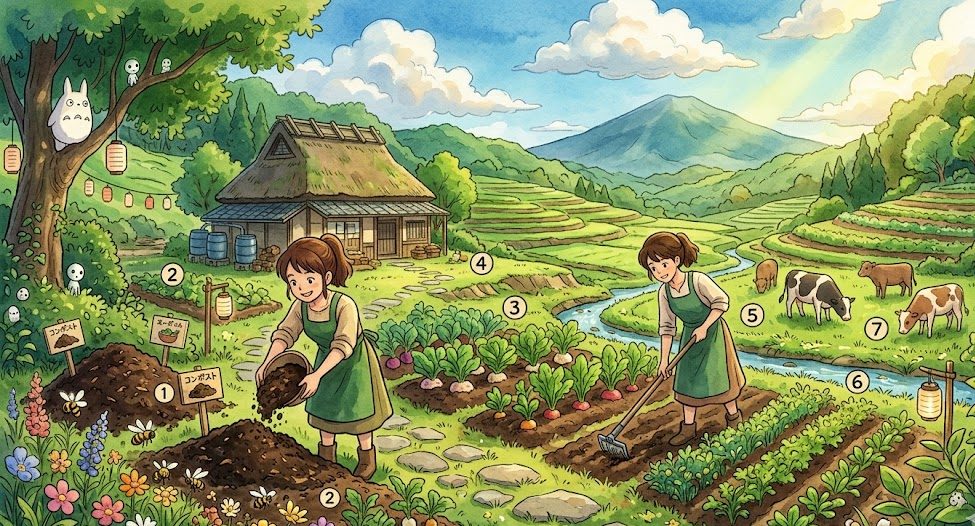
Modern industrial agriculture has often prioritized short-term yield over long-term vitality, leading to soil degradation, erosion, and a dangerous dependency on synthetic inputs. However, a quiet revolution is taking place on farms across the globe. Farmers are rediscovering that the secret to high yields isn’t found in a laboratory-made bottle, but in the living, breathing ecosystem beneath their feet: the soil.
Soil is not just dirt; it is a complex biological network. When managed correctly, it is a self-regenerating asset. If you are looking to restore your farm’s natural fertility and increase your yields without relying on expensive, soil-depleting chemicals, here are seven eco-friendly practices that can transform your land.
1. Cover Cropping: The Living Blanket
The most destructive thing you can do to soil is to leave it bare. Exposed to the sun and wind, soil loses its moisture and its vital biological structure.
- The Practice: Planting cover crops—such as clover, vetch, rye, or radishes—during the “off-season” or between main crops.
- The Benefit: These plants act as a protective blanket. Their roots hold the soil together, preventing erosion, while their biomass adds organic matter back into the ground when they are terminated. Leguminous cover crops, in particular, fix atmospheric nitrogen, essentially “growing” your own natural fertilizer.
2. No-Till Farming: Protecting the Soil Web
For decades, plowing or tilling was considered essential to prepare a seedbed. We now know that tilling is essentially a “natural disaster” for soil biology. It shreds the delicate fungal networks (mycorrhizae) that help plants absorb water and nutrients.
- The Practice: Transitioning to no-till or reduced-till methods. Instead of turning the earth over, you use specialized planters that place seeds directly into the residue of the previous crop.
- The Benefit: By leaving the soil undisturbed, you preserve its structure, increase its water-retention capacity, and allow the microbial ecosystem to flourish. Over time, no-till fields require significantly less irrigation and fertilizer.
3. Crop Rotation: Breaking the Pest Cycle
Monocropping—growing the same plant in the same field year after year—is a recipe for disaster. It depletes specific soil nutrients and creates a “buffet” for pests and diseases that specialize in that particular crop.
- The Practice: Implementing a planned rotation sequence. For example, follow heavy feeders (like corn) with nitrogen-fixers (like legumes), and then with root crops that help break up compacted soil.
- The Benefit: Rotation disrupts the life cycles of soil-borne pests. Different crops also have different root depths, which means they pull nutrients from different levels of the soil, preventing the “mining” of a single nutrient zone.
4. Integrating Composting and Organic Amendments
The goal of sustainable farming is to close the nutrient loop. If you are exporting produce from your farm, you are exporting nutrients. You must return them.
- The Practice: Implementing a robust composting program using farm waste, animal manure, and crop residue.
- The Benefit: Compost is the “black gold” of sustainable farming. It doesn’t just provide nutrients; it adds stable organic matter (humus) to the soil. Humus acts like a sponge, holding onto water and nutrients so they don’t leach away during heavy rains. It also supports the vast community of worms, bacteria, and fungi that make nutrients available to plants.
5. Integrating Livestock (Mob Grazing)
If your farm setup allows it, bringing animals back into the landscape is one of the most effective ways to restore fertility.
- The Practice: “Mob grazing” or “planned rotational grazing.” This involves keeping livestock in high-density groups on small sections of pasture for a short time before moving them, mimicking the movement of wild herds.
- The Benefit: This encourages plants to grow back more vigorously. The animals provide natural, high-potency fertilization and their trampling action incorporates plant litter into the soil. It turns sunlight into grass, and grass into natural fertility.
6. Agroforestry: The Layered Approach
Nature does not grow in flat, single-layer grids. It grows in layers—ground cover, shrubs, and trees. Agroforestry mimics this diversity.
- The Practice: Integrating trees or large shrubs into your crop or pasture areas.
- The Benefit: Trees act as “nutrient pumps.” Their deep roots pull minerals from deep beneath the topsoil, and when their leaves fall, they deposit those minerals back onto the surface. Trees also provide windbreaks, reduce evaporation, and offer habitat for birds and predatory insects that control pests.
7. Water Harvesting and Contour Farming
Soil fertility is useless if the water isn’t there to make it available to the plants. Managing water flow is a cornerstone of sustainable land management.
- The Practice: Farming along the contour of the land rather than in straight lines, or creating “swales” (shallow trenches) to slow and spread rainwater.
- The Benefit: This prevents the “runaway water” effect where valuable topsoil is washed away during storms. Instead, you encourage water to infiltrate the soil, recharging your groundwater and providing a reservoir for your crops to use during dry spells.
The Long Game: Building Resilience
Transitioning to sustainable practices is not an overnight fix; it is a shift from “extraction” to “stewardship.” In the first few years of moving to no-till or cover cropping, you may see a period of adjustment. But as your soil biology recovers, you will notice something profound: your farm will become more resilient.
Your soil will hold more water, meaning you can survive droughts better than your neighbors. Your plants will be healthier, meaning you can reduce your spending on pesticides. And because you are building organic matter, the fertility of your farm will increase with every passing season, rather than declining.
Sustainable farming is not just about being “green”; it is about being smart. It is about building a business model that is as renewable as the sun and as resilient as the living earth itself.