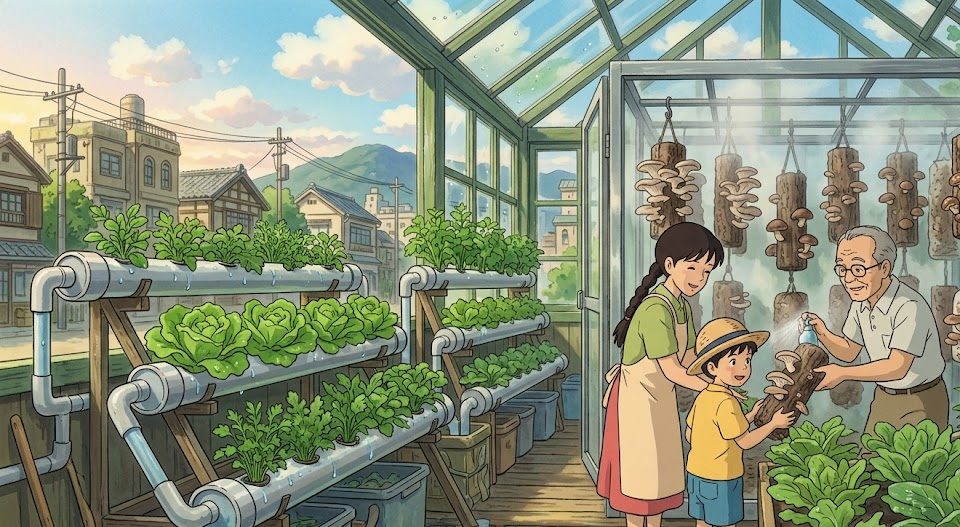
As our cities grow denser and the availability of arable land shrinks, the future of food security is moving indoors. Traditional agriculture, with its reliance on vast horizontal spaces and predictable weather, is being replaced by a more surgical approach: Revolutionary Urban Farming.
The most exciting development in this space is the synergistic integration of Advanced Hydroponic Technology and Sustainable Mushroom Production. While these two systems are often managed separately, combining them creates a closed-loop biological engine that maximizes yield per square foot while drastically reducing waste.
1. The Power of Symbiosis: Why Mushrooms and Hydroponics?
In a typical urban farm, hydroponics (growing plants in nutrient-rich water) and mushroom cultivation are seen as opposites. Plants need light and carbon dioxide (CO2) while releasing oxygen (O2). Mushrooms, being fungi, thrive in darkness or low light, consume oxygen, and release massive amounts of CO2.
The Revolutionary Logic: By connecting the ventilation systems of a mushroom fruiting chamber and a hydroponic greenhouse, you create a natural gas exchange.
- The mushrooms provide a free, organic CO2 boost to the plants, which can increase photosynthesis and plant growth rates by up to 20–30%.
- The plants, in turn, scrub the air and provide fresh oxygen back to the fungi.
This isn’t just “green” farming; it is Atmospheric Engineering.
2. Part I: Advanced Hydroponic Tech – The Vertical Engine
Modern urban hydroponics has moved far beyond simple PVC pipes. High-yield urban farms now utilize Vertical Aeroponics and Deep Water Culture (DWC) managed by AI.
A. Precision Nutrient Delivery
Advanced systems use automated dosing pumps that monitor the pH and Electrical Conductivity (EC) of the water 24/7. This ensures that a head of lettuce or a bunch of basil receives the exact milligram of nutrients it needs at every stage of its life cycle.
B. Spectrum-Specific Lighting
LED technology now allows us to manipulate the “flavor” and “growth speed” of plants. By using specific wavelengths—such as high-intensity blue light for vegetative growth and deep red for flowering—urban farmers can “trick” plants into growing faster and tasting better than their field-grown counterparts.
3. Part II: Sustainable Mushroom Production – The Hidden Yield
Mushrooms are the ultimate recyclers. In an urban setting, they offer the highest protein-to-space ratio of almost any crop.
A. Substrate Innovation
Sustainability in mushroom farming comes from what you grow them on. Urban farms are now utilizing “waste” streams from the city:
- Coffee Grounds: Collected from local cafes to grow Oyster mushrooms.
- Cardboard and Paper Waste: Shredded and pasteurized as a carbon source.
- Agricultural Byproducts: Straw or wood chips that would otherwise be discarded.
B. Vertical Mycelium Walls
Because mushrooms don’t require light for energy, they can be grown in “dark zones”—the under-utilized spaces beneath hydroponic tables or in windowless basements. This allows for a double-layer farming model, effectively doubling the revenue of the same footprint.
4. The Integration Strategy: Building the Circular Hub
To maximize potential, the integration must be planned with Hidden Logic. Here is the blueprint for a high-yield urban hub:
| Feature | Hydroponic Role | Mushroom Role | Integrated Benefit |
|---|---|---|---|
| Air Flow | Absorbs CO2 for growth. | Exhausts CO2 from respiration. | Accelerated plant growth without CO2 tanks. |
| Humidity | Requires 50-70% humidity. | Requires 80-90% humidity. | Shared humidification systems reduce energy costs. |
| Waste Management | Spent nutrient water. | Spent mushroom substrate (SMS). | SMS can be composted to create organic fertilizer. |
| Thermal Mass | Water tanks stabilize temp. | Decomposition generates heat. | Mushrooms help keep the farm warm in winter. |
Export to Sheets
5. High-Profit Specialized Crops
In Revolutionary Urban Farming, you don’t grow “commodities”; you grow Premiums.
- Gourmet Mushrooms: Lion’s Mane (known for cognitive benefits), Pink Oyster, and Shiitake. These fetch high prices from chefs and health-conscious consumers.
- Microgreens and Leafy Exotics: Wasabi arugula, micro-cilantro, and rare varieties of kale. These are light, easy to transport, and have a short shelf life, making local urban production a major competitive advantage.
6. Overcoming Urban Constraints
Urban farming isn’t without its hurdles. Success requires a “Smart” approach to logistics and space:
- The “Plug-and-Play” Model: Using shipping containers or modular racks that can be deployed in parking lots or rooftops.
- Water Reclamation: Advanced hydroponic hubs can recycle up to 95% of their water, making them far more sustainable than traditional soil-based farming.
- Acoustic Management: Mushroom fans and hydroponic pumps can be loud. Using “stealth” insulation and silent-run brushless motors is essential for staying “neighbor-friendly” in residential areas.
7. The Economic Logic: ROI and Beyond
The profitability of this integrated model is driven by Frequency and Density.
- Fast Turnaround: While a traditional farm might get 1-2 harvests a year, an urban hydroponic-mushroom hub can get 10-15 harvests of greens and 20+ harvests of mushrooms annually.
- Zero Transport Costs: Selling to a restaurant two blocks away eliminates the “middleman” and the carbon footprint of long-haul trucking.
- Data as a Product: The most successful urban farmers are also data scientists. By tracking every variable, you can eventually license your “Growth Recipe” to other urban hubs, creating a passive income stream.
8. Environmental Stewardship
Beyond the profit, this model represents a radical act of sustainability. It turns the city from a pure consumer of resources into a producer. By integrating fungi and plants, we mimic the forest floor inside a concrete jungle.
- Carbon Neutrality: The CO2 cycle is internal.
- Waste Diversion: Converting tons of city waste into high-quality protein.
- Education: These hubs serve as “living classrooms” for the next generation of urban dwellers.
Conclusion: The Future is Vertical and Fungal
The Revolutionary Urban Farming model is a testament to what happens when we stop fighting nature and start integrating its most efficient cycles. By merging the precision of Advanced Hydroponics with the recycling power of Mushroom Production, we create a system that is resilient, high-yielding, and profoundly logical.
In the cities of tomorrow, the freshest food won’t come from a truck; it will come from the basement of your apartment building or the rooftop of your office. The integration of light and dark, plant and fungi, is the blueprint for a nourished, sustainable urban future.
The logic is clear: The more we connect these systems, the more we grow.