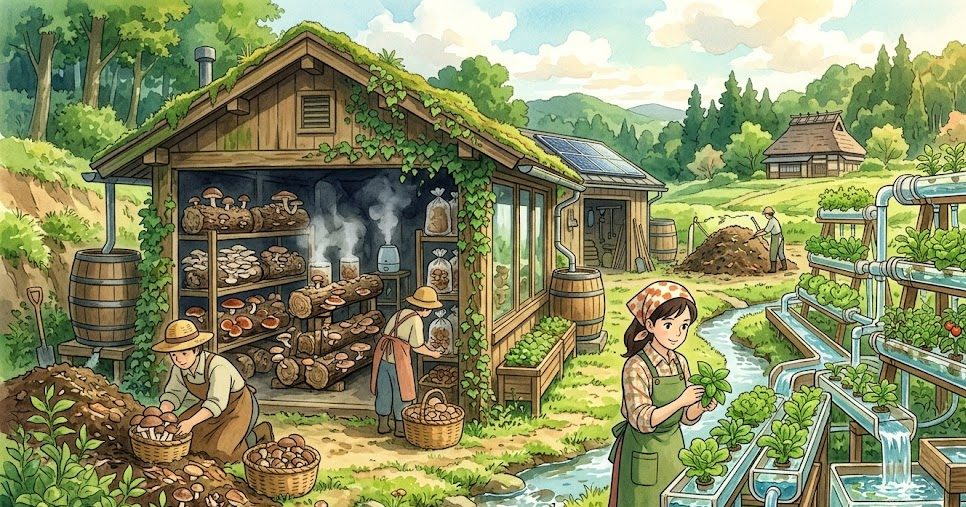
In the quest for global food security, the spotlight has shifted toward methods that require less land, less water, and zero chemical runoff. As we look toward the future of agriculture in 2026, two distinct yet complementary systems have emerged as the frontrunners of the “green revolution”: Sustainable Mushroom Farming and Hydroponic Systems.
Both methods represent a departure from traditional soil-based agriculture, offering a path to high-density food production that can exist in urban centers, arid climates, and even your own basement. This guide provides a deep dive into how these eco-friendly strategies work and how they can be integrated for maximum sustainability.
1. The Power of Fungi: Sustainable Mushroom Farming
Mushrooms are the ultimate recyclers of the natural world. Unlike green plants, they don’t require sunlight to grow; instead, they thrive on organic “waste.” This makes mushroom cultivation one of the most eco-friendly agricultural practices on the planet.
A. Turning Waste into Protein
The beauty of mushroom farming lies in the substrate. Mushrooms can be grown on materials that would otherwise end up in a landfill or be burned:
- Agricultural Waste: Wheat straw, corn cobs, and rice husks.
- Urban Waste: Used coffee grounds and shredded cardboard.
- Forestry Waste: Sawdust and wood chips.
By converting these low-value materials into high-protein, nutrient-dense food, mushroom farmers practice a “circular economy” in its purest form.
B. Low Environmental Footprint
Compared to livestock or even many row crops, mushrooms are incredibly efficient.
- Water Usage: It takes a fraction of the water to produce a pound of mushrooms compared to a pound of beef.
- Land Efficiency: Because mushrooms grow in dark, controlled environments, they can be farmed vertically in trays or hanging bags, producing thousands of pounds of food in a tiny footprint.
2. The Liquid Revolution: Hydroponic Systems
Hydroponics is the art of growing plants in a nutrient-rich water solution without the use of soil. By delivering minerals directly to the roots, plants grow up to 30–50% faster than they would in traditional dirt.
A. Water Conservation at Scale
It sounds paradoxical, but “water-based” farming uses up to 90% less water than traditional farming. In soil, much of the water evaporates or seeps away from the roots. In a hydroponic system, water is contained in a closed loop, recirculated, and reused until the plant consumes it.
B. Eliminating Chemical Runoff
One of the biggest environmental “sins” of traditional farming is fertilizer runoff, which poisons local waterways and creates “dead zones” in the ocean. In hydroponics, the nutrients stay in the tank. There is no runoff, making it the cleanest way to grow leafy greens, herbs, and even vine crops like tomatoes and cucumbers.
3. Synergizing Mushrooms and Hydroponics: The Hybrid Model
While they are powerful individually, the real “Eco-Friendly Harvest Strategy” lies in integrating these two systems. This creates a symbiotic environment where the waste of one fuels the growth of the other.
I. The CO2/Oxygen Exchange
Mushrooms are like humans; they breathe in Oxygen and exhale Carbon Dioxide (CO2). Plants, through photosynthesis, breathe in CO2 and exhale Oxygen.
- The Synergy: By placing a mushroom grow-room adjacent to a hydroponic greenhouse, you can pump the CO2 from the fungi into the greenhouse. This natural CO2 enrichment can boost plant growth rates by over 20% without the need for expensive, industrial CO2 tanks.
II. Spent Mushroom Substrate (SMS) as Fertilizer
Once a mushroom crop is finished, the “Spent Substrate” remains. This material is partially broken down and incredibly rich in organic matter. While it’s no longer good for mushrooms, it can be processed into an organic liquid tea for hydroponic systems or used as a high-grade compost for “waking up” depleted soils.
4. Choosing Your Eco-Friendly Crops
To maximize profit and sustainability, focus on high-value crops that thrive in these systems:
| System | Top Eco-Friendly Crops | Market Value |
|---|---|---|
| Mushroom Farming | Oyster, Lion’s Mane, Shiitake | High (Gourmet & Medicinal) |
| Hydroponics | Kale, Basil, Strawberries, Pak Choi | High (Freshness Premium) |
Export to Sheets
5. Implementation: Setting Up Your Eco-System
For those looking to start an eco-friendly harvest, follow these three pillars of smart setup:
1. Climate Control Automation
Sustainable farming doesn’t mean “primitive” farming. Use smart sensors to monitor humidity (crucial for mushrooms) and EC/pH levels (crucial for hydroponics). Automating your fans and pumps ensures that no energy is wasted, keeping your carbon footprint low.
2. Renewable Energy Integration
Since both systems require some electricity for pumps and lights (LEDs for hydroponics), integrating Solar PV panels makes the farm truly “Net Zero.” In 2026, modular solar kits are affordable enough to power a small-scale indoor farm completely off-grid.
3. Vertical Optimization
Don’t think horizontal. Use “A-Frame” hydroponic systems or “Mushroom Towers.” Verticality is the key to feeding urban populations without destroying more forests for farmland.
6. The Business Case (Adsense & Marketing Friendly)
From a content perspective, “Sustainable Farming” is a high-CPM niche. Advertisers in the Renewable Energy, Organic Fertilizer, and Smart Home Tech sectors are eager to reach audiences interested in self-sufficiency.
Content Ideas for High Engagement:
- “5 Ways to Start a Hydroponic Garden on a Budget”
- “Why Lion’s Mane is the Most Profitable Mushroom of 2026”
- “The Beginner’s Guide to Closed-Loop Indoor Farming”
7. Challenges and How to Overcome Them
No system is perfect. Here is how to navigate potential roadblocks:
- Contamination: Mushroom cultures are sensitive to “mold.” The Fix: Maintain a strict “Clean Zone” and use HEPA filters in your incubation room.
- Power Outages: In hydroponics, roots can dry out quickly if pumps stop. The Fix: Always have a battery backup or a gravity-fed “Kratky” backup system for emergencies.
8. Conclusion: The Future is Fungal and Fluid
The “Eco-Friendly Harvest” is not a distant dream; it is a practical reality available to anyone with a spare room or a small plot of land. By combining the recycling power of Mushroom Farming with the water-efficiency of Hydroponics, we can create a food system that gives back to the earth more than it takes.
Sustainable farming is no longer about “doing less harm.” It’s about active regeneration. As you build your systems, remember that you aren’t just growing food—you are designing an ecosystem that works in harmony with the planet.
Expert Tip: Start with Oyster mushrooms. They are the most resilient “beginner” mushroom and can grow on almost any cellulose-based waste, from straw to old jeans!