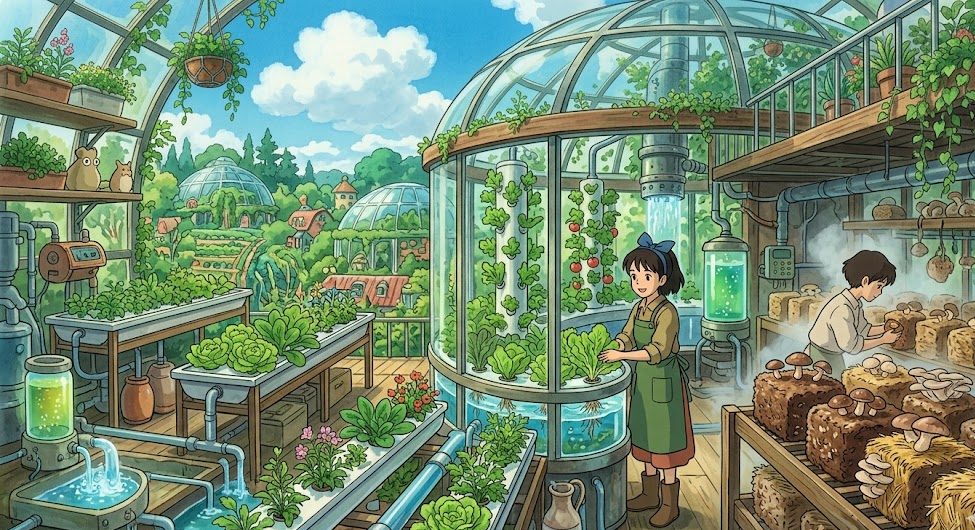
The global agricultural landscape is undergoing a silent revolution. As arable land becomes scarce and climate conditions grow increasingly unpredictable, the traditional dependency on soil is being challenged. We are entering the era of Soil-Less Agriculture—a high-tech, high-efficiency frontier that promises to feed the future while “healing the soil naturally” by giving it a rest.
By mastering Hydroponics and Mushroom Cultivation, and integrating them into a Sustainable Farming framework, modern growers can achieve higher yields in smaller spaces with a fraction of the resources.
1. Hydroponics: The Science of Water-Based Growth
Hydroponics is the cornerstone of soil-less agriculture. Instead of searching for nutrients in the earth, plants are grown in a nutrient-rich water solution. This method gives the cultivator total control over the plant’s environment.
Precision Nutrient Delivery
In a hydroponic system, nutrients are delivered directly to the roots. This eliminates “nutrient competition” from weeds and ensures that the plant spends its energy on growing foliage and fruit rather than expanding its root system in search of food. The result? Growth rates that are often 30% to 50% faster than soil-based farming.
Water Efficiency and Conservation
Perhaps the most significant advantage of hydroponics is its water efficiency. Most systems are “recirculating,” meaning the water is filtered, re-oxygenated, and sent back to the plants. This allows for up to 90% less water usage compared to traditional irrigation, making it a critical “Climate-Intelligent” strategy for the 21st century.
2. Mushroom Cultivation: The Hidden Power of Fungi
While hydroponics focuses on light and water, Mushroom Farming thrives in the shadows. Mushrooms are the decomposers of the agricultural world, and they play a vital role in a soil-less “Integrated Rural Ecosystem.”
Vertical Mastery and Space Efficiency
Mushrooms do not require vast fields. They can be grown in vertically stacked bags or trays in climate-controlled rooms. This makes them perfect for Micro-Farming setups. For the modern agri-entrepreneur, mushroom cultivation provides a consistent, high-value harvest that is decoupled from the outside weather conditions.
Converting Waste to Wealth
Mushrooms grow on substrates—often agricultural “waste” like straw, sawdust, or even coffee grounds. By converting these low-value materials into premium products like Oyster or Button mushrooms, you are implementing a perfect “Circular Economy” model. The spent substrate can then be processed into high-quality organic compost, further supporting sustainable practices.
3. Integrating Sustainable Farming Practices
Soil-less agriculture is not just about technology; it is about a philosophy of Sustainability. Mastering these techniques requires an integrated approach that respects natural cycles.
The Aquaponics Bridge
One of the most advanced sustainable practices is combining hydroponics with aquaculture (fish farming) to create Aquaponics. In this system, fish waste provides the nutrients for the plants, and the plants clean the water for the fish. It is a self-sustaining loop that mimics natural ecosystems while producing two high-value products—fish and vegetables—simultaneously.
Energy-Smart Greenhouse Management
To truly master the future of cultivation, one must look at energy. Integrating solar power and smart climate control ensures that your hydroponic and mushroom units operate with a minimal carbon footprint. Using “Smart Technology” to automate fans, heaters, and LED grow lights ensures that energy is used only when necessary, maximizing your ROI.
4. The Economic Blueprint: Turning Tech into Profit
For those focused on High-Value Cash Crops, soil-less agriculture offers an unparalleled business opportunity.
- Year-Round Production: Because these systems are typically indoor or greenhouse-based, you are no longer at the mercy of the seasons. You can produce “Summer Crops” in the winter and “Winter Crops” in the summer, commanding premium prices during the off-season.
- Reduced Input Costs: While the initial setup for hydroponics can be high, the long-term savings on water, fertilizers, and pesticides are significant.
- Premium Branding: Produce grown in controlled, soil-less environments is often cleaner, more uniform, and free from soil-borne diseases. This allows you to target high-end “Farm-to-Fork” markets and organic boutiques.
5. Overcoming the Learning Curve
Mastering soil-less agriculture requires a shift from “manual labor” to “technical management.”
- Smart Monitoring: Use IoT sensors to track pH, EC (Electrical Conductivity), and humidity levels. This data-driven approach allows you to detect issues before they affect your yield.
- Innovation Hubs: Centralizing your management through a digital hub ensures that your various units—whether they are hydroponic towers or mushroom grow rooms—are all performing at their peak.
Conclusion: Leading the Agricultural Revolution
The Future of Soil-Less Agriculture is bright, efficient, and essential. By mastering Hydroponics and Mushroom Cultivation, we are not just bypassing the soil; we are evolving our relationship with the earth. We are learning to produce more with less, protecting our natural resources while building highly profitable, resilient farming systems.
Whether you are starting a small micro-farm in an urban setting or scaling a large-scale innovation hub, the principles of sustainability and precision remain your best guides. The revolution has left the ground and moved into the water and the air—it’s time to grow upward.
SEO Meta Details:
- Focus Keyword: Soil-Less Agriculture
- Secondary Keywords: Mastering Hydroponics, Mushroom Cultivation, Sustainable Farming Practices, Vertical Farming, Smart Agriculture.
- Meta Description: Explore the future of soil-less agriculture. Learn how to master hydroponics and mushroom farming using sustainable, high-efficiency techniques for a better harvest.