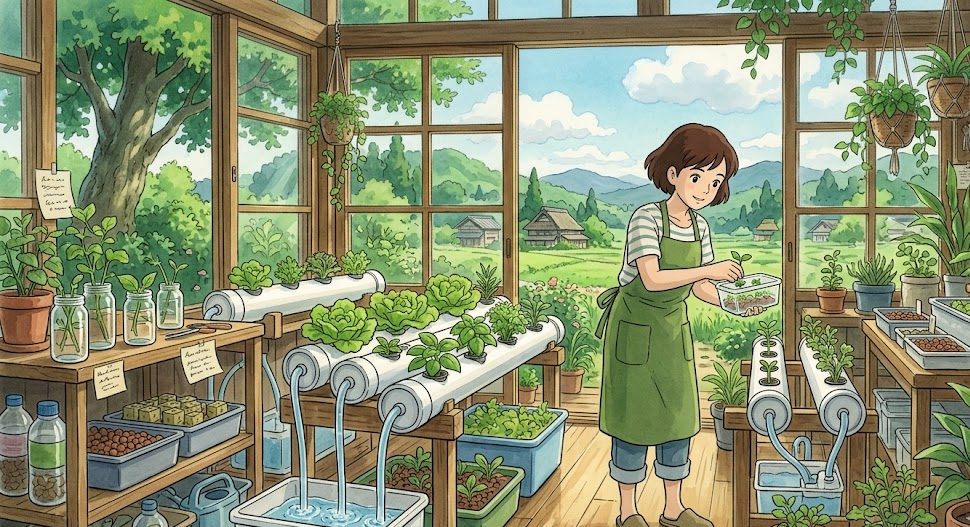
The traditional image of farming requires acres of land, tons of soil, and back-breaking labor. But what if you could produce a professional-grade harvest in your living room, garage, or even a small apartment balcony?
Welcome to the world of hydroponics. By delivering nutrients directly to plant roots via a water solution instead of soil, hydroponics allows you to grow plants up to 50% faster, using 90% less water, and with significantly higher yields. In 2026, as urban living becomes more crowded and the need for fresh, local food grows, hydroponics is the most accessible way to take control of your food supply.
Here is your ultimate 5-step guide to starting your own soilless farm at home.
Step 1: Choose Your System (The “Engine” of Your Farm)
Not all hydroponic systems are created equal. For beginners, it is best to choose a system that matches your space and budget.
- Deep Water Culture (DWC): The simplest system. Your plants sit in net pots with their roots dangling directly into a nutrient-rich, oxygenated water reservoir. It is easy to build with just a bucket, an air pump, and an air stone.
- Nutrient Film Technique (NFT): A classic commercial design. Water is pumped into channels where it flows in a thin “film” over the roots of your plants. This is excellent for leafy greens like lettuce and kale.
- Wick System: The most basic, “no-electricity” option. It uses a wick to draw nutrient solution up to the roots. It is perfect for small herbs, though it can struggle with larger plants.
Pro Tip: If you are just starting, go with Deep Water Culture. It is forgiving, inexpensive, and provides excellent results for beginners.
Step 2: The Right Environment (Light and Climate)
Since you are bypassing the sun, you have to recreate its power.
- Lighting: Invest in high-quality Full-Spectrum LED grow lights. Unlike old-school HID bulbs, modern LEDs run cool and use very little electricity. Aim for 12–16 hours of light per day.
- Temperature & Airflow: Plants in hydroponic systems are susceptible to root rot if the water gets too warm. Keep your reservoir in a cool, shaded area. Use a small oscillating fan to ensure air circulation around your plants; this strengthens the stems and prevents fungal growth.
Step 3: Mastering the Nutrient Solution
In soil, plants find their own nutrients. In hydroponics, you are the chef. You need to buy a high-quality, liquid hydroponic nutrient formula (usually sold in two parts: “Grow” and “Bloom”).
- pH Management: This is the most critical technical skill you will learn. If your water’s pH is off, your plants cannot absorb the nutrients, no matter how much you feed them. Keep your pH between 5.5 and 6.5.
- EC (Electrical Conductivity): This measures how “strong” your nutrient solution is. As plants grow, they drink water; you need to top off the reservoir with fresh, nutrient-adjusted water to keep the balance right.
Step 4: Selecting Your Plants
Not all crops behave the same in water. When starting, stick to “easy” plants to build your confidence.
- The Winners: Lettuce, spinach, arugula, basil, mint, and cilantro are the absolute best crops for hydroponics. They grow rapidly, have low nutrient requirements, and are ready for harvest in as little as 3–4 weeks.
- The Challenges: Once you master the basics, you can move on to fruiting crops like tomatoes, peppers, and cucumbers. Note that these require larger systems, more light, and “bloom” nutrients to produce fruits.
Step 5: Monitoring and Maintenance (The “Farmer’s Rhythm”)
Hydroponics is not “set it and forget it.” It is a living system. Your daily routine should include:
- The Daily Check: Look at your plants. Are the leaves vibrant? Is the pump running? Is the water level consistent?
- The Weekly Ritual: Every 7–10 days, check your pH. If you are using a DWC system, refresh the entire nutrient solution once a month to prevent salt buildup.
- The Harvest: Don’t let your greens sit too long. Harvesting regularly encourages the plant to produce more leaves, effectively giving you a “cut-and-come-again” harvest throughout the season.
Why Hydroponics is the Future of Home Farming
Beyond the convenience, hydroponics is an incredibly empowering skill. It turns a corner of your home into a high-efficiency production unit.
- Water Security: In a world where water is becoming increasingly expensive, your closed-loop system ensures that not a drop is wasted.
- Year-Round Harvests: You are no longer at the mercy of the seasons. Whether it is mid-winter or the peak of a dry summer, your indoor farm produces at maximum capacity 365 days a year.
- Educational Value: If you have children or are interested in the mechanics of biology, there is no better way to learn about plant physiology than by managing your own water-based ecosystem.
Final Thoughts: Start Small, Think Big
The biggest mistake beginners make is building a system that is too large, too fast. Start with a single 5-gallon bucket system. Once you successfully grow your first head of lettuce, you will understand the rhythm of the water, the needs of the plants, and the logic of the system. From there, the sky is the limit—you can scale your system into a wall-mounted vertical garden or a full-blown greenhouse operation.
Hydroponics is the ultimate marriage of technology and nature. It requires patience and attention, but the reward—a crisp, fresh, nutrient-dense salad picked from your own living room—is worth every minute of effort.