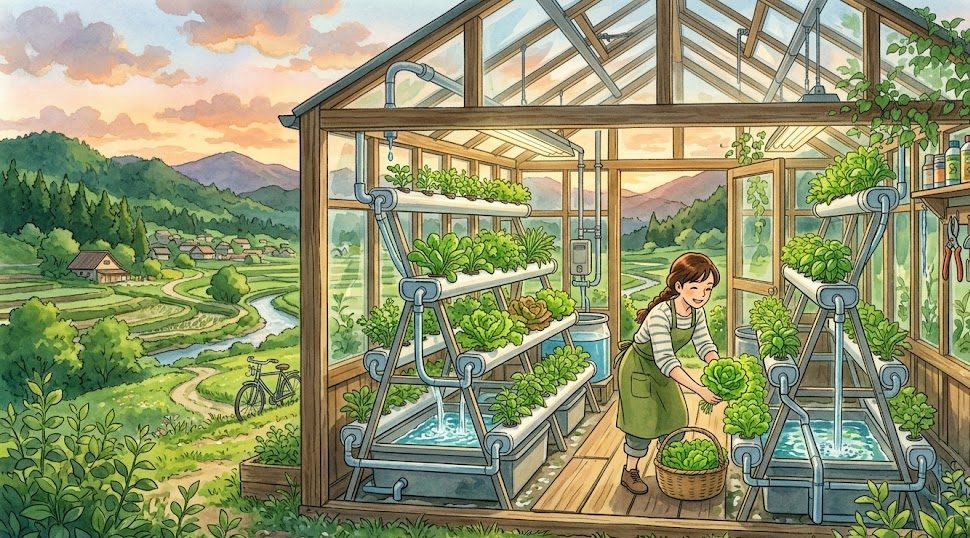
Agriculture is currently undergoing a massive transformation. As land becomes more expensive, water more precious, and urban spaces more crowded, the traditional method of growing crops in soil is increasingly being challenged by a more efficient, high-tech alternative: Hydroponics.
Hydroponics is the science of growing plants without soil, by using mineral-nutrient solutions in an aqueous solvent. It sounds like something out of a science fiction novel, but it is a proven, highly efficient method for producing dense, healthy crops. For the beginner, hydroponics offers the ability to garden anywhere—whether in a basement, on a balcony, or in a dedicated greenhouse—while achieving yields that often double or triple those of conventional farming.
The Fundamental Logic: Why Soilless?
In soil-based farming, plants must expend significant energy growing deep root systems to “hunt” for water and nutrients. In a hydroponic system, those resources are delivered directly to the root zone in a precise, optimized form. The plant no longer needs to work as hard, allowing it to dedicate almost all of its metabolic energy to upward growth, fruit production, and leaf development.
Key benefits include:
- Water Efficiency: Hydroponics uses up to 90% less water than traditional soil farming because water is recirculated in a closed system.
- Faster Growth: Because nutrients are readily available, plants grow 30–50% faster.
- Space Optimization: Vertical stacking allows you to grow significantly more plants in a smaller footprint.
- Pest Control: Without soil, you eliminate soil-borne pests and diseases, drastically reducing the need for chemical pesticides.
Understanding the 3 Core Hydroponic Systems
For beginners, starting with one of these three systems will provide the best balance of ease and productivity:
1. Deep Water Culture (DWC)
The simplest way to start. Plants are suspended in a container filled with nutrient-rich water. An air stone, powered by an aquarium pump, bubbles oxygen into the water so the roots don’t “drown.”
- Best for: Leafy greens like lettuce, kale, and herbs.
- Pros: Low cost, minimal equipment.
2. Nutrient Film Technique (NFT)
A slightly more advanced system where a very thin film of nutrient solution is pumped through a channel, flowing over the tips of the roots. The plants are held in net pots on top of the channel.
- Best for: Lettuce and other fast-growing greens.
- Pros: Highly efficient, excellent for vertical setups.
3. Drip Irrigation (Ebb and Flow)
A pump pushes nutrient solution to the base of the plant, which then drains back into a reservoir.
- Best for: Heavier fruiting plants like tomatoes, peppers, and cucumbers.
- Pros: Very reliable and allows for better support for larger plants.
The Vital Elements: Mastering the “Recipe”
In soil, the dirt acts as a buffer for the plant’s health. In hydroponics, you are the buffer. You must monitor three critical metrics:
- pH Levels: Plants can only absorb nutrients if the water is at the right pH level (typically between 5.5 and 6.5). If the pH drifts too high or too low, the plant will essentially starve, even if nutrients are present. A simple digital pH meter is your most important tool.
- Electrical Conductivity (EC): This measures the concentration of nutrients in your water. As plants grow, they consume nutrients, so you must add more to keep the concentration consistent.
- Oxygenation: Roots need oxygen to “breathe.” Without a functioning air stone or constant flow, your plants will develop root rot very quickly.
Essential Gear for the Beginner
You don’t need a massive investment to get started. A basic beginner setup can be built for a modest cost:
- Reservoir: A light-proof container (to prevent algae growth).
- Net Pots & Growing Medium: Clay pebbles or coco coir are standard.
- Nutrient Solution: A high-quality, water-soluble fertilizer formulated specifically for hydroponics.
- Air Pump & Stone: Crucial for aeration.
- Light Source: If growing indoors, full-spectrum LED grow lights are essential to mimic natural sunlight.
Step-by-Step: Setting Up Your First System
- Select Your Space: Choose a location with stable temperatures. Avoid areas with extreme cold or heat, which can shock the root system.
- Choose Your Crop: If you are a complete beginner, start with lettuce or basil. They are incredibly forgiving and grow very quickly, giving you a “win” within just a few weeks.
- Prepare the Nutrient Solution: Always follow the manufacturer’s instructions on your nutrient mix. More is not better; “burning” the plants with an overly concentrated solution is a common mistake.
- Monitor Daily: Spend 5 minutes every day checking your pH levels and water levels. Consistency is the secret to high yields.
- Maintain Hygiene: Algae is the enemy of hydroponics. Keep your reservoir covered and dark to prevent sunlight from hitting the nutrient solution.
Common Challenges and How to Beat Them
- Algae Growth: If your water turns green, it’s because light is hitting it. Simply paint your reservoir black or wrap it in reflective foil.
- Root Rot: If your roots turn brown and slimy, your water is too warm or lacks oxygen. Increase your airflow and, if possible, keep your reservoir temperature below 25°C.
- Nutrient Lockout: If your plants look yellow despite having nutrients, check your pH. It is almost always a pH imbalance preventing the plant from absorbing the nutrients.
The Path to High-Yield Professionalism
Once you master the basics, you can scale your operation. Moving from a single DWC bucket to a vertical NFT rack allows you to increase your production density. Many hobbyists eventually graduate to automated systems, where a central computer monitors and adjusts pH and nutrient levels in real-time, allowing for a truly “set it and forget it” farming experience.
Hydroponics is a journey of discovery. It turns you into a chemist, an engineer, and a farmer all at once. By removing the guesswork of soil biology, you gain absolute control over the quality, speed, and flavor of your produce.
The future of agriculture is not just about having more land; it is about having more precision. Whether you are looking to supplement your kitchen with fresh greens or launch a small-scale commercial operation, hydroponics offers the most direct path to sustainable, high-yield success. Your journey to the future of farming begins with a single reservoir and a handful of clay pebbles.