Did you know that a single honeybee must visit roughly two million flowers to produce just one pound of honey? It is a staggering feat of biological engineering, yet for many backyard beekeepers and curious consumers, the journey from the wax comb to the kitchen jar remains a mystery. Harvesting honey is often seen as a daunting task, filled with the fear of angry bees, sticky messes, and the potential for ruining a season’s worth of hard work through improper handling.
The challenge lies in the delicate balance of extraction: removing the honey without harming the colony or degrading the “liquid gold’s” natural enzymes and floral notes. This “pain point” of complexity often stops enthusiasts from scaling their hobby into a sustainable production. Professional Harvesting and Processing serves as the ultimate solution, utilizing time-tested techniques and modern tools to ensure a clean, efficient, and high-quality yield. This article provides a comprehensive roadmap of the honey harvest, offering a thesis on the biological readiness of the hive, the mechanical steps of extraction, and the artisanal touches of final processing.
Understanding Honey Harvesting: Key Concepts and Importance
To understand the harvest, you must first understand the “ripening” process. Bees do not just collect honey; they manufacture it. They gather nectar—which is about 80% water—and use their wings to evaporate that moisture down to roughly 17% to 18%. Once the water content is low enough to prevent fermentation, the bees seal the cell with a fresh layer of white beeswax.
Think of the honey harvest like bottling a fine vintage wine. If you pick the grapes too early, the wine is sour; if you harvest honey before it is “capped,” it has too much water and will eventually turn into vinegar. Modern harvesting centers on the Langstroth system, which uses removable frames. This historical innovation allowed beekeepers to take only the surplus honey—stored in “supers” above the main brood nest—leaving the bees’ winter food stores intact.
Analogously, processing honey is like filtering a diamond. The raw material comes out of the hive with bits of wax, propolis (bee glue), and the occasional stray bee. The goal of processing isn’t to change the honey, but to clarify it. By using centrifugal force and gravity, we can separate the pure liquid from the physical debris of the hive, preserving the honey’s status as the only food on Earth that truly never spoils.
Why It Matters: The Top Benefits of Proper Harvesting
Executing a clean, professional harvest isn’t just about the taste; it has profound impacts on the business, the environment, and the product’s shelf life.
- Preservation of Living Enzymes: Proper cold-processing (avoiding high heat) ensures that the honey retains its antibacterial and antioxidant properties. Overheating honey can destroy its medicinal value and darken its flavor profile.
- Colony Sustainability: A methodical harvest ensures the beekeeper leaves enough “capped” honey for the bees to survive the winter. This prevents colony collapse and ensures a strong start for the following spring.
- Market Premium for “Raw” Honey: Consumers are willing to pay significantly more for honey that is unfiltered and unpasteurized. Proper processing allows you to label your product as “Raw,” a high-value term in the health-food industry.
- Waste Reduction: Processing produces valuable byproducts. The beeswax cappings removed during harvesting are a premium ingredient for high-end cosmetics, candles, and wood polishes.
Pro Fact: Archeologists have found pots of honey in ancient Egyptian tombs that are over 3,000 years old and still perfectly edible. This is due to honey’s low moisture content and naturally acidic pH ($3.9$), which creates an environment where bacteria cannot survive.
How to Get Started: A Practical Guide for Beginners
If you are ready to transition from hive management to honey production, follow this 5-step actionable plan for a successful harvest.
Step 1: Assess Readiness and Clear the Bees
Check your “honey supers.” At least 80% of the cells on each frame should be capped with wax. To remove the frames, use a “fume board” with a natural bee repellent or a “bee escape” board, which allows bees to leave the honey super but prevents them from returning.
Step 2: Uncapping the Cells
Once you have the frames in a clean, bee-proof room, you must remove the wax seals. Use an uncapping knife (heated or serrated) to gently slice off the thin layer of wax cappings. Do this over an “uncapping tank” to catch the honey and wax that falls away.
Step 3: Centrifugal Extraction
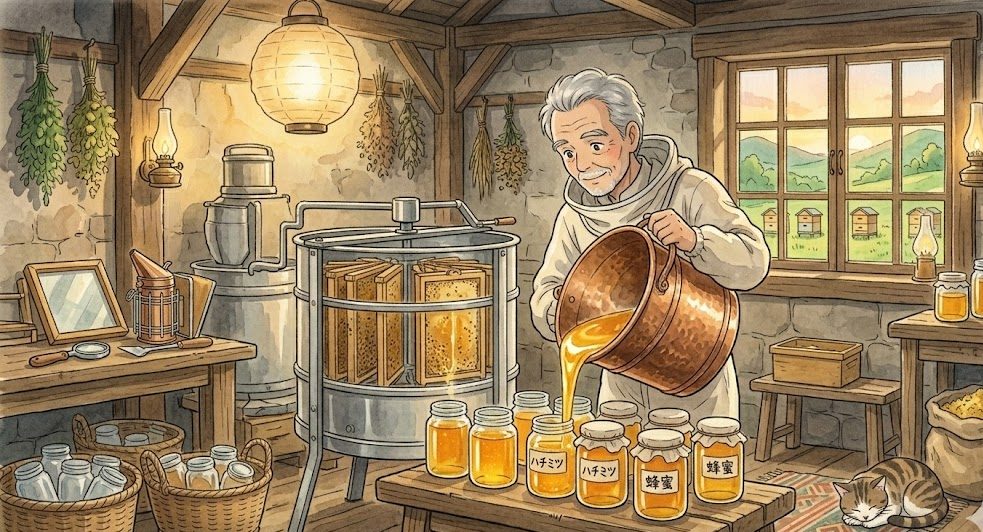
Place the uncapped frames into a Honey Extractor. This machine spins the frames at high speeds, using centrifugal force to pull the honey out of the wax cells and fling it against the walls of the tank, where it drains to the bottom.
Step 4: Straining and Settling
Drain the honey from the extractor through a double-sieve stainless steel strainer. This removes large wax particles and bee parts. After straining, let the honey sit in a “settling tank” for 24 to 48 hours. This allows tiny air bubbles and micro-debris to rise to the top, leaving crystal-clear honey at the bottom.
Step 5: Bottling and Labeling
Use a “honey gate” (a specialized valve) to fill your jars from the bottom of the settling tank. Ensure your jars are sterilized and dry. Label with the floral source (e.g., Wildflower, Clover) and the harvest date.
Beginner’s Tip: Never harvest in the rain or high humidity. Because honey is hygroscopic, it absorbs moisture from the air. Harvesting on a humid day can raise the water content above 19%, causing your honey to ferment and sour in the jar.
Overcoming Challenges and Looking into the Future
One of the most common hurdles is Crystallization. Many consumers mistakenly believe that “hard” honey has gone bad. In reality, it is a sign of purity. To solve this, beekeepers can gently warm the honey (never exceeding 40°C) to reliquefy it. Another challenge is Robbing; if you leave honey exposed during the harvest, thousands of bees from other hives will descend to “steal” it back, creating a dangerous frenzy. Always harvest in an enclosed, bee-proof space.
Looking into the future, the industry is moving toward Automated Extraction Systems and “Flow Hive” technology, which allows honey to be harvested directly from the hive without opening it. While controversial among traditionalists, these innovations are lowering the barrier for backyard enthusiasts. Furthermore, blockchain traceability is becoming a trend, allowing consumers to scan a QR code on the jar to see the exact GPS coordinates of the apiary and the lab results of the honey’s purity.
Conclusion
The journey of honey from the hive to the home is a testament to the incredible synergy between humans and honeybees. By mastering the fundamentals of capped readiness, centrifugal extraction, and cold-processing, you ensure that every jar of honey is a masterpiece of nature. Beekeeping is not just about the harvest; it is about respecting the thousands of hours of flight that went into every spoonful.
Your Task: Check your honey supers this weekend. If they are 80% capped, prepare your extraction space. If not, wait one more week—patience is the difference between fermented syrup and award-winning honey.
The “liquid gold” is ready for you; are you ready to preserve its legacy?
Frequently Asked Questions (FAQs)
1. Is “Raw” honey better than supermarket honey?
Yes. Most supermarket honey is “flash-heated” and ultra-filtered to keep it liquid longer on the shelf. This process removes beneficial pollen and kills enzymes. Raw honey is handled at low temperatures, preserving all its natural health benefits.
2. Why shouldn’t I give honey to infants under one year old?
Honey can contain trace amounts of Clostridium botulinum spores. While an adult’s digestive system can easily handle these, an infant’s underdeveloped gut cannot, leading to a risk of botulism.
3. Does harvesting honey hurt the bees?
When done correctly, no. Beekeepers only harvest the “surplus” honey. Bees are natural over-producers. By using bee escapes or fume boards, we move the bees away from the honey without harming them.
4. How can I tell if my honey has too much water?
Professional beekeepers use a Refractometer. It’s a small device that uses light to measure the exact sugar-to-water ratio. If your reading is above 18.6%, the honey is at risk of fermenting.