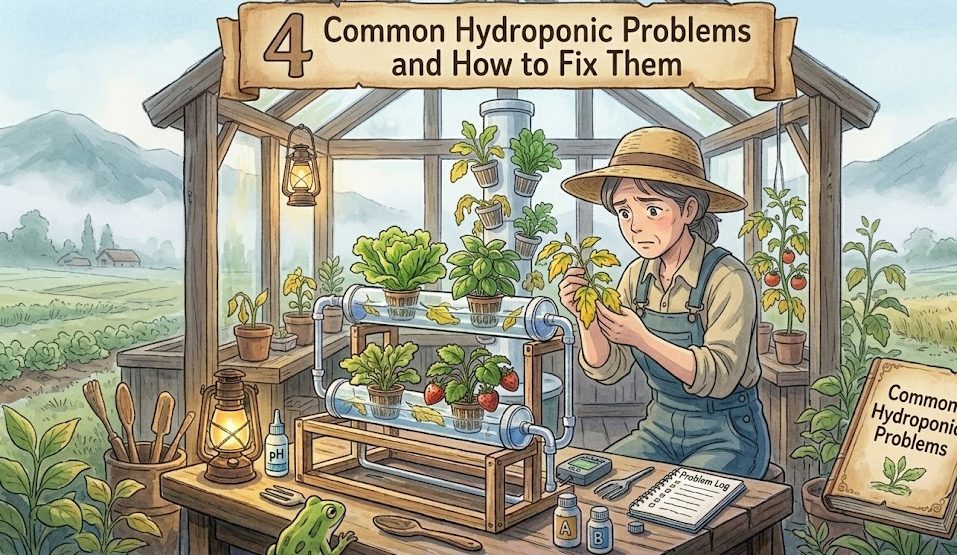
Did you know that a single afternoon of pump failure can destroy a hydroponic crop that took three months to grow? Unlike traditional soil gardening, where the earth acts as a protective buffer, hydroponics is a “live-wire” system. While it offers incredible growth speeds, it also operates on a razor’s edge. For many indoor farmers, the initial excitement of a high-tech setup quickly turns into a nightmare when leaves begin to yellow, roots turn brown, or strange algae begins to carpet their reservoirs.
The challenge is that in a soil-less environment, the gardener is the “Mother Nature” of the system. You are responsible for every drop of mineral and every breath of oxygen. When something goes wrong, the symptoms appear rapidly because there is no soil to hide the evidence. This troubleshooting guide serves as the ultimate solution for those facing “growing pains.” In the following sections, we will break down the science of plant stress, identify the “big three” killers of hydroponic gardens, and provide a systematic recovery plan to save your harvest.
Understanding Hydroponic Troubleshooting: Key Concepts and Importance
To fix a hydroponic system, you must first understand that it is a closed-loop ecosystem. In soil, nutrients are released slowly through microbial action. In hydroponics, nutrients are delivered in a purely ionic form, meaning they are ready for the plant to “drink” immediately. This lack of a middleman is why plants grow so fast, but it is also why mistakes are amplified.
Think of a hydroponic system like a Formula 1 racing car. In a regular car (soil gardening), if you have a slightly flat tyre or old oil, the car will still get you to the grocery store. In a Formula 1 car, even a tiny deviation in fuel pressure or tyre temperature can lead to a spectacular crash at 200 mph.
Modern hydroponic troubleshooting focuses on three pillars: Water Chemistry, Oxygenation, and Environment. Most problems are not caused by “bad seeds” or “bad luck,” but by a shift in one of these variables. Historically, farmers had to rely on guesswork, but today, we use precision tools like pH meters and EC (Electrical Conductivity) sensors to “listen” to what the water is telling us. Understanding these fundamentals allows you to move from being a reactive gardener to a proactive plant scientist.
Why It Matters: The Top Benefits of Masterful Troubleshooting
Becoming an expert at identifying and fixing hydroponic issues is what separates the hobbyists from the professional growers. Mastering this skill set provides massive long-term advantages.
- Waste Reduction & Cost Savings: By catching a nutrient lockout early, you prevent the death of expensive heirloom plants and avoid wasting gallons of nutrient solution.
- Predictable Harvest Cycles: When you can fix a pH swing in minutes rather than days, you ensure that your harvest stays on schedule, providing your family with a consistent food supply.
- Pest and Disease Resilience: Many hydroponic problems (like root rot) are preventable. Learning the “fix” actually teaches you how to create an environment where pathogens cannot survive in the first place.
- Data-Driven Confidence: Once you understand the “why” behind a problem, the fear of gardening disappears. You gain the confidence to experiment with more difficult crops like strawberries or peppers.
Pro Fact: Over 70% of all hydroponic failures are traced back to incorrect pH levels. If your water is too alkaline or too acidic, the plant’s roots literally “lock” and cannot absorb nutrients, even if the water is full of them.
How to Get Started: A Practical Guide for Beginners
If your plants are looking sad, don’t panic. Follow this 5-step recovery plan to diagnose and fix 90% of common hydroponic issues.
Step 1: The “Flush” and Reset
If you see unexplained leaf spotting or wilting, the safest first step is to drain your reservoir. Refill it with plain, pH-balanced water for 24 hours. This “resets” the plant’s internal chemistry and flushes out excess salts.
Step 2: Calibrate Your Tools
Check your pH and EC meters. Are they accurate? Dip them in a calibration solution. A faulty meter is like a broken compass; it will lead you further into the woods. Ensure your pH is between 5.5 and 6.5.
Step 3: Inspect the “Root Zone”
Lift your plants out of their net pots. Healthy roots should be bright white and smell like fresh earth. If they are brown, slimy, or smell like compost, you have Root Rot (Pythium). Add an air stone to increase oxygen or use a hydroponic-safe fungicide.
Step 4: Adjust the “Light-to-Nutrient” Balance
If your leaves are turning yellow between the veins (interveinal chlorosis), you likely have a magnesium or iron deficiency. Increase your nutrient strength slightly, but ensure your grow lights aren’t so close that they are “bleaching” the leaves.
Step 5: Seal the Light Leaks
Check your reservoir. If you see green film on the surface, you have an Algae bloom. Algae competes with your plants for oxygen. Cover any clear plastic with black tape or paint to ensure the water stays in total darkness.
Beginner’s Tip: Always keep a “Garden Log.” Write down every time you add nutrients or adjust the pH. When a problem occurs, you can look back and see exactly what changed 48 hours ago.
Overcoming Challenges and Looking into the Future
One of the persistent hurdles in hydroponics is Temperature Flux. If your water gets too warm (above 24°C), it can no longer hold oxygen, leading to root death. Professional growers solve this with “Water Chillers,” but a simple fix for beginners is adding frozen water bottles to the reservoir during heatwaves. Another challenge is Nutrient Burn, where the tips of leaves turn brown and crispy. This is easily solved by diluting your solution with 25% fresh water.
The future of troubleshooting is Automated Correction. We are seeing the arrival of “Smart Dosers” that monitor pH and nutrients 24/7 and automatically inject “pH Down” or minerals when the levels drift. Soon, AI-powered cameras will be able to scan a leaf, identify a calcium deficiency before the human eye can see it, and adjust the system parameters instantly. This “Self-Healing Garden” will make hydroponics accessible to even the busiest city dwellers.
Conclusion
Every hydroponic expert has killed a few plants—it is part of the learning process. The key is to view every yellow leaf as a piece of data rather than a failure. By maintaining a clean environment, monitoring your pH religiously, and ensuring your roots can breathe, you can overcome almost any obstacle the hobby throws at you.
Your Task: Go to your system right now and check the roots. If they aren’t pearly white, add an extra air stone or clean your reservoir today.
Keep your water cool, your pH stable, and your lights bright, and your indoor farm will reward you with an abundance you never thought possible.
Frequently Asked Questions (FAQs)
1. Why are my plant’s leaves curling downward? This is often a sign of “nitrogen toxicity” (too much fertilizer) or over-watering in systems where the roots aren’t getting enough air. Try diluting your nutrient solution and checking your air pump.
2. How often should I completely change my nutrient water? For most small systems, a full change every 14 days is ideal. This prevents the “buildup” of unused minerals that can cause the pH to swing wildly.
3. What causes white “crust” on my clay pebbles? That is usually just salt buildup from evaporated nutrient solution. It’s generally harmless, but you should rinse your growing medium with plain water between grows to prevent it from affecting the pH.
4. Can I use tap water for my hydroponic system? You can, but you must let it sit out for 24 hours to allow the chlorine to evaporate, or use a de-chlorinator. If your tap water is “hard” (high in calcium), you may need to use a specific “Hard Water” nutrient formula.