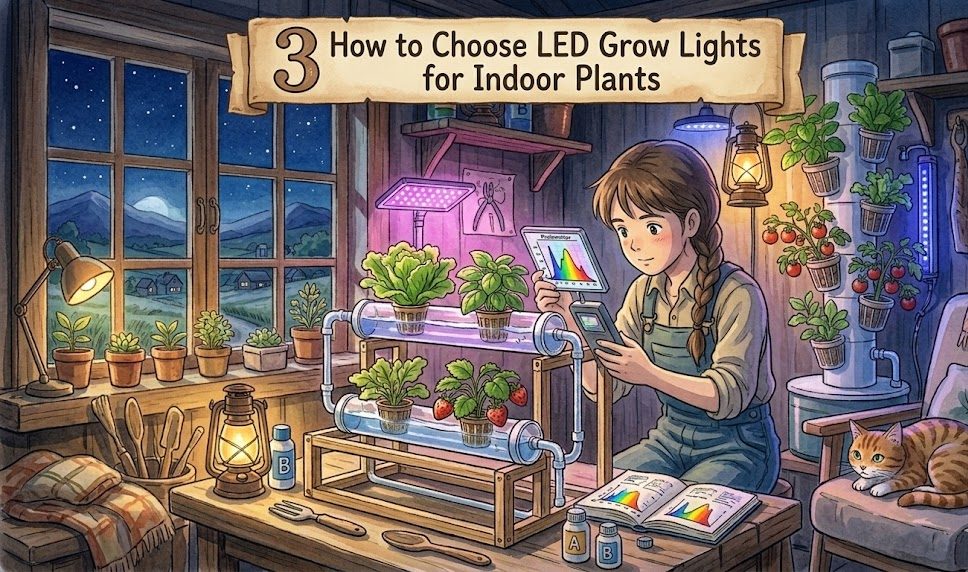
Have you ever wondered why your indoor plants look “leggy,” pale, or refuse to bloom despite your best watering efforts? It’s likely because they are starving for light, even if they sit right next to a window. In fact, standard window glass can filter out up to 50% of the usable light energy plants need for photosynthesis. For the indoor gardener, this creates a frustrating cycle of buying beautiful plants only to watch them slowly decline in the dim corners of a modern home.
The challenge lies in the “invisible” side of gardening: the light spectrum. Our eyes see brightness, but plants “see” fuel. LED grow lights serve as the ultimate solution, acting as a customisable, high-efficiency sun that you can turn on and off with a switch. By mastering light technology, you can grow anything from tropical orchids to sun-loving tomatoes in a windowless basement. This guide will navigate the complex world of PAR, Kelvins, and Wattage, providing you with a roadmap to choosing the perfect lighting setup for your indoor sanctuary.
Understanding LED Grow Lights: Key Concepts and Importance
To choose the right light, you must first understand that plants don’t use all light equally. While humans see a “white” light, that light is actually a mixture of colours. Plants primarily crave Red and Blue wavelengths to trigger growth and flowering. In the past, indoor gardeners relied on High-Pressure Sodium (HPS) or Fluorescent bulbs, which were hot, bulky, and energy-hungry. The modern shift to Light Emitting Diodes (LEDs) has revolutionised the hobby by allowing us to target specific spectrums with pin-point accuracy.
Think of lighting like a nutritional diet. Traditional light bulbs are like “junk food”—they provide a lot of brightness (calories) but very little of the specific vitamins (red and blue light) the plant needs to stay healthy. An LED grow light is a precision-engineered meal, delivering exactly the wavelengths required for each stage of a plant’s life.
Key terms you’ll encounter include PAR (Photosynthetically Active Radiation), which measures the light that plants can actually use, and PPFD (Photosynthetic Photon Flux Density), which tells you how much of that light is actually reaching your leaves. Modern LEDs are crucial because they offer a “Full Spectrum” approach, mimicking natural sunlight while remaining cool enough to touch.
Why It Matters: The Top Benefits of LED Grow Lights
Investing in quality LED lighting isn’t just about keeping plants alive; it’s about optimising their biological potential and your home environment.
- Energy Efficiency & Low Cost: LEDs produce more light per watt than any other technology. You can expect to save up to 70% on your energy bill compared to traditional grow lights, making a high-end indoor garden surprisingly affordable.
- Low Heat Output: Unlike older bulbs that could bake your plants (and increase your air conditioning bill), LEDs run cool. This allows you to place the lights closer to the foliage without the risk of leaf burn.
- Targeted Growth Phases: Many LEDs come with “Veg” and “Bloom” switches. You can provide blue-heavy light for leafy growth and switch to red-heavy light when you want your plants to flower or fruit.
- Longevity: A quality LED panel can last for 50,000 hours or more. This means you won’t have to worry about replacing expensive bulbs for several years.
Pro Fact: Most plants need between 12 and 16 hours of light per day to thrive indoors. Because LEDs are so efficient, running a small grow light for 14 hours often costs less than a few pennies a day.
How to Get Started: A Practical Guide for Beginners
Choosing a light can feel overwhelming with all the technical jargon. Follow this 5-step plan to ensure you get the right gear for your green friends.
Step 1: Determine Your “Light Footprint”
Measure the area you want to cover. Grow lights have a “coverage area” (e.g., 2×2 feet). A light that is too small will leave your outer plants stretching toward the centre, while a light too large is a waste of energy.
Step 2: Look for Full-Spectrum LEDs
Avoid the cheap “blurple” (blue + purple) lights if you want a pleasant home environment. Look for “Sunlike” or White Full-Spectrum LEDs. These contain all the wavelengths and make your plants look natural to the human eye, which helps you spot pests or diseases early.
Step 3: Check the PPFD Map
Don’t just look at wattage. Reliable manufacturers provide a PPFD map, showing the intensity of light at different heights. For leafy greens, you need a PPFD of 200–400; for flowering plants like peppers or tomatoes, you’ll want 600–900.
Step 4: Evaluate the Build Quality
Choose lights with a solid Heat Sink (usually aluminium) and, if possible, no fans. Fan-less designs are silent and have fewer moving parts that can break over time.
Step 5: Install and Adjust
Hang your light using adjustable ratchets. As your plant grows taller, you’ll need to move the light upward to maintain a consistent distance (usually 12–18 inches) from the canopy.
Beginner’s Tip: Use a plug-in timer. Consistency is more important than intensity. If you turn your lights on and off at random times, you will stress your plants and may prevent them from flowering.
Overcoming Challenges and Looking into the Future
The biggest challenge with LEDs is the Initial Investment. While they save money in the long run, a high-quality panel can be expensive upfront. To solve this, start with a smaller “COB” (Chip on Board) LED or a strip light and expand as your garden grows. Another hurdle is Light Saturation; it is possible to give a plant too much light, causing stunted growth. Always start with your lights further away and move them closer as you observe the plant’s reaction.
The future of LED lighting is Smart Integration. We are moving toward lights that connect to your Wi-Fi, allowing you to simulate a “sunrise” and “sunset” directly from your smartphone. Some advanced systems even use sensors to detect the ambient light in your room and dim the LEDs automatically when the sun shines through the window, ensuring your plants get a perfect, steady dose of energy with zero waste.
Conclusion
Choosing the right LED grow light is the single most important decision you will make for your indoor garden. By moving away from “brightness” and focusing on the spectrum and PAR levels, you bridge the gap between a struggling plant and a thriving domestic jungle. Whether you are growing a single orchid or a shelf full of microgreens, the right LED setup puts the power of the sun in your hands.
Your Task: Check your plants for “stretching”—if the stems are long and thin with wide gaps between leaves, they are begging for light. Research a 30W to 50W full-spectrum LED panel today to give them the boost they deserve.
Your plants have been waiting for the sun; it’s time to turn it on!
Frequently Asked Questions (FAQs)
1. Can I use a regular LED light bulb for my plants? While a regular household LED provides some light, it lacks the intensity and specific wavelengths (Red/Blue) required for healthy growth. It might keep a plant alive, but it won’t help it thrive or flower.
2. How far should the LED be from my plants? Generally, 12 to 24 inches is the “sweet spot.” However, it depends on the power of your light. If you see the leaves turning yellow or curling at the tips, move the light further away.
3. What is the difference between “Veg” and “Bloom” settings? The “Veg” setting uses more blue light to encourage thick stems and large leaves. The “Bloom” setting adds more red light, which signals to the plant that it’s time to produce flowers or fruit.
4. Will grow lights hurt my eyes? High-intensity grow lights can be very bright. It is best not to stare directly at the diodes. If you spend a lot of time working under them, consider wearing “Grow Room Glasses” that filter the specific wavelengths for your protection.