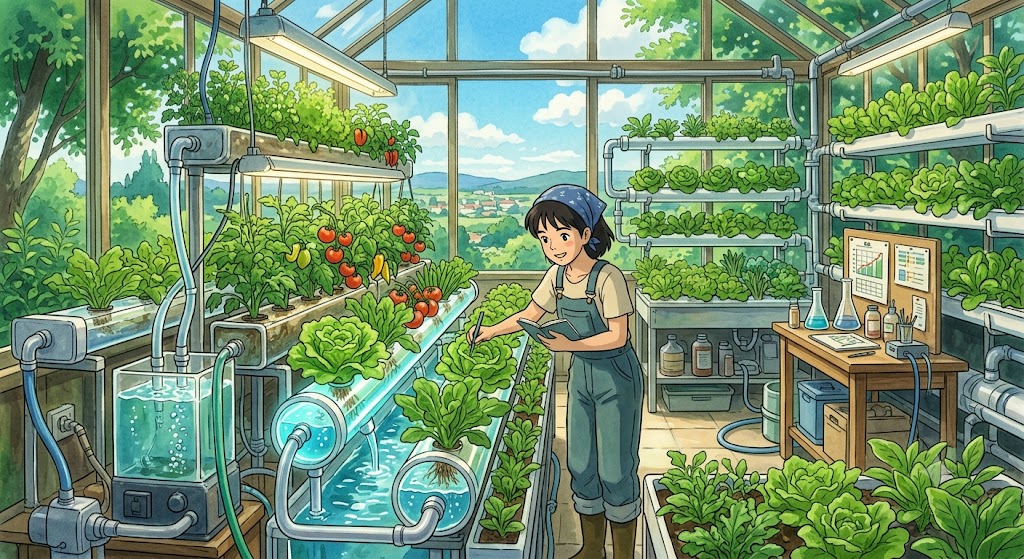
Hydroponic farming is a method of growing plants without relying on traditional agricultural soil. Instead, plants receive water, nutrients, oxygen, and physical support through a carefully managed growing system.
The idea may sound highly technical, but the basic principle is surprisingly simple: plant roots need access to water, nutrients, oxygen, and suitable environmental conditions—not necessarily soil itself.
Hydroponics can be used in small home systems, greenhouses, commercial farms, educational projects, and urban growing spaces. Depending on the design, plants can grow in nutrient-rich water or in an inert growing medium that provides physical support while nutrients are delivered through irrigation.
For beginners, understanding the relationship between roots, water, nutrients, light, and temperature is more important than buying expensive equipment.
How Hydroponic Farming Works
In conventional farming, soil performs several jobs at once. It anchors the plant, stores water, holds nutrients, and provides an environment where roots can access oxygen.
A hydroponic system separates these functions.
The plant may be supported by materials such as:
- Coconut coir
- Rockwool
- Perlite
- Clay pebbles
- Other suitable inert growing media
Meanwhile, a nutrient solution supplies the minerals required for plant growth.
The roots need access to both water and oxygen. This is why hydroponic systems are designed to prevent roots from remaining in poorly oxygenated water.
Why Grow Plants Without Soil?
There are several reasons farmers and gardeners experiment with hydroponics.
These can include:
- Efficient use of growing space
- Controlled nutrient delivery
- Reduced dependence on agricultural soil
- Potentially lower water consumption in recirculating systems
- Ability to grow in areas with poor or unsuitable soil
- Greater control over the root environment
- Possibility of year-round production in protected structures
However, hydroponics is not automatically easier or cheaper than conventional farming.
A hydroponic farm requires careful monitoring and equipment management. Pumps, electricity, nutrient concentrations, water quality, temperature, and sanitation all become important.
Choosing the Right Hydroponic System
There are several major hydroponic systems.
Deep Water Culture
In deep water culture, plant roots are suspended in a nutrient solution while air is supplied to the water.
This method can be relatively simple for beginners, particularly for leafy greens.
The main consideration is oxygen. If aeration stops for an extended period, roots can quickly become stressed.
Nutrient Film Technique
Nutrient Film Technique, often called NFT, moves a thin stream of nutrient solution through channels containing plant roots.
The roots receive nutrients and water while remaining exposed to air.
NFT can work well for crops with relatively small root systems, but proper flow and system design are important.
Drip Systems
Drip hydroponics delivers nutrient solution to individual plants through small emitters.
This approach can be useful for larger plants and greenhouse production.
The system requires careful attention to clogged emitters, drainage, and irrigation timing.
Ebb and Flow
Ebb-and-flow systems periodically flood the growing area with nutrient solution and then allow it to drain.
This provides roots with both moisture and access to air.
Timers, pumps, and drainage must work reliably for the system to function correctly.
Wick Systems
Wick systems use a passive method to move nutrient solution toward the growing medium.
They can be useful for small-scale experiments, although they may not provide enough nutrient flow for larger, fast-growing plants.
Start With Easy Crops
Not every crop is equally suitable for a beginner hydroponic system.
Good starting choices often include:
- Lettuce
- Basil
- Mint
- Spinach
- Kale
- Pak choi
- Other leafy greens
- Some herbs
These crops can have relatively manageable growth cycles and modest space requirements.
Once the system is stable, growers can experiment with larger plants such as tomatoes, cucumbers, peppers, and strawberries.
Larger fruiting crops generally require more support, light, nutrients, and careful environmental management.
The Root Zone Is the Heart of the System
In hydroponics, healthy roots are essential.
A healthy root system generally needs:
Water + nutrients + oxygen + suitable temperature
If one of these is missing, plant growth can suffer.
Roots that remain in stagnant, poorly oxygenated water can become stressed. Excessively wet growing media can create similar problems.
At the same time, roots must not be allowed to dry out.
The ideal balance depends on the particular hydroponic system.
Understand Nutrient Solutions
Plants require several essential mineral nutrients.
These are generally divided into macronutrients and micronutrients.
Major nutrients include:
- Nitrogen
- Phosphorus
- Potassium
- Calcium
- Magnesium
- Sulfur
Plants also require smaller quantities of micronutrients such as iron, manganese, zinc, copper, boron, molybdenum, and chlorine.
A complete hydroponic nutrient product is usually easier for beginners than attempting to create a nutrient formula from individual chemicals.
Different crops and growth stages may have different nutrient requirements.
Always follow the manufacturer’s mixing instructions rather than assuming that a stronger solution will produce faster growth.
Monitor pH
pH affects how easily plants can access nutrients from the solution.
If the pH moves too far outside a suitable range, certain nutrients may become less available even when they are physically present in the water.
This can result in deficiency-like symptoms.
A basic hydroponic setup should therefore include a reliable pH testing method.
Avoid making large corrections based on a single questionable measurement. Test equipment should be maintained and used according to its instructions.
Monitor Nutrient Strength
Electrical conductivity, commonly abbreviated as EC, is often used to estimate the concentration of dissolved nutrients in hydroponic water.
Some growers use total dissolved solids measurements as a related indicator.
The appropriate nutrient concentration depends on factors such as:
- Crop type
- Plant age
- Growth stage
- Water source
- Temperature
- Growing system
More nutrients do not automatically mean better growth.
An excessively concentrated solution can cause stress, while an insufficient supply can limit development.
Water Quality Matters
The quality of the water entering a hydroponic system can influence the entire operation.
Tap water may contain minerals or other characteristics that affect nutrient management.
Important factors can include:
- pH
- Mineral content
- Alkalinity
- Salinity
- Chlorine or chloramine levels
- Potential contaminants
If water quality is inconsistent, testing the source water can help explain unexpected plant problems.
Light Is Just as Important as Nutrients
A plant cannot grow well simply because its roots have excellent access to nutrients.
Plants need suitable light to perform photosynthesis.
Outdoor hydroponic systems can use sunlight, while indoor or greenhouse systems may require supplemental lighting.
For indoor growing, growers may use LED grow lights designed for plant production.
Consider:
- Light intensity
- Duration
- Distance from plants
- Heat produced by fixtures
- Crop requirements
More light is not always better. Excessive intensity can stress plants or raise leaf temperatures.
Temperature and Humidity
Hydroponic plants respond to their surrounding environment.
Temperature affects:
- Root activity
- Nutrient availability
- Plant growth
- Water oxygen levels
- Disease development
Very warm nutrient solution can hold less dissolved oxygen than cooler water, which can become particularly important in systems where roots depend heavily on the solution for oxygen.
Humidity also influences plant water loss and disease risk.
A greenhouse or indoor system should therefore be designed with ventilation in mind.
Air Movement Helps Plants
Good airflow serves several purposes.
It can:
- Help regulate temperature
- Reduce stagnant humid conditions
- Strengthen stems
- Improve gas exchange around leaves
- Reduce conditions favorable to certain fungal problems
Fans can be useful in indoor systems, but they should not be positioned so aggressively that they constantly damage or excessively dry plants.
Keep the System Clean
Hydroponic systems recirculate water in many designs, meaning problems can spread through the system.
Regular cleaning helps reduce the buildup of:
- Algae
- Organic debris
- Mineral deposits
- Plant residues
- Potential pathogens
Light entering nutrient reservoirs can encourage algae growth.
Keeping reservoirs appropriately covered and maintaining clean equipment can help.
At the end of a crop cycle, thoroughly clean and inspect the system before starting the next crop.
Watch for Root Problems
Root health can provide early clues about system conditions.
Healthy roots often have a firm appearance appropriate to the crop and growing system.
Potential warning signs include:
- Unusual discoloration
- Slimy roots
- Unpleasant odors
- Sudden wilting
- Rapid decline despite adequate water
Root problems can be associated with poor oxygenation, excessive heat, contamination, or other environmental issues.
Do not automatically assume that a root problem is caused by a nutrient deficiency.
Common Hydroponic Problems
Yellow leaves
Possible causes include nutrient imbalance, root stress, incorrect pH, insufficient light, or natural aging.
Brown leaf edges
Possible causes may include excessive nutrient concentration, inconsistent water supply, environmental stress, or other growing conditions.
Wilting plants
Wilting can occur even when plenty of water is present if roots are damaged or oxygen availability is inadequate.
Slow growth
Poor light, unsuitable temperature, nutrient problems, root stress, or insufficient space can all contribute.
Algae
Algae often becomes more noticeable when light reaches nutrient-rich water.
Reducing unnecessary light exposure to reservoirs and maintaining good sanitation can help.
Pest Management Still Matters
Growing plants hydroponically does not make them immune to insects.
Common pests may include:
- Aphids
- Fungus gnats
- Whiteflies
- Thrips
- Spider mites
Regularly inspect both sides of leaves and the growing environment.
Early detection is much easier than trying to control a large infestation.
Use pest-control methods appropriate for the crop and production environment, especially when growing food intended for consumption.
Pollination Becomes Important for Fruiting Crops
Leafy greens can often be harvested without worrying about fruit development.
Tomatoes, cucumbers, peppers, strawberries, and other fruiting plants are different.
When these crops are grown indoors or in enclosed structures, natural pollinators may not be available.
Depending on the crop, growers may need to encourage or manually assist pollination.
The exact method varies between species and varieties.
Hydroponics Does Not Eliminate Water Use
Hydroponics can use water efficiently, especially in recirculating systems, but it is incorrect to think that plants require almost no water.
Water is still consumed through:
- Plant growth
- Transpiration
- Evaporation
- System losses
- Cleaning and maintenance
Good system design can reduce unnecessary losses by recirculating nutrient solution and preventing leaks.
Start With a Small System
A beginner does not need a commercial greenhouse.
A small system can teach the fundamentals of:
- Nutrient mixing
- pH monitoring
- Water management
- Root health
- Lighting
- Plant spacing
- Harvesting
For example, a small leafy-green system can be easier to manage than beginning with dozens of large fruiting plants.
Once you understand the system, you can increase its size.
Plan Before Buying Equipment
Before purchasing equipment, answer a few basic questions.
What will you grow?
Leafy greens require different infrastructure from large fruiting crops.
Where will you grow?
An outdoor setup depends heavily on weather, while an indoor setup requires lighting and ventilation.
How much space is available?
Vertical systems can make better use of limited space, but they may require more complicated plumbing.
What happens if the pump fails?
A backup plan can be important because some hydroponic systems depend on continuous water movement.
How will you monitor the system?
At minimum, growers should understand how they will check water level, nutrient concentration, pH, and plant health.
A Simple Beginner Hydroponic Routine
A practical routine might look like this:
Daily
- Check plants for unusual changes.
- Inspect water levels.
- Look for leaks.
- Check pumps and aeration.
- Observe root and leaf condition.
Several times each week
- Test relevant water parameters.
- Inspect for pests.
- Check nutrient levels.
- Remove dead or damaged plant material.
Weekly
- Review plant growth.
- Check equipment.
- Clean minor buildup.
- Adjust plant spacing where necessary.
Between crops
- Empty the system.
- Clean and sanitize suitable components.
- Inspect pumps, tubing, channels, and containers.
- Start with fresh growing media where appropriate.
The exact schedule should be adapted to the crop and hydroponic system.
Hydroponic Farming in the USA and UK
Hydroponics can be used in many climates because the growing environment can be controlled more closely than in open-field farming.
In the USA, commercial hydroponic production ranges from small local operations to large controlled-environment facilities. Energy costs, water availability, climate, and local markets can strongly influence whether a system is economically practical.
In the UK, protected growing can help growers produce crops outside traditional outdoor growing seasons, although heating and lighting costs can become significant considerations.
In both countries, commercial growers should also consider food-safety requirements, water management, electrical safety, waste disposal, and local planning or agricultural regulations.
Is Hydroponic Farming Suitable for a Small Farm?
It can be, but the answer depends on the farm’s goals.
Hydroponics may make sense when:
- Soil quality is poor
- Space is limited
- High-value crops have a local market
- Water needs to be carefully managed
- A protected growing environment is available
- The grower is comfortable monitoring equipment
It may be less suitable when electricity, equipment, water quality, or technical management would make the system unnecessarily expensive.
The economics should always be calculated before investing in a large commercial installation.
Final Thoughts
Hydroponic farming replaces many of the functions normally provided by soil with carefully managed water, nutrients, growing media, and environmental controls.
The technology can be used for anything from a small home experiment to a commercial growing operation, but successful results still depend on the fundamentals of plant biology.
Healthy roots need water and oxygen. Leaves need suitable light. Plants need balanced nutrients. The growing environment needs appropriate temperature and humidity. Equipment needs regular inspection and cleaning.
For beginners, starting with a small number of easy crops is usually a practical way to learn. Once the system becomes predictable, it can be expanded gradually.
Hydroponics is not simply “growing plants in water.” It is a controlled method of managing the entire root environment. When water, nutrients, oxygen, light, temperature, and plant care are kept in balance, hydroponic systems can provide an efficient and flexible way to grow healthy plants without relying on traditional soil-based farming.