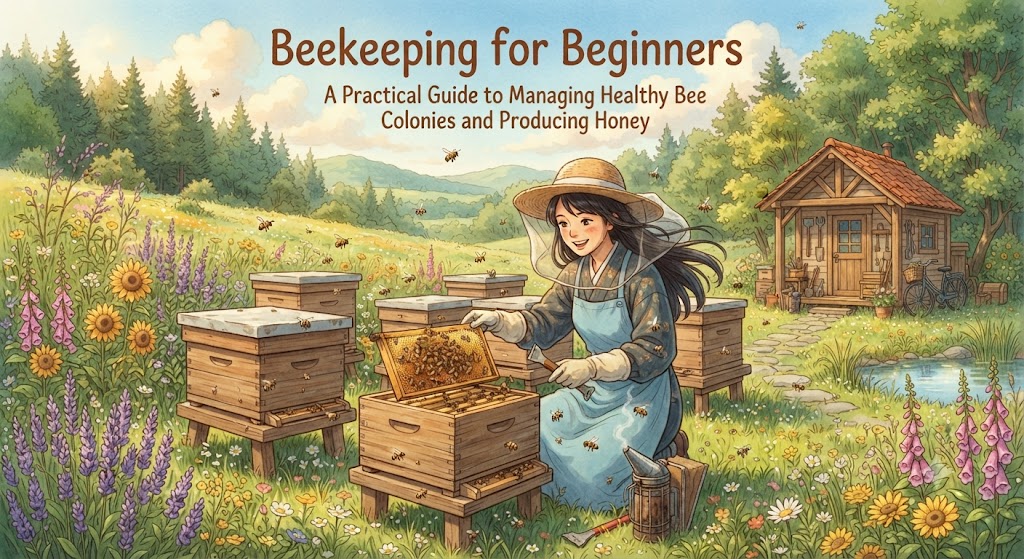
Beekeeping can be a rewarding part of a small farm or home garden. A healthy honey bee colony can produce honey while also supporting pollination of many flowering plants. However, successful beekeeping requires regular observation, suitable equipment, responsible colony management, and an understanding of how bees respond to seasonal changes.
Keeping bees is not simply a matter of placing a hive in the garden and waiting for honey. A colony is a living community that changes throughout the year. The beekeeper needs to understand food availability, brood development, swarm behavior, pests, weather conditions, and the colony’s overall strength.
For beginners, the best approach is to start with basic equipment, learn how to inspect a colony safely, and develop good management habits before expanding to several hives.
Understanding a Honey Bee Colony
A honey bee colony is made up of different types of bees with different roles.
The queen
The queen is the primary reproductive female in the colony. Her main role is laying eggs, which allows the colony to produce new generations of workers and other bees.
A healthy queen does not necessarily need to be physically observed during every inspection. Beekeepers often look for evidence of her presence by checking whether the colony contains an appropriate pattern of eggs, larvae, and developing brood.
Worker bees
Worker bees are female bees that perform most colony tasks.
Depending on their age and the needs of the colony, workers may:
- Clean cells
- Feed larvae
- Produce wax
- Process nectar
- Store food
- Guard the hive
- Collect nectar and pollen
- Regulate the hive environment
Drones
Drones are male bees. Their primary biological role is reproduction with queens from other colonies.
The number of drones in a colony can change according to the season and colony conditions.
Understanding these basic roles makes hive inspections much easier because the beekeeper can interpret what is happening inside the colony.
Choosing the Right Location for a Hive
Hive placement is one of the first major decisions for a new beekeeper.
A good location should provide:
- Reasonable sunlight
- Protection from strong winds
- Good drainage
- Easy access for inspections
- Nearby flowering plants
- A reliable water source
- Appropriate distance from busy areas
The entrance should ideally not face directly toward a frequently used path, doorway, or other location where people regularly walk.
A hedge, fence, or similar barrier can sometimes encourage bees to fly upward rather than directly across human activity.
Always consider neighbors, children, pets, livestock, and local rules when selecting a location.
Learn Local Beekeeping Regulations
Before purchasing bees or equipment, check the rules that apply to your location.
Requirements can vary between countries, states, counties, councils, and municipalities.
Depending on the location, beekeepers may need to consider:
- Hive registration
- Apiary location rules
- Movement of colonies
- Disease reporting
- Honey sales
- Labeling
- Food-safety requirements
In the United States, regulations can vary significantly between states and local jurisdictions.
In the UK, beekeepers should check current guidance from relevant agricultural and animal-health authorities and local councils where applicable.
Understanding these requirements early can prevent avoidable problems later.
Choose a Suitable Hive System
Several hive designs are used around the world.
Common examples include:
- Langstroth hives
- National hives
- Warre hives
- Top-bar hives
The Langstroth system is widely used in commercial and hobby beekeeping, while the National hive is particularly common in the UK.
For beginners, choosing a hive style that is widely supported in the local beekeeping community can make learning easier because equipment, advice, and replacement parts are more readily available.
Essential Beekeeping Equipment
A beginner does not need every possible beekeeping tool.
Basic equipment generally includes:
- Hive boxes
- Frames
- Foundation where appropriate
- Hive tool
- Smoker
- Protective veil
- Beekeeping suit or jacket
- Gloves if preferred
- Feeder when required
- Secure hive stand
A suitable bee brush may also be useful for certain tasks, although experienced beekeepers often rely on other methods to move bees.
Quality protective equipment is particularly important for beginners because confidence develops gradually.
Buy Bees From a Reputable Source
Starting with healthy bees is important.
Beginners commonly obtain colonies through:
- Established local beekeepers
- Reputable bee suppliers
- Nucleus colonies
- Package bees
- Swarms collected by experienced beekeepers
A nucleus colony, often called a nuc, is a small established colony containing brood, food stores, bees, and usually a queen.
For a beginner, an established colony can provide useful information about how a healthy hive develops.
Ask the supplier about the colony’s history, queen, health status, and any relevant disease-management information.
Handle Bees Calmly
Bees respond to movement, vibration, smoke, weather, and other environmental factors.
Slow and deliberate movements generally make hive inspections easier.
Avoid:
- Hitting or crushing bees
- Blocking the entrance unnecessarily
- Working roughly through frames
- Inspecting during unsuitable weather
- Opening colonies without a clear reason
A smoker can be used appropriately to influence bee behavior during inspections.
The purpose of smoke is not to fill the hive with large amounts of smoke. A few controlled applications can help manage bee behavior.
Perform Regular Hive Inspections
Regular inspections allow a beekeeper to identify problems before they become severe.
During an inspection, look for:
- Eggs
- Larvae
- Capped brood
- Food stores
- Pollen
- Queen evidence
- Colony population
- Signs of disease
- Pest activity
- Swarm preparation
- Damaged equipment
You do not need to disturb the colony unnecessarily.
A good inspection should answer specific questions rather than becoming a routine exercise of repeatedly examining every part of the hive.
How to Recognize a Healthy Colony
There is no single visual sign that proves a colony is completely healthy.
Instead, look at several indicators together.
A healthy colony may show:
- Active worker bees
- Normal brood development
- Adequate food stores
- Good population for the season
- Appropriate nest organization
- Normal behavior
- No obvious signs of major disease or infestation
The expected appearance of a colony changes throughout the year, so seasonal context is important.
Understand Seasonal Changes
Bee colonies behave differently during different seasons.
Spring
Spring can bring rapid population growth as flowers become available.
This is often an important period for:
- Monitoring colony expansion
- Checking food supplies
- Watching for swarm preparation
- Managing available space
Summer
Summer can provide strong nectar flows in some regions.
Colonies may become very active, and honey production can increase.
Good ventilation, sufficient space, water access, and swarm management become important considerations.
Autumn
The colony begins preparing for colder conditions.
The beekeeper may need to evaluate:
- Food stores
- Colony strength
- Pest levels
- Hive condition
- Winter readiness
Winter
Bee activity usually decreases in colder conditions.
Avoid unnecessary hive disturbance.
The colony needs sufficient food, suitable protection from severe weather, and appropriate ventilation.
Exact seasonal timing differs between regions, so local weather and flowering patterns should guide management.
Provide Water Without Creating Problems
Bees need water, especially during warm weather.
If a reliable water source is not naturally available, a beekeeper may provide one near the apiary.
A bee-friendly water source should include landing areas such as stones, floating materials, or shallow sections that reduce the risk of bees drowning.
Providing water early in the season can encourage bees to use the beekeeper’s chosen source rather than seeking water from neighbors’ pools, taps, or other locations.
Understand Feeding
Honey and pollen are the colony’s natural food resources.
Under certain circumstances, beekeepers may provide supplemental feed.
This can be appropriate when colonies have insufficient stores, particularly during periods when natural forage is limited.
However, feeding should not become an automatic routine.
The type, concentration, timing, and quantity of supplemental feed depend on the colony, season, weather, and management objective.
Beekeepers should also understand that feeding honey bees is not a substitute for maintaining access to suitable natural forage.
Plant for Bees
A garden or small farm can provide valuable forage for pollinators.
Consider planting a mixture of flowering plants that bloom at different times.
Useful categories can include:
- Fruit trees
- Flowering herbs
- Native wildflowers
- Clover
- Lavender
- Sunflowers
- Borage
- Other locally suitable flowering plants
Native and locally adapted plants can be particularly valuable because they are suited to the regional environment.
Avoid treating a single flowering plant as the complete food solution. Diversity helps provide resources across a longer portion of the growing season.
Monitor Varroa and Other Pests
One of the most important challenges in modern beekeeping is managing pests and diseases.
Varroa mites are a major concern for honey bee colonies in many regions. They can weaken colonies and contribute to the spread of harmful viruses.
Other concerns can include:
- Wax moths
- Small hive beetles in some regions
- Tracheal mites in certain areas
- Bacterial diseases
- Viral diseases
- Fungal problems
Regular monitoring is important.
Do not assume that a colony is healthy simply because bees are flying normally outside the hive.
When treatment is necessary, use approved products according to current instructions and local regulations.
Avoid Unnecessary Chemical Use
Beekeeping involves balancing pest management with protection of the colony and honey.
Treatments should be selected based on evidence of a problem and used according to the product label.
Avoid experimenting with unapproved chemical mixtures or homemade treatments that may contaminate hive products or harm bees.
When a disease or pest problem is unclear, contacting a local beekeeping association, extension service, or experienced beekeeper can be much safer than guessing.
Prevent Swarming Problems
Swarming is a natural part of honey bee reproduction.
A colony may produce new queens and divide, with a large group of bees leaving the original hive.
Swarming is not necessarily a sign that bees are unhealthy. However, it can reduce the number of bees remaining in the original colony and affect honey production.
Beekeepers can monitor colonies for signs of swarm preparation and use management techniques appropriate to their hive system and local conditions.
Learning to recognize queen cells and changes in colony space is an important beginner skill.
Honey Production Comes Later
New beekeepers are often excited about harvesting honey, but the colony’s needs should come first.
A colony needs enough food to survive periods when flowers are unavailable.
Before harvesting honey, consider:
- Colony strength
- Available food stores
- Seasonal conditions
- Upcoming nectar availability
- Local weather
- Winter requirements
Never remove honey simply because it is present.
The amount that can safely be harvested varies from colony to colony and from season to season.
Harvesting Honey
When a colony has surplus honey that is properly stored and ready for harvest, the beekeeper can remove suitable frames.
Honey is generally harvested after bees have reduced the moisture content sufficiently and sealed the cells with wax.
Basic harvesting may involve:
- Removing suitable honey frames.
- Separating bees from the frames.
- Uncapping sealed honey cells.
- Extracting honey using an appropriate method.
- Filtering larger pieces of wax and debris.
- Allowing the honey to settle.
- Storing it in clean, food-safe containers.
Commercial honey sales may require additional food-safety, labeling, processing, and licensing requirements.
Protect Yourself and Others
Beekeeping involves stinging risk.
Protective clothing and sensible hive handling are important, particularly for beginners.
People with known severe reactions to bee stings should discuss appropriate emergency planning with a medical professional before taking up beekeeping.
The apiary should also be positioned so that routine bee activity does not create unnecessary risk for neighbors, visitors, pets, or livestock.
Keep children away from active hive inspections unless they are closely supervised and using appropriate protection.
Keep Simple Beekeeping Records
Good records make hive management much easier.
For each hive, record:
- Inspection date
- Colony strength
- Queen observations
- Brood condition
- Food stores
- Pest observations
- Treatments
- Feeding
- Swarm activity
- Honey harvests
- Weather conditions
Over time, these records help you understand how individual colonies behave.
They can also make it easier to identify seasonal patterns and recognize when something changes.
A Beginner’s First-Year Routine
A simple first-year plan can look like this:
Before getting bees
- Learn basic bee biology.
- Join a local beekeeping group if available.
- Check regulations.
- Purchase protective equipment.
- Prepare the hive location.
When the colony arrives
- Allow the colony to settle.
- Check food and general activity.
- Avoid excessive disturbance.
During the active season
- Perform purposeful inspections.
- Monitor brood and food.
- Watch for swarming.
- Monitor pests.
- Maintain equipment.
Before winter
- Assess colony strength.
- Check food reserves.
- Address pest-management needs.
- Prepare the hive for local winter conditions.
The exact schedule should always be adjusted to local climate and advice from experienced beekeepers.
Beekeeping in the USA and UK
Beekeeping practices vary considerably between regions.
In the United States, climate and regulations differ from state to state. A beekeeper in a warm southern state may manage colonies very differently from one in a northern region with long winters.
In the UK, hive types, weather, forage availability, and seasonal management also vary between regions. The National Bee Unit and local beekeeping associations can provide useful information on bee health and disease risks.
In both countries, beginners should use current local guidance because disease risks, regulations, approved treatments, and reporting requirements can change.
Final Thoughts
Beekeeping is a long-term learning process rather than a hobby that can be mastered after a few hive inspections.
The most important skills are learning how to observe a colony, recognize normal seasonal changes, maintain suitable equipment, monitor pests and diseases, and make decisions based on the colony’s actual needs.
Honey production is an important part of beekeeping, but a healthy and well-managed colony should remain the priority.
For beginners, starting with one or two colonies can provide valuable experience without creating an overwhelming workload. With careful observation, good records, appropriate equipment, and support from local beekeeping communities, it is possible to build practical skills and gradually become more confident in managing bees.
A successful apiary is ultimately built through consistency: inspect thoughtfully, respond to problems early, protect the bees, and give colonies the conditions they need to develop naturally through the seasons.