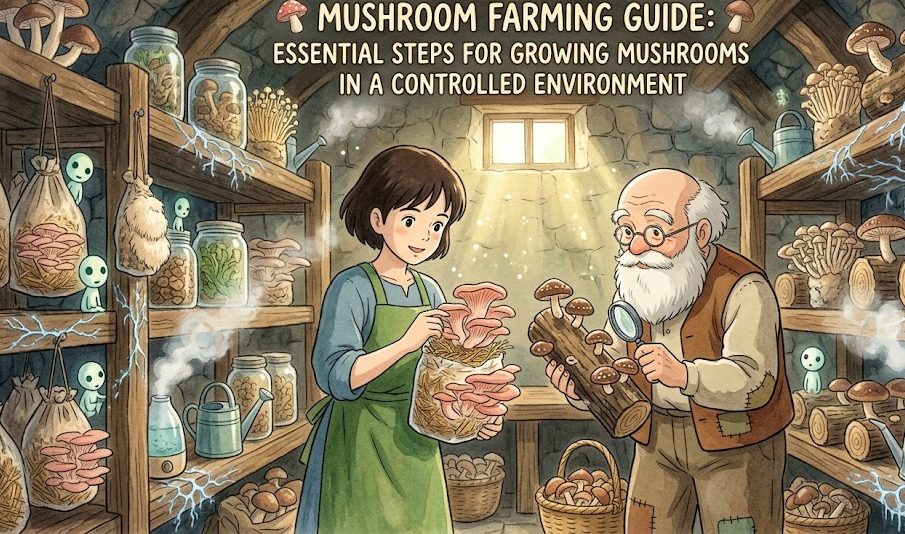
Mushroom farming is different from traditional crop production because mushrooms do not rely on sunlight and soil in the same way that most vegetables do. Instead, edible fungi grow on a prepared material called a substrate under carefully managed environmental conditions.
This makes mushrooms particularly interesting for small farms, indoor growers, and agricultural businesses with limited land. A suitable growing room can be created in a relatively small space, although successful production requires careful attention to temperature, humidity, ventilation, cleanliness, and contamination control.
For beginners, the easiest way to understand mushroom farming is to think of it as a controlled biological process. The grower prepares a suitable food source, introduces healthy mushroom spawn, allows the fungal network to develop, and then creates the conditions required for mushrooms to produce fruiting bodies.
How Mushroom Farming Differs From Vegetable Growing
Mushrooms are fungi rather than plants.
Instead of growing roots into soil and using sunlight for photosynthesis, mushrooms obtain nutrients from organic material through their fungal network, known as mycelium.
The basic production cycle looks something like this:
Suitable substrate → Spawn → Mycelium colonization → Fruiting conditions → Mushroom harvest
Each stage requires different environmental conditions.
This is one reason mushroom farming can be rewarding but also technically demanding. A small mistake in preparation or environmental control can affect the entire growing batch.
Choose a Mushroom Variety First
Different mushroom species require different growing conditions.
Common cultivated varieties include:
- Oyster mushrooms
- Button mushrooms
- Shiitake
- Lion’s mane
- Enoki
- King oyster mushrooms
For beginners, oyster mushrooms are often a practical starting point because they can grow on several types of prepared organic substrates and have relatively straightforward cultivation requirements.
Button mushrooms generally require a more specialized composting and environmental-management process.
Shiitake can be grown using prepared substrates or suitable logs, depending on the production method.
Before building a growing room, choose the species first. The species determines much of the equipment and environmental control you will need.
Understand the Role of Mycelium
The visible mushroom is only part of the organism.
Most of the fungal growth occurs as a network of fine structures called mycelium.
When healthy spawn is introduced to a suitable substrate, the mycelium gradually spreads through the material.
Once the substrate is adequately colonized, environmental conditions can be changed to encourage the fungus to produce mushrooms.
This means that successful farming depends on keeping the mycelium healthy before fruiting begins.
Prepare a Suitable Growing Space
A controlled mushroom-growing room does not necessarily need to be large.
A small operation might use:
- A dedicated room
- Shelving
- A converted agricultural building
- A greenhouse-style structure with suitable environmental controls
- A purpose-built grow room
The space should be easy to clean and capable of maintaining reasonably stable environmental conditions.
Consider:
- Temperature control
- Humidity
- Fresh-air exchange
- Drainage
- Lighting where appropriate
- Shelving
- Water access
- Electrical safety
- Cleaning procedures
Avoid using a space that is heavily contaminated with mold, pests, or decaying organic material.
Cleanliness Is Extremely Important
One of the biggest challenges in mushroom cultivation is contamination.
Mushroom mycelium has to compete with other microorganisms. If unwanted molds or bacteria establish themselves in the substrate, they can reduce mushroom growth or destroy a batch.
Good hygiene practices can therefore make a major difference.
Important habits include:
- Cleaning work surfaces
- Washing hands before handling materials
- Using clean tools
- Keeping growing containers clean
- Removing contaminated material promptly
- Preventing unnecessary movement between clean and dirty areas
A clean growing environment does not need to be perfectly sterile, but it should be managed carefully.
Choose the Right Substrate
The substrate is the material from which the mushroom obtains nutrients.
Different mushroom species prefer different substrates.
Depending on the species and production method, substrates may include:
- Straw
- Hardwood sawdust
- Wood-based materials
- Agricultural by-products
- Specialized prepared growing media
Oyster mushrooms are commonly grown on suitable plant-based materials such as straw or certain agricultural residues.
The substrate should be appropriate for the mushroom species and prepared using a method that reduces competing microorganisms.
Prepare the Substrate Correctly
Substrate preparation is one of the most important steps.
The general process can involve:
- Selecting an appropriate substrate.
- Preparing it to the correct particle size.
- Adjusting moisture.
- Applying an appropriate heat treatment or other preparation method.
- Allowing it to reach a suitable temperature.
- Inoculating it with healthy spawn.
The exact process varies considerably by mushroom species and substrate.
The substrate should contain enough moisture for mycelial growth without becoming excessively wet.
Too much water can create poor aeration and increase contamination risk.
Use Quality Spawn
Spawn is material containing actively growing mushroom mycelium that is used to inoculate the substrate.
Good-quality spawn should come from a reliable supplier and be appropriate for the chosen mushroom species and cultivation method.
Look for spawn that shows healthy, consistent growth without obvious signs of contamination.
Do not assume that older or poorly stored spawn will perform normally.
The condition of the spawn can have a major influence on colonization speed and final production.
Inoculate Carefully
Once the substrate is prepared and has reached a suitable temperature, spawn can be mixed or introduced according to the cultivation method.
Work efficiently while maintaining clean handling practices.
The objective is to distribute enough healthy spawn through the substrate so that the desired mycelium can colonize the available material before competing organisms become established.
The exact spawn rate varies according to species, substrate, and production system.
Following a proven cultivation protocol for the selected mushroom is more reliable than using one universal formula.
The Colonization Stage
After inoculation, the mycelium begins spreading through the substrate.
During this stage, the grower generally wants stable environmental conditions and minimal disturbance.
Watch for:
- Consistent mycelial growth
- Unusual colors
- Strange odors
- Wet or damaged areas
- Signs of contamination
Healthy colonization usually becomes increasingly visible as the mycelium spreads.
The time required depends on the mushroom species, substrate, spawn rate, temperature, and other conditions.
Recognize Contamination Early
Contamination is one of the most common problems for beginners.
Unwanted organisms may appear as:
- Unusual green growth
- Black or dark patches
- Orange or pink discoloration
- Slimy areas
- Unpleasant odors
- Mycelium that stops spreading normally
Not every unusual color is necessarily contamination, so identification should be based on the particular mushroom species and growing method.
If a batch is clearly contaminated, isolate it from healthy production rather than allowing the problem to spread throughout the growing room.
Do not consume mushrooms from contaminated growing material unless their safety is clearly established.
Control Temperature
Temperature affects fungal growth.
Each mushroom species has preferred temperature ranges for colonization and fruiting.
This means the temperature that works well during one stage may not be ideal during another.
A controlled growing room should therefore have a reliable way to monitor temperature rather than relying on guesswork.
Sudden temperature changes can stress the crop.
In commercial production, environmental sensors can make it easier to identify problems before they affect an entire batch.
Manage Humidity Carefully
Mushrooms contain a large amount of water, so humidity is important during fruiting.
However, high humidity does not mean the growing room should remain wet.
Excess surface moisture can contribute to bacterial problems and other production issues.
A good system balances:
- Relative humidity
- Air movement
- Fresh-air exchange
- Surface moisture
- Water availability
Humidity should be monitored with a reliable hygrometer rather than estimated from how the room feels.
Fresh Air Is Essential
As mushrooms grow, they exchange gases with their environment.
Fresh-air exchange is therefore an important part of controlled mushroom production.
Insufficient fresh air can lead to poor development and abnormal mushroom shapes in some species.
However, excessive ventilation can make it difficult to maintain appropriate humidity.
The goal is to find a balance suitable for the species and stage of growth.
This is why mushroom farming is often described as environmental management rather than simply watering and harvesting.
Light Requirements Depend on the Species
Mushrooms do not require sunlight for photosynthesis.
Some species can still respond to light during fruiting and may benefit from a modest light cycle.
The exact requirements depend on the species and production system.
This means a mushroom-growing room does not necessarily need expensive high-intensity grow lights designed for vegetables.
Encourage Fruiting
Once the substrate is sufficiently colonized, the environmental conditions can be adjusted to encourage mushroom formation.
Depending on the species, this may involve changes in:
- Temperature
- Humidity
- Fresh-air exchange
- Light exposure
- Surface conditions
The exact process varies.
For some mushrooms, simply maintaining the correct fruiting environment is enough. Others require more specific environmental changes.
Following species-specific cultivation instructions is therefore important.
Monitor the First Pins
Small mushroom formations are often called pins.
This is an exciting stage because it indicates that the crop is moving into fruiting.
At this point, pay close attention to:
- Humidity
- Air exchange
- Surface moisture
- Temperature
- Contamination
- Mushroom development
Avoid excessive handling of developing mushrooms.
Environmental stability is generally more useful than making constant adjustments.
Harvest at the Right Time
Mushrooms should be harvested according to the characteristics of the species.
For many cultivated varieties, harvesting too early reduces size and yield, while harvesting too late can affect appearance, texture, and market quality.
Oyster mushrooms, for example, can change shape as the caps expand.
Commercial growers should establish a consistent harvest stage based on their target market.
Use clean tools or clean handling methods and avoid unnecessarily damaging the growing substrate.
Handle Mushrooms Carefully After Harvest
Fresh mushrooms are highly perishable.
After harvesting:
- Handle them gently.
- Remove visible debris.
- Keep them cool when appropriate.
- Use clean food-contact surfaces.
- Package them in suitable containers.
- Move them to the market or storage facility promptly.
The exact storage temperature and packaging method depend on the species and intended shelf life.
For commercial sales, food-safety requirements should be followed carefully.
Common Beginner Problems
Mushrooms become dry
Possible causes include insufficient humidity, excessive air movement, or inadequate moisture management.
Mushrooms become soft or develop wet spots
This can be associated with excessive surface moisture, poor ventilation, contamination, or other environmental problems.
Mycelium stops growing
Possible causes include unsuitable temperature, poor substrate preparation, contamination, or damaged spawn.
Mushrooms grow with unusual shapes
In some species, inadequate fresh-air exchange can affect fruiting development.
Green mold appears
Green contamination is a common warning sign in some mushroom-growing systems. Contaminated material should be isolated and managed appropriately rather than mixed with healthy batches.
Keep Production Batches Separate
For a small farm, separating production batches can reduce the impact of contamination.
Instead of preparing hundreds of bags at once, a beginner may find it easier to produce smaller batches on different dates.
This creates a staggered production schedule.
For example:
Week 1: Prepare Batch A
Week 2: Prepare Batch B
Week 3: Prepare Batch C
Week 4: Prepare Batch D
Once the system becomes reliable, this approach can provide more consistent harvesting while reducing the risk of losing the entire crop to one problem.
Build a Simple Production Schedule
A mushroom farm can be organized around four main stages:
Stage 1 — Preparation
Prepare the substrate, equipment, growing containers, and work area.
Stage 2 — Colonization
Introduce spawn and maintain appropriate conditions while the mycelium spreads.
Stage 3 — Fruiting
Adjust environmental conditions to encourage mushroom formation.
Stage 4 — Harvest and Reset
Harvest mature mushrooms, clean the growing area, and prepare for the next production cycle.
Keeping these stages organized makes it easier to predict labor and production.
Consider the Economics
Mushroom farming can be performed on a relatively small footprint, but that does not mean production is automatically inexpensive.
Potential costs include:
- Spawn
- Substrate
- Containers or growing bags
- Shelving
- Humidity equipment
- Ventilation
- Heating or cooling
- Water
- Electricity
- Labor
- Packaging
- Cleaning supplies
- Refrigeration
- Transportation
Before starting a commercial operation, estimate the cost per production batch and compare it with realistic selling prices.
Local demand matters as much as biological production.
Start Small Before Scaling
A small pilot operation can answer important questions:
- Can the chosen species grow reliably?
- Can contamination be controlled?
- Can environmental conditions be maintained?
- How much labor is required?
- What is the actual yield?
- How quickly can mushrooms be sold?
- What is the production cost?
Only after answering these questions should a grower consider expanding the facility.
Scaling a system with unresolved contamination or environmental problems can multiply losses rather than profits.
Mushroom Farming in the USA and UK
Controlled mushroom production can work in many regions because indoor environments provide greater control over temperature, humidity, and airflow.
In the USA, production conditions vary considerably between regions, and energy costs, building requirements, food-safety regulations, and local markets can influence the business model.
In the UK, indoor mushroom growing can also reduce dependence on outdoor weather conditions, but heating, ventilation, electricity, and building suitability remain important considerations.
Commercial growers in either country should check current local requirements for food production, business registration, waste management, building use, labeling, and direct sales.
A Beginner’s Essential Checklist
Before starting a first batch, make sure you have:
- A suitable mushroom species
- Reliable spawn
- Appropriate substrate
- Clean preparation equipment
- Suitable growing containers
- Temperature monitoring
- Humidity monitoring
- Adequate ventilation
- Clean shelving
- A contamination-control routine
- Harvest and storage plans
- A reliable market if selling commercially
The more of these elements that are planned in advance, the easier it becomes to identify problems.
Final Thoughts
Mushroom farming is a controlled form of food production that requires a different mindset from conventional crop growing.
Instead of managing soil, sunlight, and plant roots, the grower manages fungal mycelium, substrate, moisture, temperature, humidity, airflow, and cleanliness.
The most important lesson for beginners is that environmental consistency matters. A healthy crop depends on creating conditions that allow the desired mushroom to grow while limiting opportunities for competing organisms.
Start with one suitable species, use quality spawn, prepare the substrate carefully, maintain clean working practices, monitor environmental conditions, and keep production batches manageable.
Once the first growing cycles are understood, the system can be improved step by step. With careful planning and good environmental control, mushroom farming can become a practical small-scale agricultural activity that makes efficient use of indoor space.