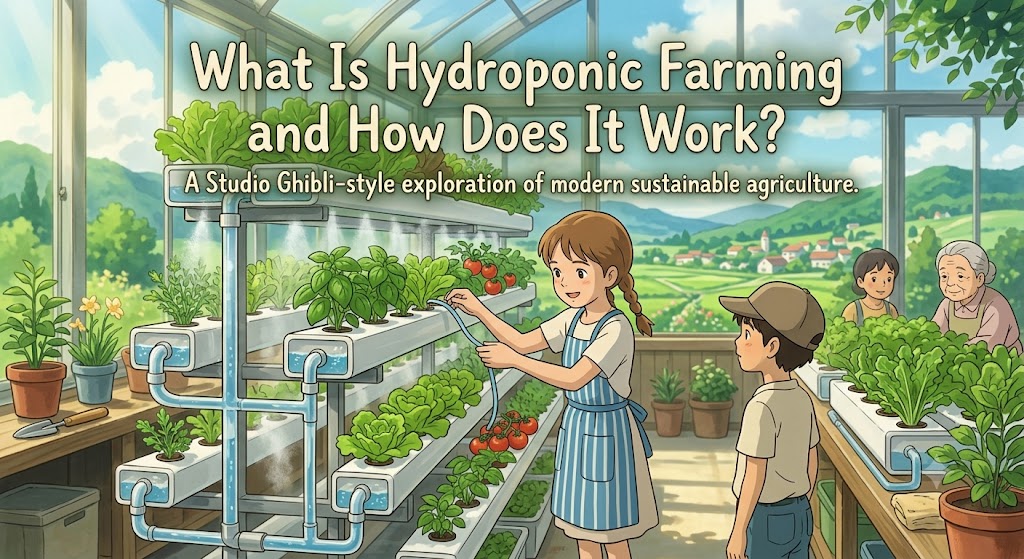
For thousands of years, farming has depended on one essential resource—soil. Every crop, from grains to vegetables, has traditionally been grown by planting seeds in the ground and relying on the soil to supply water and nutrients. But what if plants could grow without soil at all?
That question led to one of the most innovative developments in modern agriculture: hydroponic farming.
Hydroponics is a cultivation method in which plants grow without soil. Instead, their roots receive carefully balanced nutrients through water, allowing crops to grow in a clean, controlled environment. This approach is transforming agriculture by producing fresh vegetables and herbs using less water, less space, and fewer pesticides than many traditional farming systems.
From rooftop gardens in crowded cities to large commercial greenhouses, hydroponic farming is helping farmers and entrepreneurs produce food more efficiently while overcoming challenges such as limited farmland, poor soil quality, and changing climate conditions.
Understanding Hydroponic Farming
Hydroponic farming is a method of growing plants by supplying nutrients directly through water rather than soil.
Although soil normally provides plants with minerals, its main purpose is simply to support the roots. In hydroponic systems, plants receive the same nutrients from specially prepared nutrient solutions while their roots are supported by water or inert growing materials.
Common growing media include:
- Coco coir
- Rockwool
- Perlite
- Vermiculite
- Clay pebbles
These materials provide physical support but do not supply nutrients.
How Does a Hydroponic System Work?
A hydroponic system delivers everything a plant needs in a controlled manner.
The basic process is simple:
- Seeds are germinated.
- Young plants are transferred into a hydroponic setup.
- Roots receive oxygen and nutrient-rich water.
- Pumps circulate the nutrient solution continuously or at scheduled intervals.
- Plants absorb nutrients directly through their roots.
- Excess water is often collected, filtered, and reused.
Because nutrients are immediately available, plants spend less energy searching for food and can devote more energy to growth.
The Main Components of a Hydroponic Farm
Every hydroponic system includes several essential parts.
Growing Structure
Supports the plants while keeping roots properly positioned.
Nutrient Solution
Contains the essential minerals required for healthy plant growth.
Water Reservoir
Stores nutrient-rich water before it circulates through the system.
Water Pump
Moves the nutrient solution to plant roots.
Air Pump
Supplies oxygen to the root zone in certain hydroponic systems.
Lighting
Indoor systems often use LED grow lights when natural sunlight is limited.
Different Types of Hydroponic Systems
Several hydroponic designs are used depending on the crop and production scale.
Deep Water Culture (DWC)
Plant roots remain suspended in oxygenated nutrient water.
Suitable for leafy vegetables.
Nutrient Film Technique (NFT)
A thin stream of nutrient solution flows continuously beneath plant roots.
Commonly used for lettuce and herbs.
Drip Irrigation System
Nutrient solution is delivered directly to each plant through drip lines.
Ideal for tomatoes, peppers, and cucumbers.
Ebb and Flow System
Growing trays are periodically flooded with nutrient solution before draining back into the reservoir.
Provides excellent oxygen availability.
Aeroponics
Roots hang freely in the air and receive nutrient-rich mist.
This advanced system promotes extremely fast growth but requires careful management.
Which Crops Grow Best?
Although hydroponics can produce many different crops, certain plants perform exceptionally well.
Popular choices include:
| Crop | Why It’s Suitable |
|---|---|
| Lettuce | Fast growth |
| Spinach | High productivity |
| Kale | Excellent quality |
| Basil | Strong commercial demand |
| Mint | Continuous harvesting |
| Tomatoes | Premium greenhouse production |
| Bell Peppers | High market value |
| Cucumbers | Good vertical growth |
| Strawberries | Efficient protected cultivation |
| Microgreens | Quick harvest cycles |
These crops often produce consistent yields throughout the year.
Why Farmers Are Choosing Hydroponics
Hydroponic farming offers several important advantages over conventional agriculture.
Water Conservation
Hydroponic systems recycle water, reducing consumption significantly compared to many traditional irrigation methods.
Faster Plant Growth
Direct nutrient delivery allows plants to develop more quickly.
Space Efficiency
Vertical farming systems produce more crops in limited areas.
Fewer Weeds
Without soil, weed growth becomes minimal.
Cleaner Production
Controlled environments reduce contamination from soil-borne diseases.
Year-Round Farming
Greenhouses and indoor systems allow production regardless of season.
Challenges Beginners Should Understand
Although hydroponics offers many benefits, it also requires careful management.
Some common challenges include:
| Challenge | Practical Solution |
|---|---|
| Higher startup costs | Begin with a small system |
| Electricity dependence | Use backup power when possible |
| Nutrient management | Monitor solution regularly |
| Equipment maintenance | Inspect pumps and pipes frequently |
| Technical knowledge | Learn before expanding |
Careful planning helps reduce these challenges.
Is Hydroponic Farming Suitable for Small Farmers?
Yes.
Many small farmers begin with compact hydroponic systems before expanding commercially.
Small-scale hydroponics can be installed:
- Inside greenhouses
- On rooftops
- In backyards
- Inside warehouses
- On small urban farms
Even limited space can produce large quantities of vegetables.
Hydroponics and Sustainable Agriculture
Hydroponic farming supports sustainability by using resources more efficiently.
Environmental benefits include:
- Lower water consumption
- Reduced soil erosion
- Minimal land disturbance
- Lower pesticide requirements
- Efficient fertilizer use
- Reduced transportation when grown near cities
These advantages make hydroponics an attractive solution for future food production.
Common Misconceptions
Many people misunderstand hydroponic farming.
Let’s clarify a few myths.
“Plants Need Soil to Grow”
Plants need nutrients, water, oxygen, and light—not soil itself.
“Hydroponic Food Isn’t Natural”
Plants absorb nutrients in the same mineral form whether they come from soil or a hydroponic nutrient solution.
“Hydroponics Is Only for Large Companies”
Affordable systems now allow hobbyists, students, and small farmers to grow hydroponically.
Looking Toward the Future
Hydroponic farming continues advancing through modern technology.
Future developments include:
- AI-controlled nutrient management
- Automated irrigation
- Smart climate control
- Vertical farming skyscrapers
- Renewable energy integration
- Robotic harvesting systems
These innovations are expected to make hydroponic farming even more productive and sustainable.
Final Thoughts
Hydroponic farming represents one of the most exciting innovations in modern agriculture. By replacing soil with carefully managed water and nutrient solutions, farmers can grow healthy crops using less water, less space, and more precise resource management. Whether producing leafy greens in urban buildings or high-value vegetables inside commercial greenhouses, hydroponics offers practical solutions for the growing demand for fresh food.
Although the system requires careful monitoring and initial investment, its long-term advantages—including higher productivity, cleaner production, and year-round cultivation—make it an increasingly attractive option for both beginners and experienced growers. As technology continues to evolve, hydroponic farming is expected to play an even greater role in the future of sustainable agriculture.
Frequently Asked Questions
1. What is hydroponic farming?
Hydroponic farming is a method of growing plants without soil by supplying nutrients directly through water.
2. Which crops grow best in hydroponic systems?
Lettuce, spinach, basil, tomatoes, cucumbers, strawberries, kale, and microgreens are among the most commonly grown hydroponic crops.
3. Does hydroponic farming use less water?
Yes. Most hydroponic systems recycle water, making them far more water-efficient than many conventional farming methods.
4. Is hydroponic farming suitable for beginners?
Yes. Small starter systems are available that allow beginners to learn hydroponic farming before expanding into commercial production.
5. What are the biggest advantages of hydroponic farming?
The main advantages include faster plant growth, efficient water use, year-round production, reduced weed problems, better space utilization, and improved crop quality.