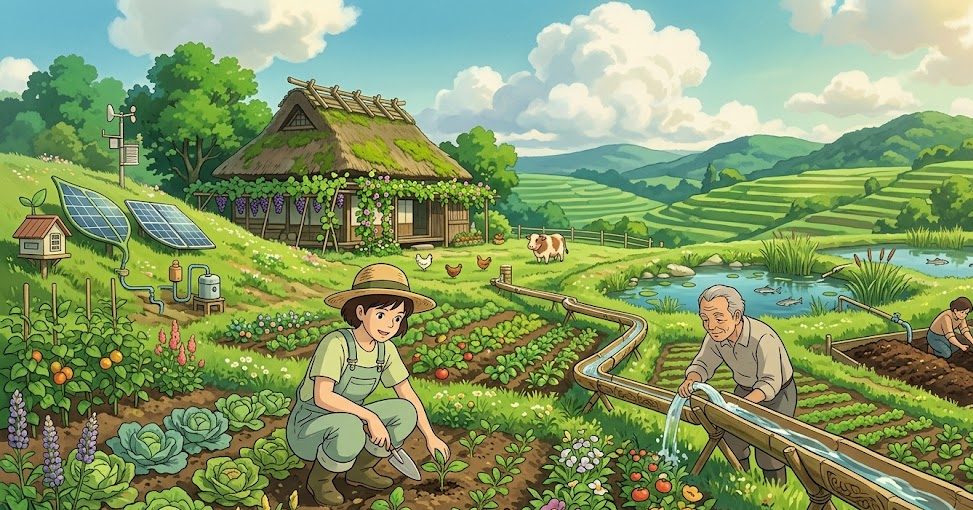
The global agricultural landscape is at a critical crossroads. As we navigate the complexities of 2026, farmers are facing an unprecedented combination of challenges: increasingly unpredictable weather patterns, severe soil degradation, resource scarcity, and rising input costs. The old model of industrial farming—characterized by heavy chemical use and deep tillage—is rapidly losing its economic and environmental viability. In its place, a new agricultural revolution is taking root.
Sustainable farming is no longer just a buzzword for niche organic growers; it is the fundamental future of global food security. Today’s sustainable agriculture blends timeless ecological wisdom with cutting-edge technology to produce higher yields while actively healing the environment. Whether you are managing a massive commercial operation or a specialized local farm, adopting these modern practices is essential for long-term profitability and resilience.
In this comprehensive guide, we will explore the most innovative techniques and best practices driving sustainable farming today.
Precision Agriculture: The Power of Data-Driven Farming
The cornerstone of modern sustainable farming is efficiency. Precision agriculture relies on the principle of treating every square meter of a field uniquely, rather than applying blanket treatments of water, fertilizer, and pesticides across an entire acreage.
AI and IoT Integration
The integration of Artificial Intelligence (AI) and the Internet of Things (IoT) has transformed the modern farm into a data-driven ecosystem. Farmers are now utilizing networks of affordable, low-power soil sensors that monitor moisture, pH, and nutrient levels in real-time. When combined with multispectral drone imagery, AI platforms can instantly identify early signs of crop stress, localized nutrient deficiencies, or pest outbreaks before they become visible to the human eye. This allows for hyper-targeted interventions, drastically reducing the volume of synthetic chemicals introduced into the environment and saving the farmer significant money.
Automated and Smart Machinery
Technological advancements have also revolutionized how we interact with the soil. Autonomous, GPS-guided tractors and robotic weeders are becoming increasingly common in commercial operations. These machines minimize soil compaction by following exact, repeatable paths year after year. Furthermore, computer-vision-guided smart sprayers can differentiate between a cash crop and an invasive weed, delivering micro-doses of herbicide—or using high-powered thermal lasers—only where absolutely necessary. This protects local ecosystems from chemical runoff while lowering operational overhead.
Regenerative Soil Management: Healing the Earth
While basic sustainable farming aims to maintain the status quo, regenerative farming actively improves it. The health of your crop is directly tied to the biological health of your soil. Decades of intensive chemical farming have stripped soils of their natural microbial life, making crops completely dependent on artificial inputs.
No-Till Farming and Cover Cropping
Every time a field is deeply plowed, complex fungal networks are destroyed, and stored soil carbon is released into the atmosphere. No-till or low-till farming practices leave the soil structure intact, allowing these beneficial microbial communities to thrive and naturally aerate the earth.
When paired with cover cropping, the results are transformative. Instead of leaving fields bare and vulnerable to wind and water erosion after the main harvest, sustainable farmers plant cover crops like clover, winter rye, or vetch. These plants act as a living armor for the soil. They suppress weeds naturally, fix atmospheric nitrogen directly into the earth, and increase the soil’s organic matter. Over time, this transforms the soil into a sponge that can hold significantly more water during dry spells.
Biological Inputs and Biofertilizers
One of the most exciting trends in 2026 is the rapid shift away from synthetic agrochemicals toward biological inputs. Leading agricultural innovators are developing advanced biofertilizers using beneficial microbes, such as mycorrhizal fungi and microalgae. These microscopic organisms form symbiotic relationships with plant roots, drastically improving the plant’s ability to absorb water and essential nutrients like phosphorus. By enhancing the plant’s natural immune system through biology rather than chemistry, farmers can reduce their reliance on chemical fungicides, leading to cleaner groundwater and healthier crops.
Water Conservation and Smart Irrigation
Agriculture currently consumes nearly 70% of the world’s accessible freshwater. With climate change causing prolonged droughts and erratic seasonal rainfall, water conservation is a critical pillar of any sustainable farming operation.
Sensor-Based Micro-Irrigation
Traditional flood and overhead sprinkler irrigation are incredibly wasteful, losing massive amounts of water to wind evaporation and deep percolation. The best practice today is the implementation of smart micro-irrigation systems, such as subsurface drip lines.
These systems deliver water directly to the plant’s root zone. When integrated with soil moisture sensors and AI-driven weather forecasting, the irrigation system becomes fully automated. It only waters the plants when the soil moisture drops below a specific threshold and automatically pauses if heavy rain is predicted in the next 24 hours. This level of precision can reduce water usage by up to 50% compared to traditional methods, while simultaneously preventing the nutrient leaching that occurs when fields are over-watered.
Agroforestry: Blending Trees with Agriculture
Agroforestry is an ancient practice making a massive comeback in modern sustainable farming. It involves the intentional integration of trees and shrubs into crop and animal farming systems to create environmental, economic, and social benefits.
By planting rows of timber or fruit-bearing trees alongside traditional crops (a practice known as alley cropping), farmers create diverse, resilient microclimates. The trees act as massive windbreaks, protecting delicate crops from wind damage and reducing topsoil erosion. Their deep root systems pull up nutrients from deep within the earth, making them available to shallower-rooted cash crops. Additionally, agroforestry provides farmers with secondary income streams—such as nuts, fruits, or high-value timber—adding robust financial resilience to their operations.
Controlled Environment Agriculture (CEA)
For regions facing extreme weather volatility, severe land scarcity, or depleted soils, moving operations indoors is becoming the ultimate sustainable solution. Controlled Environment Agriculture (CEA), which includes commercial hydroponics and vertical farming, represents a paradigm shift in how we grow food.
Vertical Farming and Hydroponics
By growing crops in stacked layers using nutrient-rich water solutions instead of soil, vertical farms can produce exponentially more food per square foot than traditional agriculture. Because the indoor environment is strictly controlled, crops can be grown 365 days a year without the risk of late frosts, sudden droughts, or devastating pest infestations.
Most importantly, advanced hydroponic and aeroponic systems recycle their water continuously. A modern vertical farm uses up to 90% less water than a conventional open-field farm and completely eliminates agricultural runoff. While the energy requirements for indoor LED lighting remain a hurdle, the increasing adoption of on-site solar panels and renewable energy grids is rapidly making CEA a highly sustainable, low-carbon way to feed growing urban populations.
Conclusion
The transition to sustainable farming is no longer an optional ethical choice; it is a strict economic and environmental necessity. By embracing innovative techniques like precision agriculture, regenerative soil management, smart irrigation, and advanced biological inputs, farmers can protect their land while simultaneously maximizing their yields.
The agricultural industry in 2026 is proving that technology and nature do not have to be at odds. Instead, when used thoughtfully, data-driven tools can help us understand, support, and mimic natural ecosystems better than ever before. Whether you implement a simple cover crop rotation this season or invest in a fully automated smart irrigation system, every step toward sustainability builds a more resilient and profitable future for your farm and the planet.