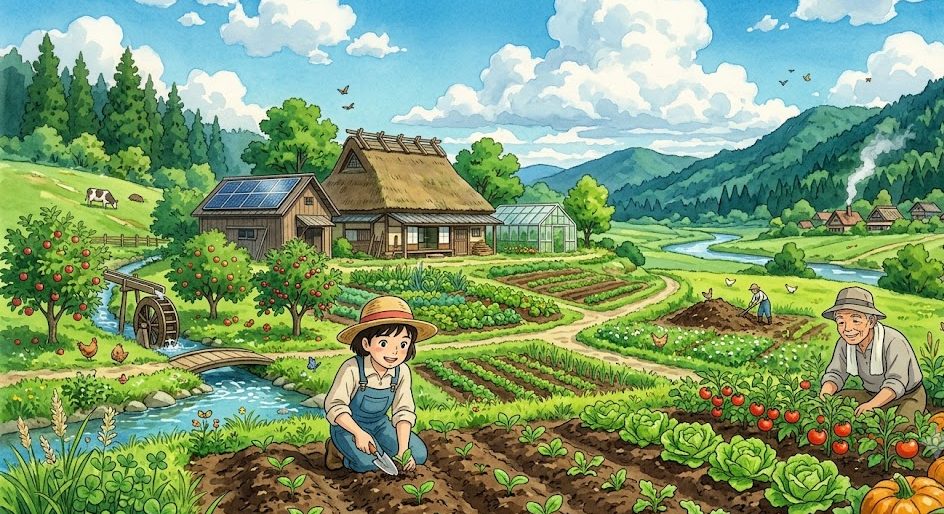
Sustainable farming is not about following one specific agricultural method. It is a broader approach to managing land, water, crops, livestock, energy, and farm finances in a way that supports productive farming over the long term.
For farmers across the United States, sustainability can look different from one operation to another. A large Midwest grain farm may focus heavily on soil erosion, nutrient efficiency, and fuel use, while a vegetable grower in California may place greater emphasis on irrigation, water availability, and soil health. A livestock operation may concentrate on pasture management, manure utilization, grazing systems, and feed efficiency.
The common goal is to use resources carefully while maintaining productive and financially practical farming operations.
Sustainable farming does not require every farm to completely change its production system. In many cases, small improvements—such as reducing unnecessary tillage, improving irrigation timing, planting cover crops, or keeping better records—can gradually make a meaningful difference.
What Does Sustainable Farming Mean?
Sustainable farming means managing agricultural resources with both today’s production and future productivity in mind.
A sustainable farm generally tries to balance three important areas:
Environmental performance — protecting soil, water, air, and ecosystems.
Farm productivity — producing reliable crops or livestock while maintaining the condition of the land.
Economic viability — keeping the operation financially manageable over the long term.
These areas are connected.
For example, healthier soil may improve water retention. Better water management can reduce irrigation costs. Efficient fertilizer use can reduce unnecessary input expenses. Good crop rotation can support soil quality while also helping diversify production.
Sustainability is therefore not simply an environmental concept. It can also be a practical farm-management strategy.
Start With the Soil
Soil is one of the most valuable assets on a farm.
A field may produce crops for many years, but repeated intensive cultivation without proper management can contribute to erosion, compaction, declining organic matter, and poor water movement.
One of the first steps toward sustainable farming is understanding the condition of the soil.
Regular soil testing can provide useful information about nutrient levels and pH. Farmers can then make fertilizer decisions based on actual field conditions instead of applying the same amount everywhere.
Other soil-protection practices include:
- Maintaining soil cover
- Reducing unnecessary disturbance
- Adding suitable organic matter
- Using crop rotations
- Managing traffic to reduce compaction
- Controlling erosion
- Maintaining healthy root systems
Healthy soil is not created in a single season. It is developed through consistent management.
Reduce Unnecessary Tillage
Tillage has an important role in agriculture, but repeated or aggressive soil disturbance can affect soil structure and leave fields more exposed to erosion.
Conservation tillage, reduced tillage, and no-till systems are approaches farmers may consider depending on their crops, equipment, soil type, climate, and weed-management requirements.
Reduced soil disturbance can help preserve soil structure and protect the organisms living within the soil.
However, changing tillage practices should be approached carefully.
A farmer should consider:
- Existing weed pressure
- Soil drainage
- Crop requirements
- Available machinery
- Residue management
- Local weather
- Planting conditions
A method that performs well on one farm may require modification on another.
Keep Soil Covered
Bare soil is vulnerable to wind and water erosion.
Keeping living plants or crop residues on the surface can provide protection between major growing periods.
Cover crops are one practical option.
Depending on the region and farming system, growers may use grasses, legumes, brassicas, or mixtures of different cover crops.
Cover crops can serve several purposes, including protecting the soil surface, supporting organic matter, improving nutrient cycling, and providing living roots during periods when a main crop is not being grown.
The right cover crop should be selected according to local climate, planting window, water availability, and the next crop.
Improve Water Efficiency
Water management is one of the most important parts of sustainable farming.
Using more water than necessary can increase operating costs and place additional pressure on local water resources.
Efficient irrigation begins with knowing how much water the crop actually needs.
Farmers can improve irrigation management by using:
- Soil-moisture monitoring
- Weather information
- Improved irrigation scheduling
- Drip systems where appropriate
- Efficient sprinklers
- Properly maintained irrigation lines
- Field-leveling techniques
- Mulches for suitable crops
Irrigation equipment should also be inspected regularly.
Leaks, blocked emitters, broken sprinkler components, and uneven application can waste significant amounts of water.
Instead of asking only, “How much water can the system deliver?” sustainable irrigation asks, “How much water does the crop actually need?”
Use Fertilizer More Precisely
Fertilizer is an important agricultural input, but excessive application does not necessarily result in better crop production.
A more sustainable approach is to match nutrient applications with crop requirements and field conditions.
Soil testing can help determine existing nutrient levels.
Farmers can then consider:
- Crop nutrient requirements
- Expected yield
- Soil characteristics
- Previous crop
- Manure applications
- Available organic nutrients
- Timing of fertilizer applications
Precision agriculture can take this approach further by allowing different areas of a field to receive different application rates.
This can reduce unnecessary input use while maintaining crop nutrition.
Make Crop Rotation Part of the Farm Plan
Growing the same crop repeatedly can create management challenges.
Crop rotation changes the biological and nutritional conditions of a field over time.
For example, a farmer may alternate crops with different nutrient requirements, root structures, or pest relationships.
Legumes can be useful in some rotations because of their relationship with nitrogen-fixing bacteria.
Rotation can also help break certain pest and disease cycles.
The ideal rotation depends on the farm’s climate, market opportunities, soil type, machinery, and crop choices.
A good rotation should make sense not only agronomically but also economically.
Use Integrated Pest Management
Sustainable farming does not mean ignoring insects, weeds, or plant diseases.
Instead, growers can use Integrated Pest Management, commonly known as IPM, to manage problems using a combination of monitoring, prevention, biological methods, cultural practices, mechanical control, and chemical tools when appropriate.
The first step is accurate identification.
A farmer should know what organism is causing the problem before deciding how to respond.
Regular field scouting can help identify developing problems before they become severe.
Other useful practices may include:
- Crop rotation
- Resistant varieties
- Weed management
- Beneficial insect conservation
- Field sanitation
- Targeted treatments
- Monitoring pest populations
The goal is not simply to eliminate every insect. It is to manage economically important problems while avoiding unnecessary interventions.
Protect Beneficial Insects and Wildlife
Agricultural land can also provide habitat for pollinators, birds, beneficial insects, and other organisms.
Hedgerows, buffer areas, flowering plants, field borders, and carefully managed natural areas can contribute to farm biodiversity.
Beneficial insects can be particularly useful because some species prey on agricultural pests.
Farmers can consider maintaining suitable habitat while ensuring that these areas do not interfere with essential field operations.
Biodiversity should be viewed as part of the broader farm ecosystem rather than something completely separate from agricultural production.
Manage Farm Energy Efficiently
Energy use can represent a significant operating expense.
Pumps, tractors, dryers, refrigeration systems, ventilation equipment, lighting, and processing machinery can all consume energy.
Efficiency improvements can begin with basic maintenance.
Poorly maintained engines and pumps may use more fuel or electricity than necessary.
Farmers can also consider:
- Efficient motors
- Proper pump sizing
- Preventive equipment maintenance
- Reduced unnecessary field passes
- Efficient lighting
- Solar energy where practical
- Improved insulation for controlled environments
Renewable energy can be valuable, but it should be evaluated based on installation cost, available incentives, energy demand, and expected long-term savings.
Reduce Machinery Use When Practical
Every additional tractor pass across a field consumes fuel, takes labor time, and can contribute to soil compaction.
Better farm planning can reduce unnecessary trips.
Combining operations where practical, improving field logistics, using GPS guidance, and planning maintenance can increase machinery efficiency.
Precision guidance systems can help reduce overlap during planting, spraying, and fertilizer application.
This can save inputs while making field operations more consistent.
Use Technology to Improve Decision-Making
Modern sustainable agriculture increasingly relies on data.
Farmers can use technology to monitor:
- Soil moisture
- Weather
- Crop growth
- Irrigation
- Fertilizer applications
- Machinery activity
- Field conditions
- Yield
- Input costs
Satellite imagery and drones can also provide additional information about crop conditions in suitable situations.
The goal should not be to purchase technology simply because it is new.
Technology is useful when it helps answer a practical question.
For example:
“Which part of the field needs irrigation?”
“Where is crop growth weaker?”
“Which areas consistently produce lower yields?”
“Where are fertilizer applications being wasted?”
Good technology turns observations into better decisions.
Turn Farm Waste Into a Resource
Agricultural operations naturally generate organic materials.
Crop residues, manure, damaged produce, and other materials can sometimes be reused instead of treated simply as waste.
Livestock manure can provide nutrients when appropriately managed.
Crop residues may protect soil or contribute organic matter.
Some farms can use composting systems to convert suitable organic materials into a useful soil amendment.
Waste management must still be handled carefully. Poorly managed manure or organic waste can create odor, water-quality, and environmental problems.
The goal is controlled reuse rather than simply moving waste from one location to another.
Improve Livestock Sustainability
Sustainable farming also applies to livestock operations.
Well-managed grazing systems can help prevent overgrazing and protect pasture condition.
Farmers can monitor:
- Pasture recovery
- Forage availability
- Animal health
- Water access
- Manure distribution
- Stocking levels
Rotational grazing can allow portions of pasture to recover while livestock use another area.
Livestock operations can also improve efficiency through better feed management, animal monitoring, manure management, and appropriate pasture planning.
The correct system depends heavily on the animal species, land type, climate, and farm goals.
Plan for Soil and Water Protection
Fields located near streams, rivers, wetlands, or drainage areas require additional attention.
Vegetated buffer areas can help reduce soil movement and intercept some runoff before it reaches waterways.
Contour-based farming, grassed waterways, terraces, and other conservation practices may also be appropriate in certain landscapes.
Farmers should select erosion-control methods based on the actual terrain rather than applying the same solution everywhere.
Preventing soil loss is usually easier than trying to rebuild severely eroded land later.
Build a More Diverse Farm
Diversification can improve resilience.
A farm that depends completely on one crop or one market may be more vulnerable to changes in weather, prices, disease, or demand.
Diversification can take many forms:
- Multiple crops
- Livestock
- Specialty crops
- Direct sales
- Value-added products
- Seasonal production
- Agritourism
- On-farm processing
Not every farm needs all of these options.
The important point is to build a business model that matches available resources and management capacity.
Adding another enterprise only makes sense if the expected benefits justify the additional labor, equipment, and complexity.
Measure What You Improve
Sustainability becomes much more useful when farmers measure results.
A farm can track indicators such as:
- Water used per acre
- Fertilizer applied
- Fuel consumption
- Crop yield
- Soil-test results
- Input costs
- Machinery hours
- Irrigation efficiency
- Crop losses
- Revenue per crop
Records make it easier to compare one season with another.
For example, if a farmer changes irrigation scheduling, measuring water use and crop performance can show whether the change actually helped.
Sustainable farming should be based on evidence rather than assumptions.
A Practical Sustainability Plan for a Farm
Farmers who want to make their operation more sustainable do not need to change everything at once.
A simple approach is to divide improvements into stages.
Stage One: Identify Problems
Start by looking for the largest sources of waste or risk.
This could be soil erosion, excessive irrigation, fertilizer losses, fuel consumption, or poor crop planning.
Stage Two: Choose One or Two Improvements
Select changes that are realistic for the farm’s resources.
Stage Three: Track Results
Record costs, labor, water use, crop performance, and other relevant information.
Stage Four: Compare the Results
Determine whether the change produced a meaningful improvement.
Stage Five: Expand What Works
If a practice performs well, consider using it across a larger portion of the operation.
This gradual approach reduces risk and makes sustainable farming more manageable.
Common Mistakes to Avoid
Sustainability can become unnecessarily complicated when farmers focus on trends instead of practical results.
Some common mistakes include:
- Adopting technology without a clear purpose
- Changing too many practices at once
- Ignoring local soil and weather conditions
- Assuming sustainable methods require zero inputs
- Choosing practices without calculating costs
- Failing to monitor results
- Expanding before a new system is proven
- Ignoring the economic side of sustainability
A sustainable farm must remain productive and financially viable.
The Long-Term Goal
The strongest sustainable farming systems are not built around one technique.
They combine multiple practices that support one another.
Healthy soil can improve water management. Efficient irrigation can reduce costs. Crop rotation can support soil and pest management. Better records can improve financial decisions. Technology can help farmers identify where resources are being used inefficiently.
Over time, these individual improvements can become part of a more resilient farm-management system.
Final Thoughts
Sustainable farming is ultimately about making thoughtful decisions with the future of the farm in mind.
Protecting soil, using water efficiently, improving fertilizer management, reducing unnecessary fuel use, supporting biodiversity, managing pests carefully, and tracking farm performance can all contribute to a more efficient operation.
There is no universal sustainability formula for every farm in the United States. A practice that works well in Iowa may need significant adjustment in California, Texas, Florida, or another region.
The most practical strategy is to start with the farm’s biggest challenges, introduce realistic improvements, measure the results, and expand the practices that provide genuine value.
Sustainability is not a single destination. It is an ongoing process of improving how a farm uses its land, resources, technology, labor, and knowledge while maintaining productive agriculture for the years ahead.