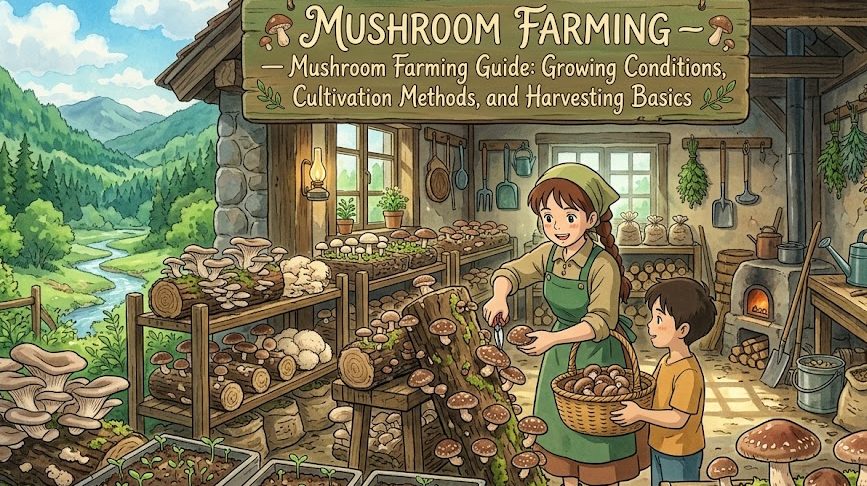
Mushroom farming is a unique form of agriculture because mushrooms are grown differently from conventional field crops. Instead of depending on sunlight and soil to produce leaves, stems, fruits, or grains, cultivated mushrooms grow from a fungal network called mycelium. The grower provides the right substrate, moisture, temperature, humidity, fresh air, and sanitation conditions so the mushroom culture can develop and eventually produce edible fruiting bodies.
In the United States, mushroom production ranges from large commercial operations to small specialty farms and indoor growing businesses. Mushrooms can be cultivated in controlled rooms, greenhouses, converted buildings, agricultural structures, or smaller dedicated growing spaces.
The process can look complicated at first, but it becomes much easier to understand when it is divided into a few basic stages. Choosing an appropriate mushroom variety, preparing a suitable growing material, allowing the mycelium to colonize, creating fruiting conditions, and harvesting at the correct time are the foundation of the process.
This guide explains the major principles behind mushroom farming and the practical considerations growers should understand before starting.
Understanding How Mushrooms Grow
Mushrooms are fungi rather than traditional plants. They do not depend on roots, leaves, and photosynthesis in the same way that vegetables do.
The main growing structure is called mycelium. It consists of a network of fine fungal threads that spread through a suitable growing material.
When the mycelium has established itself and environmental conditions become appropriate, it can produce mushrooms. These visible mushrooms are the fruiting bodies of the fungus.
This difference is important because mushroom farming is largely about managing an environment rather than simply planting seeds.
A successful grower must pay attention to:
- Growing substrate
- Moisture
- Temperature
- Humidity
- Fresh-air exchange
- Light requirements
- Cleanliness
- Mushroom variety
- Timing
Small environmental changes can influence how quickly mushrooms develop and what their final quality looks like.
Choosing the Right Mushroom Variety
Not every mushroom requires the same growing conditions.
For beginners in the United States, some varieties are particularly interesting because they can be cultivated in controlled environments and have established culinary markets.
Oyster Mushrooms
Oyster mushrooms are commonly used by small-scale growers because they can grow on several suitable agricultural materials and have relatively fast production cycles under appropriate conditions.
They are available in different colors and forms, including white, gray, yellow, and pink varieties.
Lion’s Mane
Lion’s mane has become popular among specialty mushroom growers and chefs because of its distinctive appearance and texture.
The mushroom develops hanging spines rather than the traditional cap-and-stem appearance many people associate with mushrooms.
It can be grown indoors on suitable prepared substrates.
Shiitake
Shiitake is an important cultivated mushroom with a strong culinary market.
It can be produced using prepared blocks or traditional wood-based methods. Log cultivation can take considerably longer, while indoor block production provides growers with more control over timing.
White and Brown Button Mushrooms
Button mushrooms are widely consumed and are produced commercially at significant scale.
However, their production involves more specialized environmental and substrate management than some beginner-friendly specialty mushrooms.
For a new grower, starting with a manageable specialty variety can make it easier to learn the basics.
Selecting a Growing Substrate
Mushrooms need a suitable material on which their mycelium can grow.
This material is called the substrate.
Different mushroom species prefer different substrates. Depending on the species and production method, growers may work with materials such as:
- Hardwood sawdust
- Wood-based pellets
- Straw
- Agricultural byproducts
- Prepared commercial mushroom blocks
- Hardwood logs
The substrate needs to provide an appropriate physical and nutritional environment for the selected mushroom.
It also needs to hold enough moisture without becoming excessively wet.
Choosing a substrate based only on availability can create problems. A material that works well for one mushroom may not be appropriate for another.
Spawn: The Starting Point for Cultivation
Mushroom spawn is material containing established mycelium that is used to inoculate a growing substrate.
In simple terms, spawn provides the fungal culture that will spread through the prepared growing material.
For beginners, purchasing reliable spawn from an established supplier can be easier than attempting to produce it independently.
Good-quality spawn should be handled carefully and kept under appropriate storage conditions according to supplier recommendations.
The goal is to give the desired mushroom culture a strong starting point while minimizing contamination risks.
Preparing the Growing Material
Substrate preparation is one of the most important stages in mushroom cultivation.
Depending on the material being used, the preparation process may involve chopping, hydrating, heating, pasteurizing, sterilizing, or mixing the substrate with other materials.
The exact method depends heavily on the mushroom species and substrate.
The objective is not simply to make the substrate wet. The grower needs to create a material that supports the target fungus while reducing the opportunity for unwanted organisms to take over.
Commercial growers often use specialized equipment and carefully controlled procedures for this reason.
Small growers can begin with simpler methods, but sanitation and consistency remain important.
Colonization: Letting the Mycelium Take Over
After inoculation, the mushroom mycelium needs time to spread throughout the substrate.
This period is known as colonization.
During colonization, the growing material may gradually become covered by the developing mycelium. The speed of colonization depends on the mushroom species, spawn quality, substrate, temperature, moisture, and other environmental conditions.
The growing area should be monitored without unnecessary disturbance.
One of the biggest problems at this stage is contamination. Other fungi or microorganisms can compete with the desired mushroom.
Signs of contamination can include unusual colors, unpleasant odors, unexpected growth patterns, or changes that do not match the expected appearance of the mushroom culture.
When contamination is suspected, growers should isolate the affected material rather than allowing it to spread throughout the growing area.
Creating the Fruiting Environment
Colonization is only one part of mushroom production.
Once the substrate has been sufficiently colonized, environmental conditions may need to change to encourage fruiting.
This stage can involve adjusting:
- Temperature
- Humidity
- Fresh-air exchange
- Light
- Surface moisture
- Growing-space conditions
Different mushrooms respond differently to these factors.
For example, some varieties need increased fresh-air exchange as they begin forming mushrooms. Others may respond strongly to humidity and surface moisture.
This is why growers should follow species-specific cultivation guidance rather than applying the same environmental settings to every mushroom.
The Importance of Humidity
Mushrooms contain a high percentage of water, so moisture management is extremely important.
If the growing environment becomes too dry, developing mushrooms may struggle to form properly.
If the environment remains excessively wet without adequate airflow, other problems can develop.
The goal is to maintain a balanced environment that supports mushroom development without creating constantly wet surfaces or stagnant air.
Humidity should be monitored rather than estimated simply by how the room feels.
Commercial and serious hobby growers may use humidity sensors and automated humidification systems to maintain more consistent conditions.
Fresh Air and Carbon Dioxide
Air exchange is another major factor in mushroom cultivation.
As mycelium grows and mushrooms develop, the growing culture produces carbon dioxide. If the growing space does not receive enough fresh air, carbon dioxide can accumulate.
High carbon dioxide levels can influence mushroom shape and development in certain species.
Fresh-air exchange therefore needs to be considered alongside humidity.
Simply increasing ventilation is not always the solution, however. Excessive airflow can dry the growing environment.
Good mushroom farming is often about finding the right balance between humidity and fresh air.
Lighting Requirements
Mushrooms do not use light in the same way that green plants use sunlight for photosynthesis.
However, some cultivated mushrooms can still benefit from appropriate light exposure during the fruiting stage.
The exact requirements vary by species.
For indoor farms, growers may use simple artificial lighting on a controlled schedule. The purpose is generally to support normal development and provide environmental consistency rather than to supply energy through photosynthesis.
This makes mushroom production particularly suitable for indoor growing spaces where natural sunlight may be limited.
Indoor Mushroom Farming
Indoor production offers growers significant environmental control.
A small growing room can be divided into areas for different stages, such as:
- Substrate preparation
- Inoculation
- Colonization
- Fruiting
- Harvesting
- Packing
Separating these activities can help reduce contamination and make daily operations more organized.
The growing room does not necessarily need to be large. Even a relatively compact area can produce mushrooms when the space is used efficiently.
However, the building should be suitable for cleaning, ventilation, temperature management, and moisture control.
Greenhouse and Specialty Growing Spaces
Traditional greenhouses are designed primarily around sunlight and plant cultivation, so they are not automatically ideal for mushroom farming.
Mushrooms generally require different environmental management.
Some growers may use modified agricultural structures, insulated rooms, shipping containers, basements, or purpose-built indoor spaces instead.
The important question is not whether a structure looks like a traditional farm building. It is whether the space can reliably provide the environmental conditions required by the mushroom variety.
Harvesting Mushrooms at the Right Time
Harvest timing affects appearance, texture, shelf life, and market quality.
Mushrooms should generally be harvested according to the characteristics of the particular species.
Waiting too long can cause mushrooms to become less attractive or alter their texture. Harvesting too early can reduce the usable size and potential yield.
Growers should learn the visual signs of maturity for their chosen variety.
A clean harvesting process is also important. Tools, hands, containers, and work surfaces should be kept appropriately clean to reduce contamination and protect product quality.
Handling and Storage After Harvest
Fresh mushrooms are highly perishable compared with many shelf-stable agricultural products.
After harvesting, they should be handled carefully and moved into suitable storage conditions as quickly as practical.
Avoid unnecessary crushing or excessive handling.
Packaging should protect mushrooms while allowing appropriate moisture management. Different mushroom varieties may have different packaging requirements.
For a small farm, post-harvest planning should begin before the first crop is produced.
A grower should know:
- Who will buy the mushrooms?
- How much can they purchase?
- How often do they need deliveries?
- What packaging do they prefer?
- What quality standards do they expect?
Production without a clear sales plan can create unnecessary waste.
Selling Mushrooms in the United States
Small mushroom farms can explore several potential markets depending on local rules and demand.
Possible customers include:
- Restaurants
- Local grocery stores
- Farmers markets
- Specialty food shops
- Direct household customers
- Food cooperatives
- Local chefs
Specialty mushrooms can be particularly interesting for direct markets because customers may value freshness and locally grown products.
However, growers should research their state’s and local area’s food-production, packaging, labeling, licensing, and market requirements before selling commercially.
Regulations can vary depending on the product and sales channel.
Managing Costs
Mushroom farming can look inexpensive at first because production can take place in relatively small spaces.
However, the complete cost can include much more than spawn and substrate.
Important expenses may include:
- Growing containers
- Shelving
- Humidification
- Ventilation
- Temperature control
- Lighting
- Cleaning supplies
- Packaging
- Refrigeration
- Labor
- Electricity
- Water
- Substrate
- Spawn
- Delivery
Before expanding, growers should calculate the cost per growing block or production batch.
Tracking actual yield and sales price provides a much clearer picture than estimating profitability from production volume alone.
Common Problems New Growers Face
Mushroom cultivation is highly manageable once the basics are understood, but beginners often encounter several predictable problems.
Contamination
Contamination can compete with the desired mushroom and reduce production.
Clean procedures and careful handling are essential.
Incorrect Moisture
Too little moisture can slow development, while excessive moisture can create other environmental problems.
Poor Air Exchange
Insufficient fresh air can influence mushroom shape and development.
Inconsistent Temperature
Large temperature fluctuations can interfere with predictable production.
Overcrowding
Placing too many growing blocks in a small room can make humidity, airflow, harvesting, and sanitation more difficult.
Expanding Too Quickly
Producing a small successful batch is very different from managing hundreds of growing blocks.
New growers should expand only after they understand the labor and environmental requirements of their existing operation.
A Practical Beginner’s Approach
Someone interested in mushroom farming can reduce unnecessary risk by starting with a small controlled project.
Choose one mushroom variety and learn its specific requirements.
Purchase quality spawn from a reputable supplier.
Use a manageable substrate and prepare a limited number of growing blocks.
Monitor the environment daily.
Record colonization time, fruiting performance, contamination, harvest weight, and product quality.
After completing several production cycles, compare the results.
This approach makes it easier to identify what needs improvement before money is invested in a larger growing facility.
Final Thoughts
Mushroom farming is a specialized agricultural activity that combines biological knowledge with careful environmental management. Unlike conventional crops, mushrooms do not depend on traditional soil or sunlight for their main growing process, making them suitable for a variety of indoor and controlled environments.
Successful cultivation begins with selecting an appropriate mushroom variety and substrate. From there, growers need to manage colonization, humidity, fresh air, temperature, cleanliness, and fruiting conditions.
Harvesting at the right stage and handling the crop carefully are equally important because fresh mushrooms have a limited shelf life.
For beginners in the United States, starting small is often the most practical strategy. A few successful production cycles can teach more than purchasing a large amount of equipment at the beginning.
With consistent environmental control, good sanitation, careful record keeping, and a realistic sales plan, mushroom farming can become an interesting addition to a diversified agricultural operation or a specialized small-scale growing business.