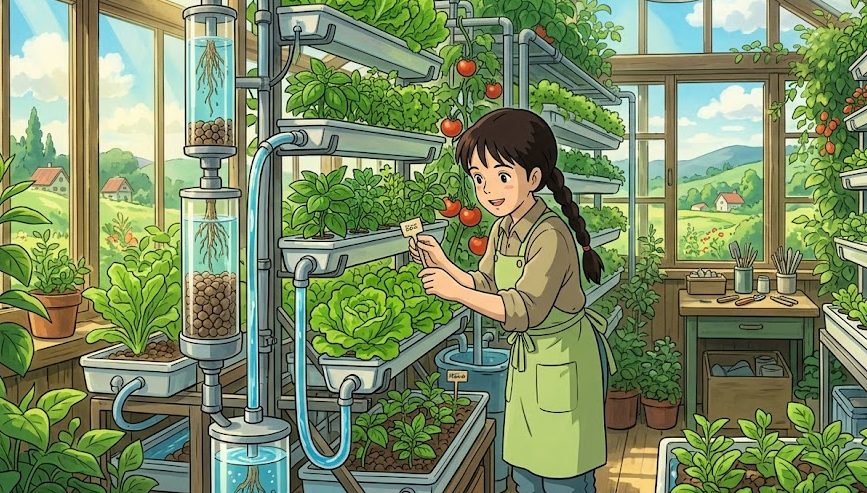
Hydroponic farming is changing the way people think about growing plants. Instead of depending on traditional garden soil, hydroponic systems provide plants with water, nutrients, oxygen, light, and physical support in a carefully managed growing environment. This approach can be used in a backyard greenhouse, indoor growing room, commercial facility, or even a small apartment setup.
In the United States, hydroponics has attracted attention from home gardeners, urban growers, small businesses, schools, and commercial farms. One reason is flexibility. Plants can be grown in places where good agricultural soil is limited, including rooftops, warehouses, greenhouses, and other controlled environments.
However, hydroponics is not simply a matter of putting plants into water. Successful growing requires an understanding of plant requirements, water quality, nutrient management, lighting, temperature, airflow, and regular observation.
This guide explains how hydroponic farming works, what equipment is needed, which crops are suitable, and how beginners can build a reliable growing routine.
What Is Hydroponic Farming?
Hydroponics is a method of growing plants without traditional soil. Instead, the plant’s roots receive water and dissolved nutrients directly through a growing system.
Plants still need many of the same basic requirements they would receive from soil:
- Water
- Nutrients
- Oxygen around the roots
- Light
- Suitable temperature
- Carbon dioxide from the surrounding environment
- Physical support
Traditional soil acts as both a support structure and a reservoir for water and nutrients. In hydroponics, these functions are handled by the growing system.
Some systems keep roots directly in nutrient-rich water, while others periodically deliver nutrient solution to the roots. In many setups, an inert growing medium such as coco coir, clay pebbles, rockwool, or perlite provides physical support without supplying significant nutrients itself.
The main idea is simple: give plants what they need while controlling the environment more precisely.
Why Grow Plants Hydroponically?
One of the biggest attractions of hydroponics is control.
A traditional garden depends heavily on soil conditions and weather. Hydroponic growers can control many important factors more directly. Water, nutrients, lighting, and root-zone conditions can be monitored and adjusted according to the crop.
Hydroponics can also make productive use of limited spaces. A grower does not necessarily need a large field. Vertical systems can use available indoor or greenhouse space efficiently.
Other potential advantages include:
- Efficient use of water through recirculating systems
- Consistent access to nutrients
- Reduced dependence on agricultural soil
- Ability to grow in urban environments
- Better control over growing conditions
- Potential for year-round production in controlled environments
- Easier monitoring of individual growing systems
These advantages do not automatically guarantee better results. Hydroponic farming requires technical management, and equipment failures can affect plants quickly.
Choosing the Right Hydroponic System
There is no single hydroponic system that works for every grower. The best option depends on available space, budget, crop type, experience, and desired production level.
Deep Water Culture
Deep Water Culture, often called DWC, is one of the simpler systems for beginners.
Plants are supported above a container while their roots extend into nutrient-rich water. An air pump and air stone provide oxygen to the root zone.
DWC can work particularly well for leafy greens and herbs.
Its main advantage is simplicity, but the system depends heavily on proper aeration and water management.
Nutrient Film Technique
Nutrient Film Technique, or NFT, moves a thin stream of nutrient solution through channels where plant roots are located.
The solution flows along the channel and returns to a reservoir.
NFT can be useful for crops such as lettuce and herbs because it allows multiple plants to grow in relatively compact spaces.
A major consideration is pump reliability. If circulation stops for an extended period, exposed roots can dry out.
Ebb and Flow
An ebb-and-flow system periodically floods the growing area with nutrient solution and then allows it to drain back into a reservoir.
This creates cycles of hydration and air exposure around the roots.
The system can support a variety of crops, but it requires careful control of flood timing, drainage, and reservoir capacity.
Drip Hydroponics
Drip systems deliver nutrient solution directly to individual plants through small emitters.
This approach provides flexibility because each plant can receive targeted irrigation.
Drip systems are widely adaptable and can be used with different growing media and crop sizes. However, clogged emitters and uneven water delivery can create problems if the system is not maintained.
Aeroponics
Aeroponic systems suspend plant roots in the air and deliver nutrient solution as a fine spray or mist.
This can provide excellent access to oxygen and nutrients, but the equipment is generally more complex.
Because the roots depend on consistent misting, pump or nozzle problems can become serious quickly.
For beginners, a simpler system is usually easier to manage.
Selecting Crops for a Hydroponic Garden
Crop selection should be based on both plant characteristics and the grower’s experience.
Leafy greens are among the easiest crops to start with. Lettuce, kale, spinach, arugula, and similar crops can perform well in many hydroponic systems.
Herbs are another popular category. Basil, mint, cilantro, parsley, and other herbs can be grown in suitable systems when temperature, light, and nutrients are properly managed.
Some fruiting crops can also be grown hydroponically, including:
- Tomatoes
- Cucumbers
- Peppers
- Strawberries
However, these crops generally require more space, stronger support structures, careful pruning, and more demanding nutrient management.
For a first project, starting with fast-growing leafy greens or herbs can make it easier to learn how the system behaves.
Understanding Water Quality
Water is one of the most important components of hydroponics because it becomes the carrier for dissolved nutrients.
Tap water can vary significantly from one location to another. Some water supplies may contain minerals or other characteristics that influence nutrient management.
Growers should understand their starting water before adding nutrients.
Two important measurements are pH and electrical conductivity, commonly abbreviated as EC.
pH describes how acidic or alkaline the nutrient solution is. Different crops have different preferred ranges, so growers should follow crop-specific guidance rather than using one number for everything.
EC provides an indication of the concentration of dissolved salts in the solution. It can help growers understand whether the nutrient solution is becoming too weak or too concentrated.
Monitoring these values regularly can prevent many avoidable problems.
Providing the Right Nutrients
Plants require nutrients to produce leaves, roots, flowers, and fruit. In traditional soil, nutrients come from soil reserves and organic matter or fertilizers. Hydroponic systems must provide them through the nutrient solution.
Commercial hydroponic nutrients are commonly available in different formulations for different growth stages and crops.
A basic nutrient program may provide major nutrients such as:
- Nitrogen
- Phosphorus
- Potassium
- Calcium
- Magnesium
- Sulfur
Plants also require smaller amounts of several micronutrients.
More fertilizer is not necessarily better. Excessive nutrient concentration can stress roots and interfere with normal plant growth.
Instead of constantly adding nutrients based on guesswork, growers should follow the product’s instructions, monitor the system, and adjust according to plant performance and water measurements.
Lighting for Indoor Hydroponics
Outdoor hydroponic systems can use sunlight, but indoor systems require artificial lighting.
LED grow lights are widely used because they can provide controlled light while producing less heat than some older lighting technologies.
The correct lighting setup depends on:
- Crop type
- Growing area
- Plant height
- Light intensity
- Daily lighting period
- Distance between plants and fixtures
A common mistake is assuming that simply installing a bright light will solve every lighting problem.
Too little light can produce weak, stretched plants. Excessive intensity or heat can also stress plants.
The goal is to create a consistent lighting environment appropriate for the crop.
Temperature, Humidity, and Airflow
Hydroponic plants still respond strongly to their surrounding environment.
Temperature affects plant growth, water consumption, nutrient uptake, and root health. Humidity influences how quickly plants lose water through their leaves.
Air movement is also important.
A small fan can help circulate air around plants, strengthen stems, and reduce stagnant pockets of humidity. In larger indoor systems, growers may use ventilation, dehumidification, cooling, or heating equipment depending on the environment.
Instead of trying to maintain one perfect environment for every crop, growers should learn the preferred conditions of the plants they are growing.
Root Health Is a Major Priority
Healthy roots are the foundation of a successful hydroponic system.
Roots need access to both water and oxygen. If roots remain poorly oxygenated, plants can become stressed and growth may slow.
Common warning signs include:
- Wilting despite adequate water
- Unusual root discoloration
- Slow growth
- Leaf yellowing
- Unpleasant odors from the reservoir
- Weak or damaged roots
Clean equipment and good water circulation can help reduce problems.
The reservoir, tubing, pumps, growing containers, and other components should be inspected regularly.
Managing Light and Plant Spacing
Hydroponic systems can make it tempting to place plants very close together.
However, overcrowding can create problems. Plants compete for light and airflow, while dense foliage can make inspection and maintenance more difficult.
Spacing should be planned according to the mature size of each crop rather than its size as a young plant.
Leafy greens may require less structural support, while tomatoes and cucumbers can become large and need trellising.
Good spacing makes harvesting easier and can improve airflow throughout the growing area.
Cleaning and Maintenance
Hydroponics requires routine maintenance.
A small problem in a traditional garden may develop slowly, but a problem in a controlled hydroponic system can sometimes affect many plants quickly.
A useful maintenance routine can include:
Daily checks
- Look at plant condition
- Check water levels
- Observe pumps and airflow
- Look for visible pest problems
- Check for leaks
Weekly checks
- Inspect roots where accessible
- Check nutrient measurements
- Clean filters or system components
- Inspect tubing and emitters
- Remove damaged leaves
Periodic maintenance
- Clean reservoirs
- Sanitize suitable equipment between growing cycles
- Inspect pumps and electrical connections
- Replace worn components
- Review growing records
Keeping simple records can make troubleshooting much easier.
Managing Pests in Hydroponic Systems
Growing without soil does not mean plants are completely protected from pests.
Indoor and greenhouse crops can still experience insects such as aphids, whiteflies, fungus gnats, thrips, and other pests.
Early detection is extremely valuable.
Inspect the underside of leaves, growing tips, stems, and nearby surfaces. Sticky traps can also help monitor certain flying insects.
Good sanitation, clean planting material, proper airflow, and regular observation are important parts of an integrated pest-management approach.
When a pest problem appears, identify the pest before selecting a control method.
Hydroponics in Different Parts of the United States
The flexibility of hydroponics can be especially useful across the diverse growing conditions found in the United States.
A grower in Arizona may be more concerned with heat and water management, while an indoor grower in Minnesota may focus heavily on heating and artificial lighting during colder months.
In Florida, humidity and ventilation can become major considerations. In urban areas such as New York, Chicago, or Los Angeles, space efficiency may be more important than access to large outdoor land.
This is why hydroponic planning should be based on the local environment rather than copying another grower’s setup exactly.
Starting a Small Hydroponic Farm
Beginners do not need to start with a large commercial facility.
A small system can provide valuable experience before major investments are made.
A practical starting approach is:
Step 1: Choose one or two crops.
Avoid managing many different crops at the beginning.
Step 2: Select a simple system.
Choose a design that is easy to inspect, clean, and repair.
Step 3: Calculate the available space.
Measure the area and plan around mature plant size.
Step 4: Set up water and electricity safely.
Keep electrical equipment protected from water and use appropriate safety practices.
Step 5: Establish a monitoring routine.
Record water conditions, nutrient measurements, plant growth, and environmental observations.
Step 6: Learn from one complete growing cycle.
Do not change everything at once. Understand what worked and what did not.
Step 7: Expand gradually.
Once the basic system is reliable, additional growing channels or crops can be considered.
Common Hydroponic Mistakes
Many hydroponic problems come from trying to make the system more complicated than necessary.
One common mistake is adding too much fertilizer. Another is ignoring water temperature or root oxygenation.
Other problems include:
- Poor cleaning routines
- Incorrect plant spacing
- Weak lighting
- Unstable pH
- Clogged irrigation lines
- Ignoring small leaks
- Using unsuitable growing media
- Overwatering certain systems
- Failing to monitor plants regularly
- Expanding before the first system is stable
Hydroponics rewards consistency more than constant experimentation.
Is Hydroponic Farming Worth It?
Hydroponics can be an excellent growing method, but its value depends on the crop, location, system design, labor requirements, energy costs, and market.
For home growers, the attraction may be fresh produce and year-round growing.
For small farms, hydroponics can provide an opportunity to produce specialty greens, herbs, or other crops in controlled environments.
For commercial operations, profitability depends on much more than crop yield. Electricity, labor, equipment, maintenance, packaging, transportation, market prices, and crop losses all need to be considered.
A good business plan should calculate the complete cost of production before expanding.
Final Thoughts
Hydroponic farming offers a practical way to grow plants without relying on traditional agricultural soil. By carefully managing water, nutrients, oxygen, lighting, temperature, and plant spacing, growers can create a controlled environment that supports healthy plant growth.
The technology can be used on a small scale at home or expanded into larger greenhouse and indoor production systems. However, successful hydroponics is based on observation and consistency rather than expensive equipment alone.
For beginners, the smartest approach is to start small, choose an uncomplicated system, grow a manageable crop, and keep detailed records. Once the fundamentals become familiar, the system can gradually be improved and expanded.
Hydroponics is not a replacement for good farming knowledge—it is another way to apply that knowledge. With careful planning and regular maintenance, it can become a useful tool for producing fresh crops in many different environments across the United States.