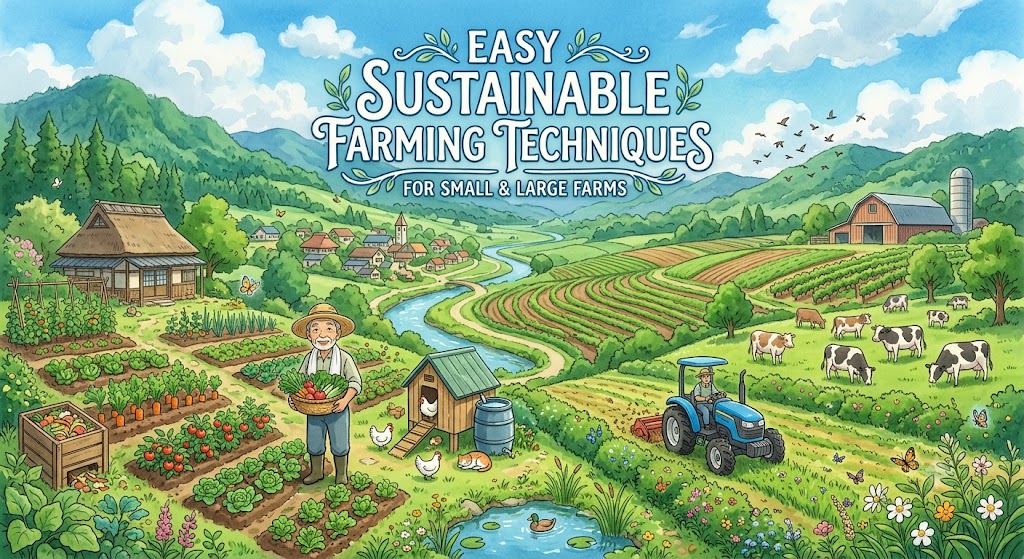
Sustainable farming has become one of the most effective ways to improve agricultural productivity while protecting natural resources. Farmers around the world are facing challenges such as declining soil fertility, rising input costs, unpredictable weather, water shortages, and increasing pest pressure. These issues make it essential to adopt farming methods that not only produce healthy crops today but also preserve the land for future generations.
The good news is that sustainable farming does not always require expensive machinery or advanced technology. Many simple and practical techniques can significantly improve soil health, conserve water, increase biodiversity, and reduce production costs. Whether you manage a small family farm or a large commercial operation, these methods can help build a more productive and resilient farming system.
This guide explains easy sustainable farming techniques that can be implemented on farms of any size.
What Is Sustainable Farming?
Sustainable farming is an agricultural approach that balances crop production with environmental protection. It focuses on using natural resources wisely while maintaining long-term productivity and profitability.
Instead of relying heavily on excessive fertilizers, pesticides, or intensive tillage, sustainable farming encourages practices that improve soil quality, conserve water, and support healthy ecosystems.
The primary objectives include:
- Improving soil fertility
- Conserving water
- Protecting biodiversity
- Reducing pollution
- Lowering production costs
- Producing healthy crops
- Increasing long-term farm profitability
These principles benefit both farmers and the environment.
1. Improve Soil with Organic Matter
Healthy soil is the foundation of successful farming.
Adding organic matter improves soil structure, water retention, nutrient availability, and biological activity.
Organic materials include:
- Compost
- Farmyard manure
- Crop residues
- Green manure
- Vermicompost
Organic matter feeds beneficial microorganisms that naturally improve soil fertility.
Over time, soils become easier to cultivate and more productive.
2. Rotate Crops Every Season
Growing the same crop continuously depletes nutrients and encourages pests and diseases.
Crop rotation helps restore soil balance.
For example:
- Cereals followed by legumes
- Vegetables followed by cover crops
- Deep-rooted crops followed by shallow-rooted crops
Rotation interrupts pest life cycles while improving nutrient availability.
Legumes naturally contribute nitrogen to the soil, reducing fertilizer requirements.
3. Plant Cover Crops
Cover crops protect soil when commercial crops are not growing.
Popular cover crops include:
- Clover
- Rye
- Mustard
- Oats
- Cowpea
- Vetch
Benefits include:
- Reduced soil erosion
- Better moisture retention
- Weed suppression
- Increased organic matter
- Improved microbial activity
Cover crops also improve long-term soil structure.
4. Reduce Excessive Tillage
Frequent plowing damages soil structure and destroys beneficial organisms.
Minimum tillage or conservation tillage helps preserve soil health.
Advantages include:
- Less erosion
- Improved water infiltration
- Better earthworm activity
- Increased soil carbon
- Lower fuel consumption
Reducing unnecessary tillage also lowers machinery costs.
5. Use Mulch
Mulching is one of the easiest sustainable farming practices.
Organic mulch materials include:
- Straw
- Dry leaves
- Grass clippings
- Wood chips
- Crop residues
Mulch provides many benefits:
- Conserves moisture
- Reduces weed growth
- Protects soil from erosion
- Regulates soil temperature
- Improves soil organic matter
As mulch decomposes, it naturally enriches the soil.
6. Practice Efficient Irrigation
Water is becoming increasingly valuable in agriculture.
Efficient irrigation helps reduce waste while improving crop performance.
Useful methods include:
- Drip irrigation
- Sprinkler systems
- Rainwater harvesting
- Soil moisture monitoring
- Proper irrigation scheduling
Healthy soils rich in organic matter also retain water more effectively.
This reduces irrigation frequency and lowers pumping costs.
7. Test Soil Regularly
Applying fertilizer without soil testing often leads to unnecessary expenses.
Regular soil analysis provides information about:
- Soil pH
- Nitrogen
- Phosphorus
- Potassium
- Organic matter
- Micronutrients
Accurate information allows farmers to apply nutrients only where needed.
Balanced fertilization improves crop growth while protecting the environment.
8. Encourage Beneficial Insects
Not all insects damage crops.
Many insects naturally control harmful pests.
Helpful insects include:
- Ladybirds
- Lacewings
- Honeybees
- Hoverflies
- Predatory beetles
- Parasitic wasps
Planting flowering borders and reducing unnecessary pesticide use encourages these beneficial species.
Natural pest control lowers chemical costs.
9. Use Integrated Pest Management
Integrated Pest Management (IPM) combines several pest-control strategies.
These include:
- Crop monitoring
- Biological control
- Crop rotation
- Resistant crop varieties
- Mechanical removal
- Responsible pesticide use
Instead of spraying chemicals routinely, farmers treat problems only when necessary.
This protects beneficial organisms while reducing production costs.
10. Prevent Soil Erosion
Topsoil contains valuable nutrients and organic matter.
Protect it by using:
- Cover crops
- Windbreaks
- Contour farming
- Terracing
- Mulching
- Permanent vegetation
Preventing erosion protects both crop productivity and nearby water sources.
11. Diversify Crops
Growing multiple crops reduces farming risks.
Benefits include:
- Better pest management
- Improved soil fertility
- More stable income
- Better biodiversity
- Reduced market dependence
If one crop performs poorly, others may compensate financially.
Diversified farms are generally more resilient.
12. Compost Farm Waste
Agricultural waste should not always be discarded.
Useful compost materials include:
- Crop residues
- Vegetable waste
- Animal manure
- Dry leaves
- Grass clippings
Composting recycles nutrients naturally.
It also reduces waste disposal costs while producing valuable organic fertilizer.
13. Plant Trees Around the Farm
Trees provide many environmental and agricultural benefits.
They help:
- Reduce wind erosion
- Improve biodiversity
- Provide shade
- Protect water sources
- Store carbon
- Improve microclimates
Agroforestry systems combine trees with crops to improve overall farm sustainability.
14. Improve Farm Drainage
Standing water damages roots and encourages disease.
Maintain clean drainage channels throughout the farm.
Proper drainage:
- Prevents root rot
- Reduces erosion
- Improves soil aeration
- Supports healthier crops
Balanced water management is just as important as irrigation.
15. Reduce Chemical Dependency
Chemical fertilizers and pesticides should be used responsibly.
Farmers can reduce dependency by:
- Building healthy soil
- Using compost
- Rotating crops
- Applying nutrients according to soil tests
- Encouraging beneficial insects
- Monitoring pests regularly
Responsible chemical use lowers production costs while protecting surrounding ecosystems.
16. Maintain Biodiversity
Healthy farms support wildlife, pollinators, and beneficial microorganisms.
Simple ways to improve biodiversity include:
- Plant hedgerows
- Maintain natural vegetation
- Grow different crops
- Preserve pollinator habitats
- Avoid unnecessary chemical spraying
Greater biodiversity strengthens the farm ecosystem naturally.
17. Keep Accurate Farm Records
Successful sustainable farming depends on good management.
Record important information such as:
- Planting dates
- Crop varieties
- Rainfall
- Irrigation
- Fertilizer applications
- Pest observations
- Harvest yields
These records help identify successful practices and improve future planning.
18. Use Modern Farming Technology
Technology makes sustainable farming more efficient.
Useful tools include:
- GPS-guided equipment
- Drones
- Soil sensors
- Weather forecasting
- Smart irrigation controllers
- Mobile farm management apps
Even small farms can benefit from simple digital tools for weather monitoring and record keeping.
Benefits of Sustainable Farming
Farmers who consistently apply sustainable practices often experience:
- Improved soil fertility
- Better water conservation
- Lower production costs
- Healthier crops
- Reduced erosion
- Improved biodiversity
- Higher long-term productivity
- Greater climate resilience
- Better crop quality
- Increased farm profitability
Although some improvements take time, the long-term benefits are substantial.
Common Mistakes to Avoid
Many farmers unintentionally reduce sustainability by:
- Overusing fertilizers
- Applying pesticides without monitoring pests
- Burning crop residues
- Ignoring soil testing
- Excessive tillage
- Poor irrigation scheduling
- Removing all natural vegetation
- Neglecting organic matter
Correcting these habits can significantly improve farm performance.
Frequently Asked Questions
Is sustainable farming suitable for small farms?
Yes. Many sustainable practices such as composting, mulching, crop rotation, and efficient irrigation are inexpensive and ideal for small farms.
Does sustainable farming reduce yields?
When managed properly, sustainable farming often maintains or improves long-term productivity by improving soil health and resource efficiency.
How does organic matter improve soil?
Organic matter increases nutrient availability, improves water retention, enhances soil structure, and supports beneficial microorganisms.
Why is crop rotation important?
Crop rotation helps prevent pest buildup, reduces disease pressure, improves nutrient balance, and supports healthier soils.
Can sustainable farming reduce production costs?
Yes. Better soil fertility, efficient irrigation, improved nutrient management, and reduced chemical dependence often lower long-term farming expenses.
Conclusion
Sustainable farming is one of the most practical approaches to building productive, profitable, and environmentally responsible farms. Simple techniques such as adding organic matter, rotating crops, planting cover crops, reducing tillage, conserving water, encouraging beneficial insects, and improving biodiversity can dramatically strengthen both soil health and crop performance. These practices are suitable for farms of every size and require consistent management rather than expensive investments.
By adopting sustainable farming methods today, farmers can protect their land, reduce input costs, improve harvest quality, and create resilient agricultural systems capable of meeting future food demands. Healthy soil, efficient resource management, and balanced ecosystems form the foundation of successful farming for generations to come.