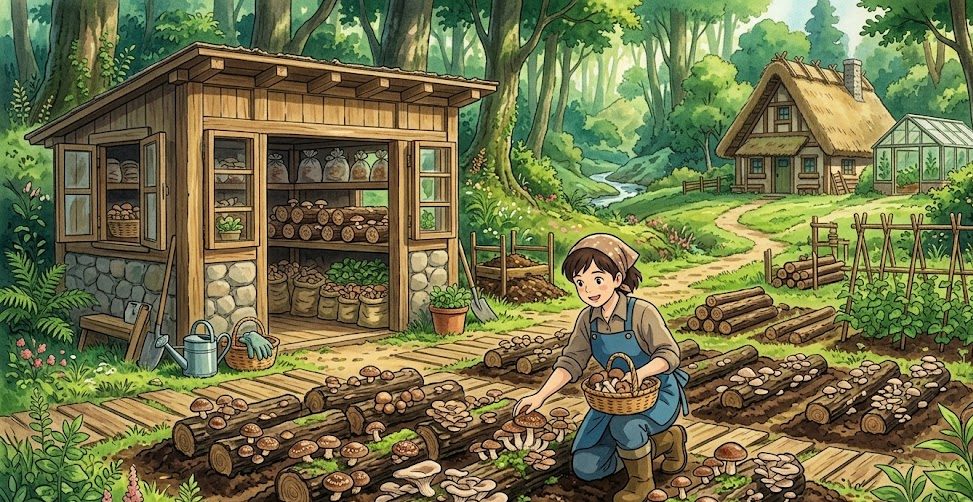
When people think of starting a commercial farming business, they usually picture vast acres of land, expensive tractors, heavy plows, and months of waiting for a single harvest. Traditional crop farming is a massive undertaking that requires significant upfront capital and real estate.
But what if you could run a highly profitable agricultural business inside a spare room, a basement, or a small insulated shed? What if your growing cycle took weeks instead of months, and your “soil” was made entirely from repurposed agricultural waste like sawdust or straw?
Welcome to the world of commercial mushroom farming.
Mushrooms are not plants; they are fungi. Because they do not rely on photosynthesis to grow, they do not require sunlight or vast outdoor fields. Instead, they thrive in dark, vertically stacked, climate-controlled indoor environments.
For urban entrepreneurs, smallholders, and modern farmers, mushroom cultivation offers one of the highest returns on investment (ROI) per square foot in the entire agricultural sector.
This comprehensive, step-by-step guide walks you through everything required to set up, manage, and scale a profitable indoor mushroom farming business.
1. Why Choose Mushroom Farming? The Economic Advantages
Before spending money on equipment, it helps to understand why the specialty mushroom market is growing so rapidly. The global demand for gourmet mushrooms—such as Oyster, Shiitake, and Lion’s Mane—is expanding due to a culinary shift toward plant-based diets, healthy eating, and functional superfoods.
- Exceptional Vertical Efficiency: Mushrooms are grown on vertical shelving units. A room measuring just 200 square feet can easily accommodate hundreds of pounds of growing substrate, maximizing your production footprint.
- Rapid Cash Flow Cycles: Unlike fruit orchards that take years to mature, gourmet mushrooms are incredibly fast growers. Depending on the variety, you can go from inoculating a growing bag to harvesting fresh blocks within 3 to 5 weeks.
- Low Cost Raw Materials: The primary material used to grow mushrooms (the substrate) is incredibly inexpensive. Mushrooms grow beautifully on agricultural byproducts like hardwood sawdust, wheat straw, sugarcane bagasse, and coffee grounds. You are essentially turning low-cost waste into a high-value gourmet product.
2. Choosing Your Cash Crop: High-Margin Mushroom Varieties
As a commercial grower, your primary focus should be on specialty gourmet mushrooms rather than generic white button mushrooms. Button mushrooms require highly specialized, chemically complex compost formulas and massive economies of scale to be profitable.
Gourmet varieties, on the other hand, fetch much higher prices at local farmers’ markets and restaurants while being easier to grow on a small scale.
Oyster Mushrooms (Pleurotus ostreatus)
Oyster mushrooms are the absolute best choice for beginners. They possess a remarkably aggressive root network (mycelium) that colonizes substrates quickly, allowing them to easily outrun competing molds and bacteria. They come in stunning variations, including Pearl, Blue, Pink, and Golden Oysters.
Shiitake Mushrooms (Lentinula edodes)
Shiitakes are highly prized in Asian cuisine and gourmet restaurants for their rich, savory flavor. They typically grow on supplemented hardwood sawdust blocks. While they take longer to colonize and fruit than Oyster varieties, their higher market wholesale price makes them an excellent addition once your farm stabilizes.
Lion’s Mane (Hericium erinaceus)
This unique mushroom looks like a shaggy white pom-pom and has a culinary texture closely resembling crab meat or lobster. Beyond its kitchen appeal, Lion’s Mane is heavily sought after by the health and wellness industry for its cognitive and neurological benefits, making it a premium, high-margin crop.
3. The Indoor Farm Infrastructure: Setting Up a Grow Room
To successfully grow mushrooms at scale, you must create a controlled environment that mimics a damp, humid forest floor. A basic commercial setup requires dividing your space into two distinct areas: an incubation room and a fruiting house.
Professional indoor mushroom grow room setup. Source: GroCycle
Atmospheric Controls Required for High Yields
A standard indoor grow room requires four basic environmental components integrated into an automated system:
- Heavy-Duty Racking: Utilize industrial metal wire shelving or suspended piping arrays. Wire shelving allows for optimal air circulation around all sides of your growing bags.
- Automated Humidifier: Mushrooms are composed of roughly 90% water. Your fruiting room must maintain a constant relative humidity (RH) level between 85% and 95%. Standard residential humidifiers are inadequate; you will need an ultrasonic pond-fogger unit connected to a digital humidity controller.
- Fresh Air Ventilation (FAE): As mushrooms grow, they breathe in oxygen and exhale large volumes of Carbon Dioxide (CO2). If CO2 levels rise too high, mushrooms grow long, stringy stems with tiny, unmarketable caps. Install inline exhaust fans to provide a complete fresh air exchange every 10 to 15 minutes.
- Low-Intensity Lighting: While mushrooms do not use light for energy, they do require a brief 12-hour light cycle (using cool-toned LEDs) to trigger the formation of mushroom pins and guide the direction of their growth.
4. The 5-Step Mushroom Cultivation Cycle
Commercial mushroom farming follows a disciplined biological cycle. Any shortcut taken during the preparation phases will inevitably lead to contamination and crop loss.
Oyster mushrooms ready for harvest from a substrate bag. Source: bm mushroom
Step 1: Substrate Preparation and Hydration
Mix your dry base material—such as clean hardwood sawdust pellets or chopped wheat straw—with water until it reaches roughly 60% moisture content. A practical field test is the “Squeeze Test”: squeeze a handful of substrate tightly; only a few drops of water should escape between your knuckles, and the material should hold its shape when you open your hand.
Step 2: Sterilization or Pasteurization
Substrates naturally contain millions of wild mold spores and bacteria. If you do not eliminate them, they will grow faster than your mushrooms, ruining the bag.
- Straw Pasteurization: Submerge the hydrated straw in hot water at 65°C to 70°C for 1.5 to 2 hours.
- Sawdust Sterilization: Hardwood sawdust supplemented with nutrient-rich bran must be pressure-steamed at 121°C (15 PSI) for 2.5 hours to achieve true sterilization.
Step 3: Inoculation
Once the sterilized substrate cools down completely below 25°C, it is time to add your “seed,” which is known in the industry as mushroom spawn (usually colonized grain grains like millet or rye). This process must be done in an incredibly clean room, preferably in front of a High-Efficiency Particulate Air (HEPA) laminar flow hood, to keep wild airborne contaminants out of the fresh mixture.
Step 4: Incubation (The Run)
Move the inoculated bags into a dark, warm room maintained at 20°C to 24°C. Over the next two to three weeks, the microscopic fungal threads (mycelium) will eat through the substrate, turning the entire dark bag into a solid, bright white block.
Step 5: Fruiting and Harvesting
Once fully colonized, move the white blocks into your humid fruiting house. Cut small slits or “X” shapes into the plastic bags. The sudden exposure to fresh air, high humidity, and light signals the mycelium to start producing fruit. Within days, tiny primordia (pins) will appear, doubling in size daily until they form mature, beautiful clusters ready for market.
5. Maximizing Sales: Marketing and Distribution Strategies
Growing top-tier mushrooms is only half the battle; you must build a diversified commercial sales funnel to secure consistent weekly profits.
Wholesale to Local Chefs
Gourmet chefs are constantly hunting for ultra-fresh, locally grown ingredients. Pack sample baskets of your finest Blue Oyster or Lion’s Mane mushrooms and visit independent, upscale restaurants during their off-peak afternoon hours. Chefs are usually happy to pay a premium price if you can guarantee consistent, bi-weekly deliveries.
Community Farmers’ Markets
Selling directly to consumers at regional weekend markets provides excellent immediate retail cash flow. Display your mushroom clusters in beautiful, open wicker baskets to spark curiosity, and offer recipe cards or dried mushroom powder mixes to maximize your average ticket value.
Agri-Waste Recycling (The Secondary Profit Loop)
Do not throw away your spent mushroom substrate blocks after harvesting. Fully colonized spent blocks are packed with broken-down organic nutrients and beneficial fungal microbial life, making them an incredible soil conditioner. You can bag and sell this spent substrate to local organic market gardeners and plant nurseries as a premium compost supplement.
Commercial Mushroom Operations Matrix
To help plan your infrastructure and space allocations, use this operational overview to balance your farm’s workflow:
| Farm Production Zone | Target Temperature Range | Target Humidity Level | Lighting Requirements | Primary Operational Focus |
|---|---|---|---|---|
| Inoculation Lab | 20°C – 22°C | Low (Dry air reduces mold) | Standard overhead LEDs | Absolute sterility; handling pure spawn cultures. |
| Incubation Room | 20°C – 24°C | 60% – 70% | Total darkness preferred | Monitoring mycelium run; identifying early bag contamination. |
| Fruiting House | 15°C – 18°C | 85% – 95% (High Fog) | 12-Hour cool LED cycle | Managing fresh air exchanges (CO2 extraction) and harvesting. |
| Packing & Cold Room | 2°C – 4°C | Low | Standard overhead LEDs | Sorting, weighing, and cold-chain storage for market prep. |
Frequently Asked Questions (FAQs)
How much capital is needed to start a small-scale indoor mushroom farm?
You can start a micro-farm in a spare room or closet for as little as $500 to $1,000. This budget easily covers a basic plastic grow tent, an ultrasonic humidifier, a small exhaust fan, shelving units, substrate, and mushroom spawn. Scaling up to a full-time commercial warehouse operation typically requires between $10,000 and $20,000 for advanced sterilization and climate equipment.
What is the average shelf life of fresh gourmet mushrooms?
Fresh gourmet mushrooms are highly perishable and should ideally reach the consumer’s plate within 5 to 7 days of harvest. To preserve quality, store them in breathable brown paper bags inside a commercial refrigerator maintained between 2°C and 4°C. Never store fresh mushrooms in sealed airtight plastic containers, as this causes them to sweat and spoil rapidly.
How do I identify and prevent green mold contamination?
Green mold (Trichoderma) is the primary enemy of mushroom farmers. It thrives in stagnant, warm, unsterilized environments. To prevent it, ensure your substrate pasteurization or sterilization times are accurate, strictly maintain clean sanitation protocols during the inoculation phase, and quickly discard any contaminated bags from your farm before they release spores.
Can I produce my own mushroom spawn at home to save money?
While it is technically possible to manufacture grain spawn using agar cultures and sterile laboratory techniques, it is rarely cost-effective for beginners. For your first few years of commercial operation, it is far more efficient to purchase pre-colonized, certified clean grain spawn from specialized wholesale labs, allowing you to focus your energy entirely on crop management and local sales.
Conclusion
Starting a profitable indoor mushroom farming business is a fantastic way to break into the modern agribusiness sector without the massive capital hurdles of traditional land-based farming. By leveraging vertical space, automating environmental controls, and transforming simple agricultural byproducts into premium gourmet produce, you can build a highly efficient enterprise from scratch.
Long-term success in the mushroom industry is built on consistency and clean operational habits. By starting with robust, high-yielding varieties like Oyster mushrooms, maintaining strict biosecurity protocols in your clean room, and building reliable local B2B relationships with chefs and specialty retailers, you can build a stable, highly profitable agricultural business.