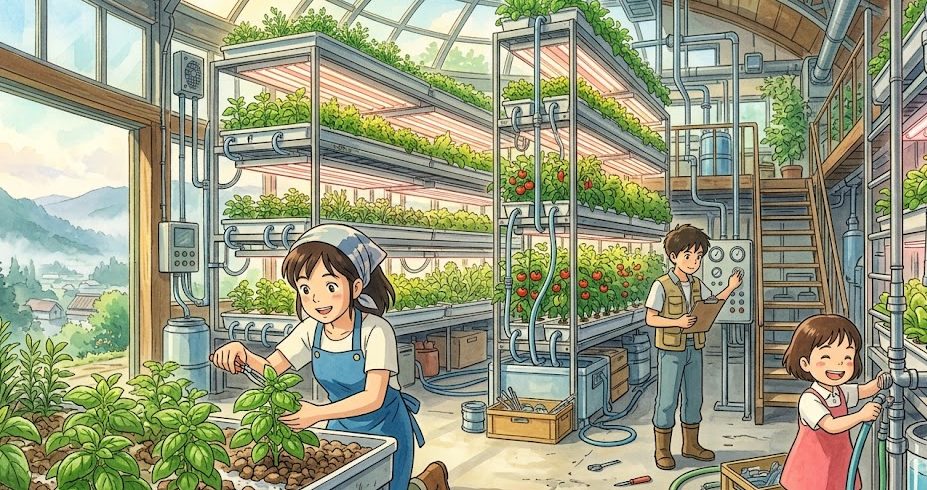
The global agricultural landscape is battling unprecedented challenges. Rapid urbanization, soil degradation, groundwater depletion, and climate change are forcing us to rethink how we grow food. The traditional dependency on vast acres of fertile soil and predictable monsoons is no longer viable for sustainable economic growth.
To bypass these environmental vulnerabilities, a massive technological wave has emerged: Advanced Hydroponics Systems, Soilless Cultivation, and Indoor AgriTech.
By removing soil completely from the equation and moving crop production inside highly regulated, data-driven facilities, indoor growers are achieving up to 10x higher yields using 90% less water. Whether you are a commercial farmer looking to scale up your revenue per square foot or an agritech investor building a next-generation vertical farm, this ultimate guide will break down the mechanics, setups, and economics of modern soilless farming.
1. Demystifying Soilless Cultivation
At its core, soilless cultivation is the practice of growing plants without using traditional dirt as a rooting medium. In open-field farming, soil acts as a physical anchor and a reservoir for nutrients. However, plants don’t actually need the soil itself; they only need the water, oxygen, and mineral ions contained within it.
In an advanced indoor agritech environment, the soil is replaced by sterile, inert growth media that hold moisture and oxygen perfectly while allowing roots to breathe freely.
Popular Soilless Grow Media:
- Coco Coir (Coco-Peat): Made from coconut husks, it offers excellent water retention and an ideal air-to-water ratio.
- Rockwool: A fibrous material made from molten rock spun into bundles, heavily favored by commercial tomato and lettuce growers.
- Expanded Clay Pebbles (LECA): Small, porous clay balls that provide superior drainage and can be washed and reused indefinitely.
- Perlite & Vermiculite: Volcanic mineral derivatives used to fluff up root zones and boost aeration.
2. Types of Advanced Hydroponics Systems
Hydroponics is the premier subset of soilless cultivation where plants are fed via a continuous flow of water enriched with precise macro and micro-nutrients. Depending on your target crop and financial budget, commercial indoor agritech utilizes distinct system architectures:
[Nutrient Reservoir] ──(Pump)──> [Root Zone Delivery System] ──> [Recirculating Drain]
A. Nutrient Film Technique (NFT)
In an NFT system, a continuous, very shallow stream (a “film”) of nutrient-rich water recirculates over the bare roots of the plants via a slightly sloped channel.
- Best Suited For: Leafy greens, herbs, spinach, basil, and exotic lettuces.
- Advantage: Maximum oxygenation to the root tips, resulting in exceptionally fast vegetative growth cycles.
B. Deep Water Culture (DWC)
In DWC setups, the plant roots are suspended directly inside a deep reservoir filled with highly aerated, nutrient-rich water. Industrial air pumps constantly bubble oxygen into the reservoir to prevent root suffocation.
- Best Suited For: Large, heavy-feeding plants or fast-rooting crops like exotic cannabis or gourmet bell peppers.
C. Aeroponics (The Pinnacle of Indoor AgriTech)
Aeroponics takes soilless farming to the absolute limit. Roots are suspended in an enclosed dark chamber and are intermittently misted with a highly concentrated nutrient solution via high-pressure nozzles every few minutes.
- Best Suited For: Seed potato multiplication, exotic root crops, and vertical tower farms.
- Advantage: Uses the lowest amount of water of any agricultural system while delivering unprecedented plant growth speeds due to 100% root oxygen exposure.
3. The Indoor AgriTech Infrastructure
Setting up an advanced hydroponic facility requires integrating industrial electronics, data tracking, and climate engineering. To run a profitable indoor hub, your infrastructure must master these four pillars:
I. Automated Fertigation and Sensing
Manually measuring water parameters is a recipe for crop failure. Advanced systems utilize digital sensors connected to automated dosing pumps. These sensors constantly monitor two crucial metrics:
- pH (Potential Hydrogen): Kept strictly between 5.5 and 6.5 to ensure plants can physically absorb nutrients.
- EC (Electrical Conductivity): Measures the salt concentration in the water to prevent under-feeding or root burn.
II. Custom LED Grow Lights
Because indoor farms operate inside enclosed warehouses, shipping containers, or basements, they replace the sun with customized LED spectrums. Plants do not utilize all wavelengths of sunlight; they primarily absorb Blue light (for vegetative leafy growth) and Red light (for flowering and fruiting). Modern AgriTech utilizes tuned LED arrays that emit precise photosynthetically active radiation (PAR), reducing electrical consumption while accelerating harvest schedules.
III. HVAC and Environmental Controls
Indoor setups use specialized environmental controllers linked to heavy-duty HVAC (Heating, Ventilation, and Air Conditioning) units, dehumidifiers, and CO2 injectors. By keeping temperatures at a steady 22∘C−25∘C and injecting carbon dioxide, crops achieve optimal photosynthesis rates 24 hours a day.
Hydroponic Systems: Technical & Commercial Comparison
To design a high-yielding business model, refer to this industrial comparison matrix of modern soilless architectures:
| Hydroponic System | Initial Capital Setup | Water Efficiency | Ideal Crop Choices | Yield Factor (vs. Traditional) |
|---|---|---|---|---|
| Nutrient Film Technique (NFT) | Medium | High (90% saving) | Lettuce, Herbs, Bok Choy | 4x to 6x |
| Deep Water Culture (DWC) | Low to Medium | Medium | Tomatoes, Kale, Peppers | 3x to 5x |
| Aeroponic Misting Towers | High | Ultra-High (95% saving) | Strawberries, Root Herbs, Seedlings | 8x to 10x |
| Drip Soilless (Coco-peat beds) | Low | Medium to High | Zucchini, Cucumber, Melons | 3x to 4x |
Export to Sheets
4. Key Strategies for Commercial Viability
While the technology behind advanced hydroponics is highly fascinating, transforming it into a high-profit commercial venture requires strict operational discipline.
Focus on High-Value Hyper-Local Crops
Do not grow low-value crops like wheat, rice, or corn in a hydroponic facility; the electrical and infrastructure costs will wipe out your margins. Focus on high-value, perishable, and exotic varieties—such as Swiss chard, premium Italian basil, strawberries, or edible flowers—that can be delivered to local high-end restaurants and urban grocery stores within hours of harvest to command premium pricing.
Eliminate the Energy Overhead via Renewable Energy
The biggest operational expense in indoor agritech is the electricity bill generated by running 18-hour grow lights and constant climate controls. Savvy commercial farmers optimize their facility’s ROI by installing rooftop solar photovoltaic grids, turning the farm into a highly self-sustaining, green-certified agricultural production unit.
Managing Risks in Advanced Soilless Systems
Critical Safety Note for System Operators: In a soil-based farm, the dirt acts as a buffer; if you don’t water your plants for a day, they survive. In advanced hydroponics (especially NFT and Aeroponics), there is no buffer. If a power outage occurs and your water pumps stop running for even 30 minutes, bare root zones will dry out completely, resulting in total crop failure. Always invest in automated backup power generators or battery systems integrated with SMS alert mechanisms.
Conclusion: The Automated Future of Food Production
Transitioning into Advanced Hydroponics Systems and embracing Indoor AgriTech marks the evolution of farming from an unpredictable outdoor gamble into a highly precise, industrial manufacturing process. By detaching crop production from seasonal variables and soil limitations, soilless cultivation offers investors and modern farmers a predictable, scalable, and highly lucrative business model.
To succeed, start by analyzing your local urban market demand, select an energy-efficient system architecture, automate your nutrient delivery, and unlock the massive financial potential of modern digital agriculture.
Frequently Asked Questions (FAQs)
Q1. Are hydroponically grown crops organic? Technically, most international organic standards require crops to be grown in soil using biological composts. However, hydroponic produce is incredibly clean, typically 100% pesticide-free, and holds a much higher nutritional density due to optimized nutrient absorption.
Q2. How long does a typical crop cycle take in an indoor farm? Because environmental conditions are kept perfect around the clock, vegetative periods are drastically shortened. For example, a head of premium exotic lettuce that takes 60–70 days to grow in an open field can be harvested in just 30–35 days in an advanced NFT system.
Q3. What water quality is needed for advanced hydroponics? The source water should have a very low initial TDS (Total Dissolved Solids), ideally below 100-150 PPM. If your local water source is hard or high in salt, integrating a industrial Reverse Osmosis (RO) filtration system is absolutely mandatory before adding nutrients.