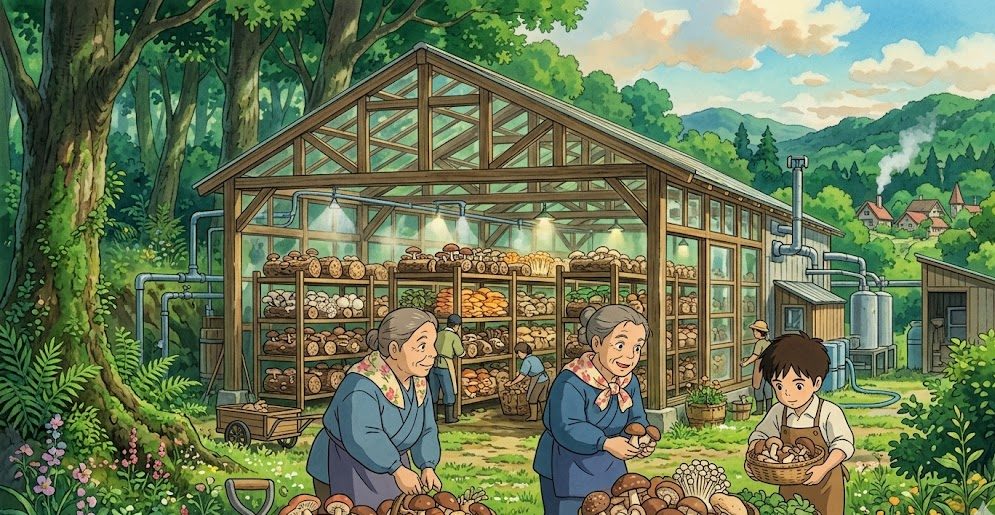
The global mushroom market size was valued at over $60 billion recently and is projected to expand at a compound annual growth rate (CAGR) of over 9% through the late 2020s. Unlike traditional open-field crop cultivation that relies heavily on vast land acreage and favorable weather conditions, mushroom farming is a highly controlled, vertically stackable indoor enterprise.
Growing premium mushrooms—such as Shiitake (Lentinula edodes), Oyster (Pleurotus ostreatus), Lion’s Mane (Hericium erinaceus), and King Oyster—offers some of the highest profit margins per square foot in modern agriculture. However, moving from hobbyist cultivation to high-yield commercial success requires strict mastery over infrastructure, substrate optimization, and scientific spore management.
1. Selecting Premium Mushroom Varieties for Commercial Success
In commercial mushroom cultivation, your choice of variety directly dictates your infrastructure requirements and your target market’s Return on Investment (ROI).
- Oyster Mushrooms (Grey, Blue, Pink, Golden): These are the easiest and fastest-growing premium varieties. They colonize substrates rapidly (typically 2 to 3 weeks) and have high biological efficiency, making them excellent for consistent weekly cash flow.
- Lion’s Mane: Highly sought after by both gourmet restaurants and the health/wellness supplement industry due to its neuroprotective properties. Lion’s mane commands a premium price point but requires precise humidity control during fruiting.
- Shiitake: Traditionally grown on hardwood logs, commercial farms now utilize sterilized synthetic sawdust logs or blocks. They take longer to colonize but offer an exceptional shelf-life and high market demand.
2. The Commercial Substrate Preparation & Sterilization Process
Mushrooms do not grow in typical soil; they are fungi that thrive on carbon-rich agricultural waste materials, known as substrates. For premium gourmet varieties, the choice of substrate is critical for maximum biological efficiency (the ratio of fresh mushroom weight harvested to the dry weight of substrate used).
Common Substrate Formulations
- Masters Mix: A highly popular commercial blend consisting of 50% hardwood sawdust and 50% soybean hulls. This combination provides the perfect balance of cellulose, lignin, and nitrogen for wood-loving mushrooms like Lion’s Mane and Shiitakes.
- Pasteurized Straw: Highly effective for Oyster mushrooms. Wheat or paddy straw is chopped, hydrated, and pasteurized to eliminate competing mold spores.
Sterilization vs. Pasteurization
- Pasteurization (60°C–80°C): Used primarily for straw or manure. It kills off harmful pathogens while leaving beneficial microbes alive that help protect the substrate from contamination.
- Sterilization (121°C under pressure): Absolute requirement for supplemented substrates like Masters Mix. Because soybean hulls are rich in nutrients, unsterilized bags will quickly grow green mold (Trichoderma). Commercial growers utilize atmospheric steam sterilizers or industrial autoclaves for 12 to 24 hours to create a completely blank canvas for the mushroom mycelium.
3. Advanced Spore Management & Laboratory Protocols
The heart of a commercial mushroom farm is its laboratory. Contamination by wild molds or bacteria is the single greatest reason commercial mushroom farms fail. True profitability lies in mastering spore management and tissue culture clone propagation rather than continuously buying expensive commercial spawn from third-party vendors.
The Cleanroom and Flow Hood Dynamics
Every step involving spores, agar culture, or grain spawn inoculation must happen under aseptic (sterile) conditions. Commercial farms utilize a Laminar Flow Hood equipped with a High-Efficiency Particulate Air (HEPA) filter that removes 99.97% of airborne particles down to 0.3 microns. This creates a continuous stream of sterile air that blows across the workspace, preventing competing wild spores from landing on open cultures.
The Lifecycle Management Pipeline
- Spore Printing / Isolation: Collecting spores from a high-performing mushroom cap onto sterile aluminum foil.
- Agar Culture: Spores or tissue clones are transferred to Petri dishes containing nutrient agar (like Potato Dextrose Agar). Here, the grower selects the fastest-growing, healthiest sectors of mycelium.
- Grain Spawn: Clean mycelium from the agar plate is transferred into sterilized grain jars or bags (such as millet, rye, or sorghum). The mycelium consumes the grain nutrients, creating “spawn.”
- Bulk Inoculation: The fully colonized grain spawn is mixed directly into the larger bulk production substrate bags.
4. Optimizing the Indoor Climate for Commercial Fruiting
Once the substrate bags are fully colonized by mycelium in a dark incubation room, they are moved to the Fruiting Chamber (often referred to as an automated Martha tent or a custom grow room). To trigger the mycelium to stop vegetative growth and start producing mushroom caps, growers must adjust four critical environmental variables:
1. Relative Humidity (RH)
Mushrooms are roughly 90% water. During the initial pinning stage, humidity must be maintained at 90% to 95% using industrial ultrasonic humidifiers. Once the mushroom caps mature, humidity is slightly lowered to 85% to prevent bacterial blotch and extend post-harvest shelf life.
2. Fresh Air Exchange (FAE) and CO2 Management
Unlike plants that breathe in carbon dioxide, mushrooms breathe in oxygen and exhale $CO_2$. In closed spaces, building levels of $CO_2$ cause mushrooms to deform, developing long, stringy stems and tiny, unmarketable caps. Commercial grow rooms utilize automated exhaust fans controlled by digital $CO_2$ monitors to keep carbon dioxide levels below 800 ppm (parts per million).
3. Temperature Control
Different varieties require distinct temperature triggers. While Pink Oysters love warm tropical climates (20°C–30°C), Blue Oysters and King Oysters fruit best in cooler conditions (10°C–18°C). Commercial facilities are heavily insulated and climate-controlled to ensure year-round steady production.
5. Commercial Viability, Yields, and Multi-Tiered ROI
| Mushroom Variety | Average Crop Cycle | Wholesale Price Range (per lb) | Ideal Substrate |
| Oyster Varieties | 3 – 4 Weeks | $6.00 – $10.00 | Straw / Sawdust |
| Lion’s Mane | 4 – 5 Weeks | $10.00 – $15.00 | Masters Mix |
| Shiitake | 7 – 9 Weeks | $10.00 – $16.00 | Hardwood Sawdust |
Maximizing Vertical Space
The true financial advantage of indoor mushroom farming is vertical integration. Using multi-tiered racking systems, a grower can stack fruiting blocks 4 to 5 layers high. This means a small 500-square-foot dedicated indoor grow room can easily yield 200 to 400 pounds of fresh gourmet mushrooms every week, translating into a highly predictable, high-margin agricultural business.
Conclusion: The Modern Mycological Enterprise
Commercial mushroom cultivation represents a perfect fusion of biology, recycling, and precision indoor engineering. By transforming low-value agricultural wood waste into premium culinary gourmet varieties, growers can establish a highly sustainable business. Success ultimately boils down to maintaining rigorous sterile lab standards during spore and spawn management, and ensuring automated, highly stable environmental controls within the fruiting facility.