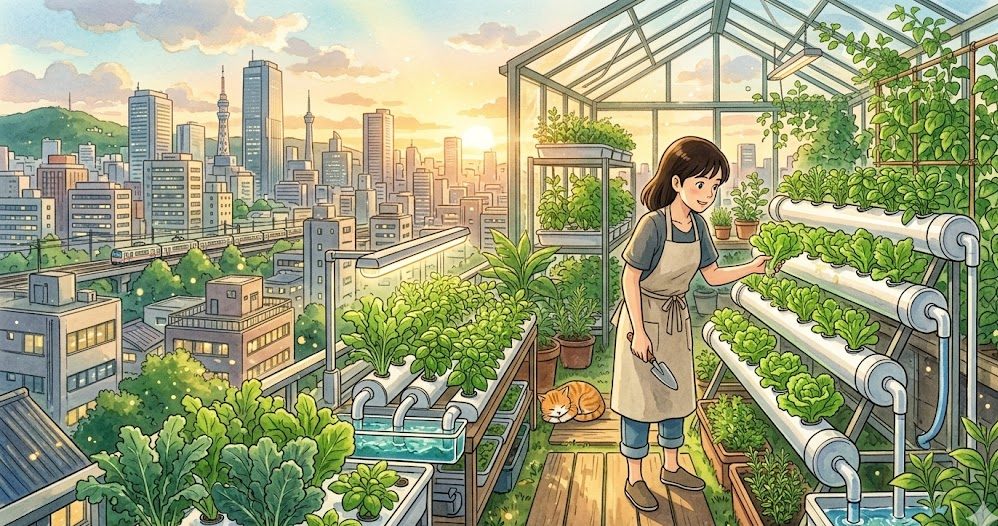
The global landscape of agriculture is undergoing a radical transformation. As urban populations swell and arable land diminishes due to industrialization and climate change, the traditional “soil-and-sun” model is facing unprecedented pressure. Enter Hydroponics: a subset of hydroculture that involves growing plants without soil, using mineral nutrient solutions in an aqueous solvent. This guide explores how hydroponics is not just a scientific curiosity, but a vital solution for the future of urban food security.
1. The Core Philosophy: Why Soil Isn’t Essential
Most people assume soil is a plant’s food. In reality, soil is merely a reservoir for nutrients and a mechanical support system for roots. Plants actually “eat” dissolved minerals and “breathe” oxygen through their roots. By removing the soil and delivering a precise “nutrient soup” directly to the root zone, we eliminate the energy a plant usually spends “searching” for food.
In a hydroponic environment:
- Growth rates increase by 30–50%.
- Water usage drops by up to 90% compared to traditional farming.
- Space efficiency is maximized through vertical stacking.
2. Primary Hydroponic Systems
There is no “one-size-fits-all” in soilless farming. The choice of system depends on the crop type, available space, and budget.
A. Nutrient Film Technique (NFT)
In NFT systems, a very shallow stream of nutrient-rich water is recirculated past the bare roots of plants in watertight channels.
- Best for: Leafy greens, herbs, and strawberries.
- Pro: Constant flow ensures roots never dry out and receive maximum oxygen.
B. Deep Water Culture (DWC)
Plants are suspended in Net Pots on a floating platform (usually Styrofoam). The roots hang directly into a reservoir of oxygenated nutrient solution.
- Best for: Fast-growing lettuce and large, water-hungry plants.
- Pro: Extremely simple to build and maintain.
C. Aeroponics
The most high-tech variation. Roots hang in the air and are misted with nutrient solution every few minutes.
- Best for: High-value crops and research.
- Pro: Maximum oxygen exposure leads to explosive growth.
D. Drip Systems & Ebb and Flow
These use a growing medium (like perlite or coconut coir). Water is either dripped onto the base of the plant or the tray is periodically flooded and drained.
- Best for: Heavy-fruiting plants like tomatoes, peppers, and cucumbers.
3. The Science of the “Nutrient Soup”
Since there is no soil to buffer mistakes, the chemistry of the water is critical. Success in hydroponics relies on mastering three variables:
- pH Levels: Most plants prefer a slightly acidic environment (typically between 5.5 and 6.5). If the pH is too high or low, the plant suffers from “nutrient lockout,” where it physically cannot absorb the food present in the water.
- EC (Electrical Conductivity): This measures the concentration of salts (nutrients) in the water. Too much salt can burn the plants; too little leads to malnutrition.
- Dissolved Oxygen: Roots need to breathe. Without aeration (usually via air stones), the roots will rot and the plant will drown.
4. Urban Advantages: Turning Concrete into Green
Hydroponics is the “engine” of the urban farming revolution. It allows for Controlled Environment Agriculture (CEA), which decouples food production from geography and season.
- Zero “Food Miles”: Growing food in a basement or on a rooftop in the middle of a city means it doesn’t need to be shipped 2,000 miles in a refrigerated truck.
- Pesticide-Free: In a controlled indoor environment, the risk of soil-borne pests and weeds is eliminated, drastically reducing the need for chemical interventions.
- Verticality: By stacking layers of crops (Vertical Farming), an urban warehouse can produce the equivalent yield of several acres of traditional farmland.
5. Challenges and Considerations
While the benefits are immense, the “Modern Hydroponics Guide” wouldn’t be complete without addressing the hurdles:
- Initial Investment: Setting up pumps, LED grow lights, and sensors requires more upfront capital than buying a shovel and seeds.
- Power Dependency: An indoor system relies on electricity. A power outage without a backup can kill a crop within hours if the pumps stop.
- Technical Knowledge: It requires a basic understanding of chemistry and biology. Monitoring a system is more “engineering” than “gardening.”
6. The Role of Technology: IoT and AI
The future of hydroponics is automated. Modern urban farms now use sensors to monitor pH and nutrient levels in real-time, sending alerts to a smartphone if something is off. Artificial Intelligence can now adjust light spectrums to change the flavor profile of a plant—for example, making basil taste sweeter or mustard greens spicier—simply by changing the “light recipe.”
7. Conclusion: The Green Horizon
Hydroponics is more than just a way to grow big tomatoes; it is a critical component of a sustainable future. As we move toward 2050, with a projected global population of nearly 10 billion, we cannot rely solely on traditional methods.
By adopting soilless farming, we can turn our cities into self-sustaining ecosystems. Whether it’s a small herb garden in a kitchen or a massive commercial facility in a repurposed factory, hydroponics offers a path to fresh, nutritious, and environmentally friendly produce for everyone, everywhere.