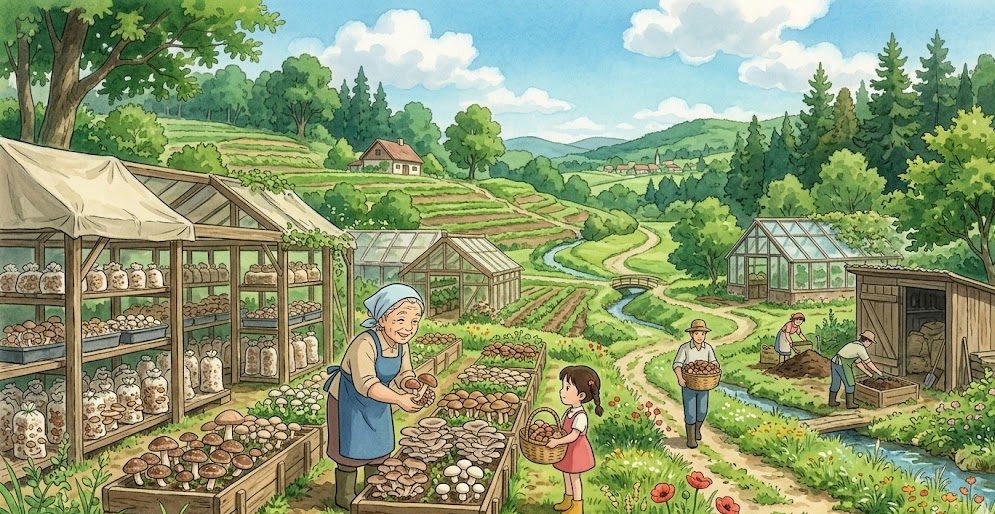
The global mushroom market has shifted from a niche agricultural activity into a high-tech, multi-billion-dollar industry. With the rise of plant-based diets and the increasing demand for medicinal fungi like Lion’s Mane and Cordyceps, commercial mushroom cultivation offers one of the highest returns per square foot in modern agriculture.
However, moving from a small hobby setup to a profitable commercial operation requires more than just growing fungi—it requires a mastery of substrate optimization, climate automation, and sterile techniques. This guide outlines the high-yield strategies that define successful commercial mushroom farming in 2026.
1. Selecting High-Profit Varieties
In a commercial setting, “yield” is not just about weight; it is about market value. Choosing the right strain for your climate and infrastructure is the first step toward profitability.
- Oyster Mushrooms (Pleurotus spp.): The “entry-level” commercial king. They have a rapid fruiting cycle (often 2–3 weeks) and can grow on almost any agricultural waste.
- Button Mushrooms (Agaricus bisporus): These command the highest volume in the market but require more complex “casing” techniques and strict temperature controls (14–18°C).
- Shiitake (Lentinula edodes): A premium variety that fetches higher prices. While they grow slower than Oysters, their firm texture and long shelf life make them a favorite for grocery chains. +1
- Medicinal “Super-Mushrooms”: Varieties like Lion’s Mane (for cognitive health) and Reishi (for immunity) are seeing explosive growth in the nutraceutical sector, often sold as dried powders or extracts at a significant premium.
2. Substrate Optimization: The Secret to Large “Flushes”
The substrate is the “fuel” for your mushrooms. Commercial success depends on creating a nutrient-dense environment while minimizing the cost of raw materials.
- The C:N Ratio: Mushrooms thrive when the Carbon-to-Nitrogen ratio is perfectly balanced. Adding nitrogen-rich supplements like wheat bran, chicken manure, or coffee grounds to base materials like sawdust or straw can increase yields by up to 25%.
- Sterilization vs. Pasteurization: * Pasteurization (60–80°C): Best for straw-based Oyster cultivation. It kills harmful molds but leaves behind beneficial microbes that protect the mycelium.
- Sterilization (121°C at 15 psi): Essential for “enriched” sawdust blocks (like Shiitake). Because these blocks are nutrient-heavy, any surviving bacteria would quickly outcompete the mushroom spawn.
- Hydration Precision: Substrates should ideally be at 60%-70% moisture. Too dry, and the mycelium stalls; too wet, and “sour rot” (anaerobic bacteria) will destroy the batch.
3. Climate Automation: The “Smart Farm” Edge
In 2026, the most successful commercial farms have moved away from manual misting. Precision climate control is the single biggest factor in achieving consistent, high-yield “flushes.”
The Three Critical Parameters:
- CO2 Management: During the “spawn run” (colonization), high CO2 is fine. However, during the “fruiting” stage, CO2 must be kept below 1,000 ppm. If CO2 levels rise too high, mushrooms grow long, leggy stems and tiny caps—a major loss in market value. +1
- Relative Humidity (RH): Most mushrooms require 85%-95% RH to initiate pinning. Commercial farms use ultrasonic foggers controlled by sensors to maintain this without soaking the mushrooms in standing water.
- Evaporative Cooling: Mushrooms generate their own heat as they grow. Automated ventilation systems are required to “burp” the grow room, bringing in fresh oxygen and carrying away metabolic heat.
4. Maximizing Vertical Space
Commercial efficiency is measured in yield per square foot. Since mushrooms do not need sunlight for photosynthesis, they are the perfect candidate for vertical farming.
- The Bag System: Growing in vertical poly-bags allows you to stack “fruiting walls.” This increases the surface area for production by 400%-500% compared to floor-based beds.
- The Dutch Shelving Model: Used primarily for button mushrooms, this involves multi-tiered aluminum racks with automated filling and harvesting machinery to minimize labor costs.
5. High-Yield Biological Strategies
- Strain Selection (Spawn Quality): Always source “First Generation” (G1) spawn from reputable laboratories. Using “multi-spore” cultures leads to unpredictable yields, whereas cloned commercial strains provide uniform growth and predictable harvest dates.
- Pulse Misting: Rather than constant humidity, “pulsing” the mist encourages the mushroom to “breathe.” This slight evaporation from the cap surface pulls more nutrients up through the stem, leading to denser, heavier mushrooms.
- The “Cold Shock” Technique: For varieties like Shiitake and King Trumpet, a sudden 5–10°C drop in temperature for 24 hours signals the mycelium that “winter is coming,” triggering a massive, simultaneous pinning event.
6. Post-Harvest & Marketing
A high yield is only profitable if it reaches the customer in peak condition.
- Cold Chain Management: Mushrooms should be cooled to 2–4°C immediately after harvest. This halts growth and prevents the caps from opening too far, which preserves the “gills” and extends shelf life.
- Modified Atmosphere Packaging (MAP): Using breathable films that control the oxygen/CO2 balance inside the package can double the shelf life of fresh Oysters and Shiitakes.
- Value-Added Products: Commercial farms often dry their “seconds” (mushrooms with minor cosmetic flaws) to create mushroom jerky, seasonings, or medicinal tinctures, ensuring that 100% of the biological yield is monetized.
Conclusion
Commercial mushroom cultivation is a game of biology and engineering. By optimizing your substrate, automating your environment, and utilizing vertical space, you can transform agricultural waste into a high-value superfood. In the modern market, the highest yields go to those who treat their grow-room like a laboratory—maintaining clinical cleanliness and digital precision at every stage of the lifecycle.