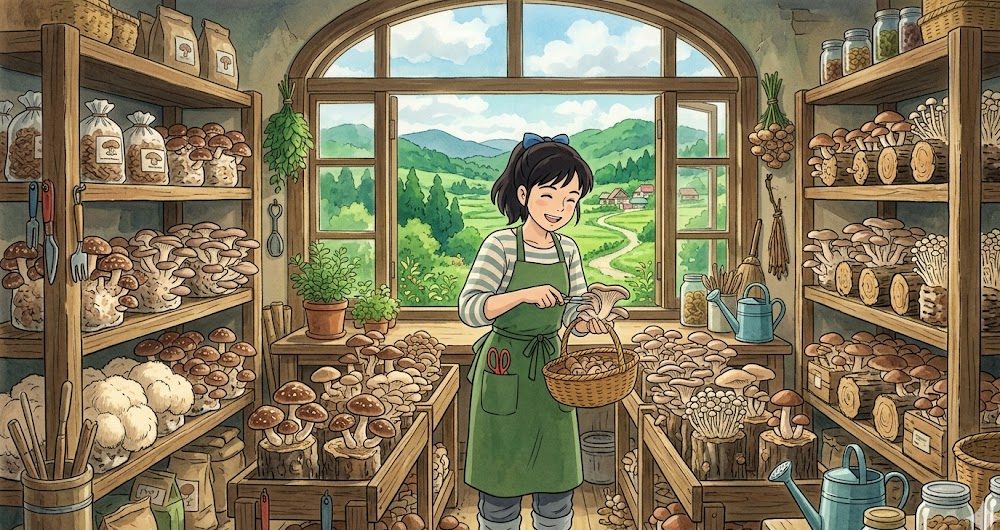
Mushroom farming has evolved from a niche hobby into one of the most profitable agribusinesses globally. Unlike traditional crops that require vast acres of land and specific seasons, mushrooms can be grown indoors, year-round, using vertical space. This makes it an ideal venture for urban entrepreneurs, small-scale farmers, and those looking for a high-margin agricultural business.
1. Why Mushroom Farming? The Economic Edge
The global demand for mushrooms is skyrocketing due to their nutritional profile—high in protein, fiber, and vitamins, yet low in fat. For a farmer, the benefits are clear:
- Low Space Requirement: You can grow hundreds of pounds of mushrooms in a single room using vertical racks.
- Fast Turnover: Some varieties go from “seed” to harvest in just 21 to 30 days.
- Waste Recycling: Mushrooms grow on agricultural waste like straw, sawdust, or sugarcane bagasse, turning “trash” into “cash.”
- High Profit Margin: Premium varieties like Oyster or Shiitake command excellent prices in local markets and gourmet restaurants.
2. Selecting the Right Variety
Success begins with choosing a mushroom that fits your climate and market demand.
| Mushroom Variety | Difficulty | Growth Cycle | Best Substrate |
|---|---|---|---|
| Oyster (Pleurotus) | Beginner | 3–4 Weeks | Wheat Straw, Wood Shavings |
| Button (Agaricus) | Intermediate | 6–8 Weeks | Pasteurized Compost |
| Milky (Calocybe) | Beginner | 5–7 Weeks | Straw (Thrives in heat) |
| Shiitake (Lentinula) | Advanced | 3–6 Months | Hardwood Logs/Sawdust |
Export to Sheets
3. The Cultivation Process: Step-by-Step
To achieve high yields, you must follow a disciplined scientific process. Mushroom farming is more like “lab work” than “field work.”
Step A: Substrate Preparation
The substrate is the “soil” for your mushrooms. For Oyster mushrooms, wheat or paddy straw is chopped and soaked in water.
Pro Tip: To prevent contamination, the substrate must be pasteurized. This involves steaming it or soaking it in hot water (approx. 80°C) for 2 hours to kill harmful bacteria and fungi.
Step B: Inoculation (Spawning)
Once the substrate cools down, “spawn” (mushroom seeds) is mixed into it. This process should be done in a sterilized environment. The mixture is then packed into perforated plastic bags.
Step C: Incubation (The Run)
The bags are kept in a dark, warm room (20°C to 25°C). During this phase, the mycelium (white root-like structure) spreads across the substrate. When the bag turns completely white, it is ready for the next stage.
Step D: Fruiting
This is where the magic happens. The bags are moved to a room with:
- Fresh Air: High oxygen levels are crucial.
- Humidity: 80–90% humidity is required (use a humidifier or spray water on walls).
- Light: Indirect, dim light triggers the growth of the mushroom “caps.”
4. Critical Success Factors: The “Lab” Mindset
The biggest challenge in mushroom farming isn’t the growth—it’s contamination. A single mold spore can ruin an entire batch.
- Hygiene: Always wear gloves and masks. Sanitize the room with bleach or disinfectant before starting a new cycle.
- Climate Control: Mushrooms are sensitive. Small fluctuations in CO2 levels or temperature can result in “leggy” mushrooms or small caps.
- Water Quality: Use clean, chlorine-free water for misting.
5. Financial Outlook & Investment
A small-scale indoor unit (approx. 500 sq. ft.) can be started with a modest investment.
- Fixed Costs: Racks, humidifiers, sprayers, and ventilation fans.
- Variable Costs: Spawn, substrate, electricity, and packaging.
In a well-managed setup, the Return on Investment (ROI) can be seen within the first two or three harvest cycles. Because you can harvest multiple “flushes” from a single bag, your output increases without additional seed costs.
6. Marketing and Scaling Your Business
You can have the best mushrooms in the world, but profit depends on your sales strategy.
- Direct-to-Consumer: Sell at local farmer’s markets or through subscription boxes.
- B2B: Partner with local cafes, pizza parlors, and high-end restaurants that value “farm-to-table” freshness.
- Value Addition: If you have surplus, don’t let it rot. Dry them, turn them into mushroom powder, or create “mushroom jerky.” Dried mushrooms have a shelf life of over a year and often sell for a premium.
7. Challenges to Consider
While profitable, it is not “easy money.” You must be prepared for:
- Pests: Fungus gnats can be a nuisance.
- Short Shelf Life: Fresh mushrooms last only 3–5 days. Cold storage (refrigeration) is mandatory.
- Labor Intensive: Harvesting and packaging require a gentle, manual touch.
Conclusion
Mushroom farming is a rare business opportunity that aligns environmental sustainability with high profitability. By utilizing vertical space and agricultural by-products, you can build a resilient income stream. Whether you start in a spare room or a dedicated warehouse, the key is to start small, master the science of sterilization, and gradually scale as you understand your local market.
The “Fungi Kingdom” offers a world of potential—it’s time to start growing.
Would you like me to expand on the specific cost-benefit analysis for a particular variety, like Oyster or Button?