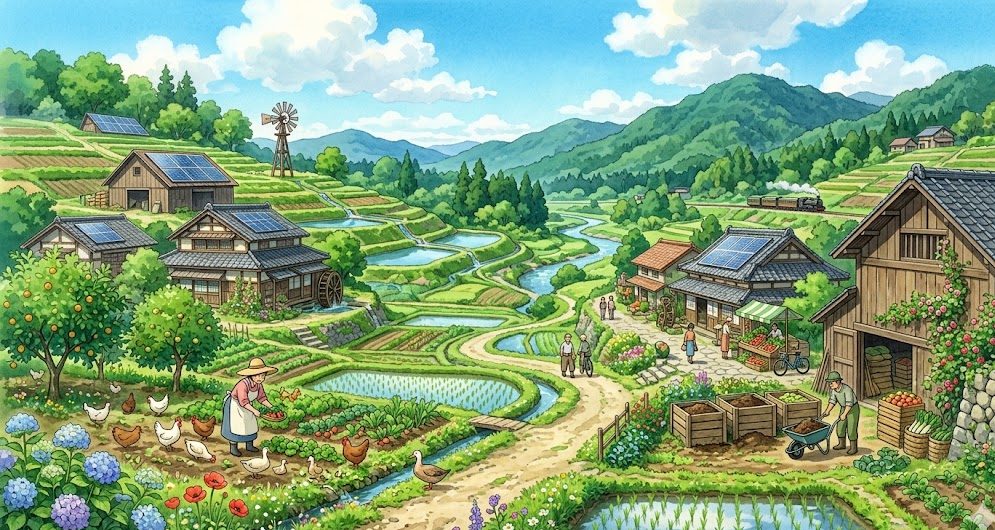
Introduction: The Imperative for Agricultural Evolution
The global food production ecosystem is facing an unprecedented convergence of challenges. Rapidly depleting groundwater tables, severe topsoil erosion, unpredictable weather anomalies, and tightening environmental regulations are forcing a paradigm shift in agronomy. The conventional agricultural model—highly dependent on heavy chemical inputs and intensive structural manipulation—is proving unsustainable and economically volatile.
To secure long-term food security and maintain operational profitability, the industry must transition toward Future-Proof Agriculture. This approach integrates ecological engineering, biomimicry, and nature-focused practices to design self-sustaining farming systems. By establishing structural resilience within the farm ecosystem, future-proof agriculture minimizes dependency on synthetic inputs, maximizes resource efficiency, and actively regenerates the environment. This article outlines the step-by-step methodologies and eco-friendly strategies required to build a climate-smart, sustainable farming enterprise.
1. Regenerative Soil Management: Building the Sub-Surface Shield
The foundation of a future-proof farm is its living soil matrix. Conventional farming treats soil as a dead substrate used merely to hold plants upright while flooding it with synthetic N-P-K fertilizers. Regenerative management, however, views soil as a complex biological engine that must be nurtured.
Conservation Tillage and No-Till Mechanics
Mechanical plowing destroys the intricate subterranean networks formed by mycorrhizal fungi and beneficial soil microorganisms. Intensive tillage exposes hidden organic matter to oxygen, causing rapid carbon loss through greenhouse gases. Future-proof systems utilize no-till or strip-till mechanics. By leaving the soil undisturbed, the natural soil architecture is preserved, significantly improving water infiltration rates, preventing topsoil erosion from heavy rain, and maintaining a thriving biological habitat for macro and micro-fauna.
Advanced Multi-Species Cover Cropping
Leaving fields bare between commercial crop seasons accelerates nutrient leaching and weed invasion. Multi-species cover cropping solves this by keeping a continuous living root system in the ground year-round. A strategic cover crop blend combines:
- Deep-Rooting Radishes: Physically fracture compacted soil layers, improving deep root aeration.
- Legumes (Clover, Vetch): Form a symbiotic relationship with Rhizobium bacteria to naturally fix atmospheric nitrogen into the soil.
- Grasses (Rye, Oats): Produce high biomass, building a thick organic surface layer that suppresses weed germination and acts as a natural living mulch.
+------------------------------------------------------------------------+
|                    THE FUTURE-PROOF FARM SYSTEM LOOP                   |
+------------------------------------+-----------------------------------+
| 1. Regenerative Soil Matrix        | 2. Closed-Loop Hydrology          |
| - Continuous no-till architecture  | - Subterranean drip infrastructure|
| - High-biomass multi-species cover | - Automated moisture-sensor zones |
+------------------------------------+-----------------------------------+
| 3. Integrated Poly-Ecosystems      | 4. Biological Protection Shield   |
| - Agroforestry microclimates       | - Allelopathic weed suppression   |
| - Multi-tier animal integration    | - Beneficial predatory insect zones|
+------------------------------------+-----------------------------------+
2. Closed-Loop Hydrological Design: Advanced Water Conservation
Water scarcity is one of the most immediate threats to global agricultural production. Future-proof agriculture abandons wasteful flood irrigation methods in favor of high-efficiency, closed-loop hydrological architectures.
Subterranean Drip and Fertigation Loops
Subterranean drip irrigation delivers water directly to the plant’s root zone via buried porous laterals. This framework eliminates water loss through surface evaporation and surface runoff, dropping overall water consumption by up to 60%. When coupled with automated fertigation units, water-soluble organic nutrients are spoon-fed to the crops in precise micro-doses based on their specific growth stages, eliminating nutrient leaching and preserving local groundwater quality.
Landscape-Level Water Harvesting
To protect the farm against prolonged droughts, the macro-landscape must be structurally engineered to slow, spread, and sink rainwater. Implementing contour swales (shallow, level ditches dug along landscape curves), living bioswales, and native rain gardens captures sudden stormwater rushes. Instead of allowing water to erode fields and wash away topsoil, these landscape features slow down the flow, giving the water ample time to filter through the soil and recharge the local aquifer, ensuring sub-surface moisture reserves remain stable throughout dry seasons.
3. Integrated Micro-Ecosystems: Diversification Through Symbiosis
Single-commodity monoculture farming creates an incredibly fragile economic and biological structure. If a specific pest attacks or market prices crash, the entire agricultural enterprise faces collapse. Future-proof designs mitigate this risk through tightly integrated polycultural micro-ecosystems.
Agroforestry and Microclimate Engineering
Agroforestry consciously integrates long-term woody perennials (fruit, nut, or timber trees) alongside annual agricultural crops on the same plot of land. The multi-tiered layout functions as an intentional ecological shield:
- The Canopy Layer: Tall timber or windbreak trees shield delicate lower crops from scorching sun and destructive high winds, lowering ambient temperatures and reducing crop transpirational stress.
- The Productive Understory: Shorter fruit or nitrogen-fixing leguminous trees utilize different root depths, pulling up deep sub-surface minerals to the topsoil layer where shallow-rooted annual crops can access them.
Circular Crop-Livestock Integration
The most efficient, self-sustaining farms operate as zero-waste production loops. In a smart crop-livestock framework, crop residues that would traditionally be burnt are harvested and processed into high-fiber fodder for livestock (such as goats, cattle, or poultry). The organic manure generated by the animals is fed into anaerobic digestion systems to generate clean biogas energy for the farm’s operational infrastructure. The remaining nutrient-dense biogas slurry is returned straight to the crop fields as a premium, weed-seed-free organic fertilizer, entirely replacing expensive synthetic chemical options.
4. Advanced Biological Crop Protection: The Smart Shield
Managing weeds, pests, and plant diseases without heavy chemical pesticides requires deploying nature’s internal check-and-balance systems. This is the core methodology of Integrated Pest and Weed Management (IPM/IWM).
Allelopathic Bio-Shields for Weed Control
Rather than deploying toxic pre-emergent herbicides, sustainable farming utilizes the natural biochemical defenses of plants. Certain species release target compounds from their root systems that inhibit the germination of neighboring weed seeds—a process called allelopathy. Integrating allelopathic cover crops like winter rye, sorghum, or sunflowers into the commercial crop rotation creates a natural sub-surface biochemical shield, keeping fields clean during the critical early growth stages of the primary cash crop.
Enhancing Trophic Cascades with Beneficial Insects
Chemical insecticides are non-selective; they kill beneficial predatory insects alongside the target pests, triggering a vicious cycle of chemical dependency. Future-proof farms actively design habitats for predatory insects, birds, and bats by planting specialized insectary strips (wildflowers, herbs, and native hedgerows) around field borders. Establishing these conservation zones keeps populations of ladybugs, lacewings, and parasitic wasps stable. These natural predators execute biological control, suppressing devastating pest outbreaks naturally without causing chemical resistance or leaving toxic residues on the final harvest.
Conclusion: Activating the Future-Proof Blueprint
Transitioning to future-proof agriculture demands a profound shift in mindset away from input-heavy cultivation toward ecological system design. True sustainability is not achieved by finding alternative chemical substitutions, but by redesigning the farm to operate as a self-healing, self-regulating ecosystem.
By combining low-disturbance no-till management, closed-loop precision hydrology, symbiotic agroforestry loops, and biological protection systems, growers can establish a highly predictable and resilient agricultural asset. This integrated methodology drastically reduces input overhead, mitigates climate-driven production risks, and steadily regenerates the natural vitality of the earth. Ultimately, activating this eco-friendly blueprint guarantees that your agricultural enterprise remains profoundly productive, environmentally responsible, and highly profitable for the decades to come.