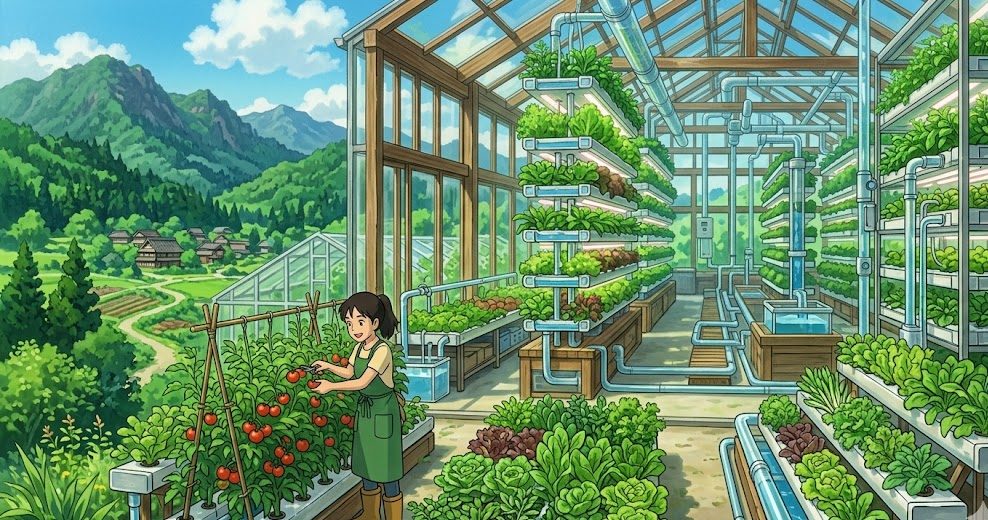
The global food system is at a crossroads. With arable land shrinking due to urbanization and climate change making traditional soil-based farming increasingly unpredictable, the world is looking for a more stable, efficient way to feed itself. The answer lies in Advanced Hydroponic Systems.
Hydroponics—the method of growing plants in a water-based, nutrient-rich solution instead of soil—has evolved from small-scale experiments into a high-tech agricultural powerhouse. Today, these systems are the backbone of the “Vertical Farming” revolution, allowing crops to be grown in the heart of deserts, the middle of skyscrapers, and even in outer space.
In this guide, we will explore the mechanics of advanced hydroponics, the systems driving the industry forward, and why this technology is the definitive future of sustainable agriculture.
What Makes a Hydroponic System “Advanced”?
While the basic concept of hydroponics is simple (roots in water), Advanced Hydroponics integrates modern technology to remove human error and maximize biological potential. These systems utilize:
- Precision Nutrient Delivery: Using sensors to maintain exact ratios of Nitrogen, Phosphorus, and Potassium (NPK).
- Automated pH Balancing: Real-time adjustments to ensure the water remains at the optimal acidity for nutrient uptake.
- Climate Control Integration: Syncing the water system with CO2 injectors, LED grow lights, and humidity controllers to create a “perfect” 24/7 growing season.
Top 3 Advanced Hydroponic Systems Dominating the Industry
As we move into 2026, three specific configurations have emerged as the most efficient for commercial and high-yield home production.
1. Aeroponics: The “Mist” Revolution
Aeroponics is considered the pinnacle of hydroponic technology. Instead of submerging roots in a liquid solution, the roots hang in the air and are periodically misted with a nutrient-dense spray.
- The Advantage: Roots have maximum access to oxygen, which leads to growth rates up to 300% faster than soil.
- Best For: Leafy greens, herbs, and even some root vegetables like seed potatoes.
2. Nutrient Film Technique (NFT)
In an NFT system, a very shallow stream of nutrient-rich water (the “film”) constantly flows over the roots of the plants, which are housed in long, tilted channels.
- The Advantage: It uses minimal water and is highly scalable. It is the preferred method for commercial lettuce and basil production worldwide.
- Key Tech: Advanced NFT systems now use flow sensors that alert a farmer’s smartphone the second a pump fails, preventing crop loss.
3. Deep Water Culture (DWC) with Recirculation (RDWC)
DWC involves suspending plants in a reservoir where the roots stay permanently submerged in highly oxygenated water. In Advanced RDWC, the water is constantly circulated between multiple reservoirs to ensure uniform nutrient distribution and temperature.
- The Advantage: It is incredibly stable. Because the water volume is high, pH and nutrient levels don’t fluctuate as wildly as in smaller systems.
- Best For: Large, “hungry” plants like tomatoes, peppers, and cucumbers.
The Role of IoT and AI in Modern Hydroponics
The “Smart” in Smart Farming comes from the integration of the Internet of Things (IoT). In advanced setups, the system is no longer just a series of pipes; it is a data-driven ecosystem.
- Remote Monitoring: Farmers can now manage thousands of plants from a laptop. If the water temperature rises by even 1°C, the system can automatically trigger a water chiller.
- Predictive AI: Modern software analyzes the growth rate of a crop and can predict exactly when it will be ready for harvest, down to the hour. This allows for seamless supply chain management with grocery stores and restaurants.
- Light Recipes: Advanced LED systems can change their “spectrum” (color of light) depending on the plant’s growth stage. For example, blue light is used for leafy growth, while red light is boosted during the flowering stage to increase fruit yield.
Environmental and Economic Benefits
Why are investors pouring billions into advanced hydroponics? The numbers speak for themselves.
1. Water Conservation
Traditional agriculture is responsible for nearly 70% of global freshwater use. Hydroponic systems are “closed-loop,” meaning water is recycled rather than lost to the soil. Advanced systems use 90% to 95% less water than traditional farming.
2. Zero Pesticide Requirement
Because hydroponic systems are usually housed in controlled indoor environments, the risk of soil-borne pests and diseases is virtually eliminated. This allows growers to produce “organic-quality” food without the need for toxic chemical pesticides.
3. Year-Round Food Security
Hydroponics decouples farming from the weather. A drought in the Midwest or a frost in Florida doesn’t affect a hydroponic facility. This stability is essential for maintaining food prices and supply chains in an era of climate volatility.
4. Hyper-Local Production
Since these systems don’t need fertile soil, they can be built in urban centers. Growing food in a “Vertical Farm” in New York City for New York consumers eliminates the carbon footprint of shipping produce across the country.
Challenges and The “High-Barrier” Entry
Despite the benefits, advanced hydroponics isn’t a “get rich quick” scheme. It requires:
- High Initial Capital: The cost of sensors, LED lighting, and automation software is significant compared to buying a bag of soil and some seeds.
- Technical Expertise: A hydroponic farmer needs to be part-biologist and part-engineer. If the power goes out and there is no backup, an entire crop can die within hours because there is no soil to hold moisture.
- Energy Dependence: While water use is low, electricity use (for lights and pumps) can be high. The industry is currently solving this by integrating solar panels and wind energy into farm designs.
The Road Ahead: 2026 and Beyond
As we look toward the future, we are seeing the rise of “Full-Stack Automation.” We are entering an era where robots handle everything from seeding the hydroponic trays to harvesting and packaging the final product.
Furthermore, the “Bio-Hacking” of nutrient solutions is allowing us to grow food that is more nutritious than anything found in nature. By precisely controlling the minerals a plant absorbs, we can create “Functional Foods”—for example, lettuce with higher iron content or tomatoes with 3x the standard lycopene (an antioxidant).
Conclusion
Advanced Hydroponic Systems are no longer a niche curiosity for tech enthusiasts. They are a multi-billion dollar solution to some of the world’s most pressing problems: water scarcity, land degradation, and food insecurity.
For the modern entrepreneur, the opportunity lies in the intersection of technology and biology. By mastering the flow of water and nutrients, we aren’t just growing plants; we are engineering the future of human survival. Whether you are looking to build a small-scale “smart garden” or a massive commercial vertical farm, the message is clear: the future of farming is soilless.
Is your agribusiness ready for the hydroponic shift? Let us know in the comments which system you think is most efficient!