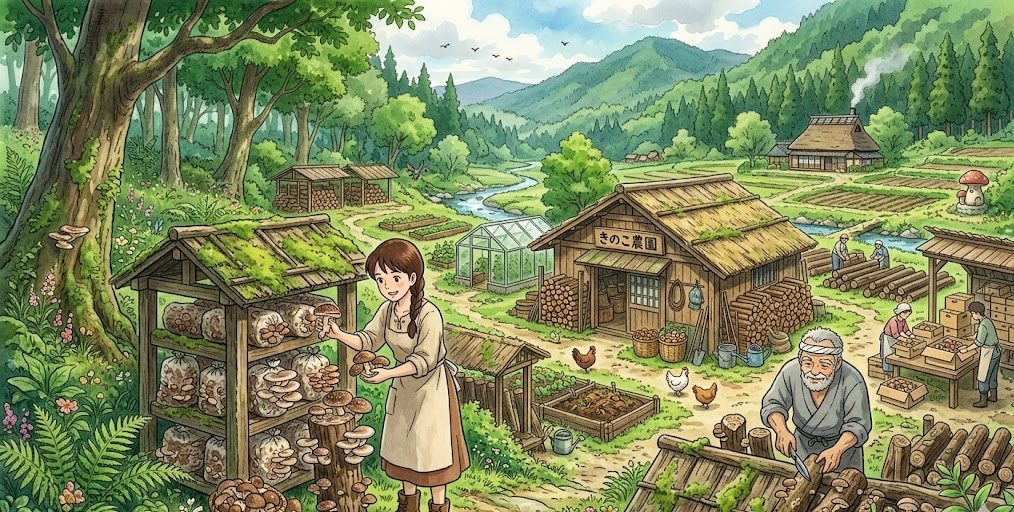
Mushroom farming has emerged as one of the most profitable and sustainable agribusiness ventures in the modern world. Unlike traditional crops that require vast acres of land and heavy machinery, mushrooms can be grown indoors, vertically, and on agricultural waste.
For the “agropreneur,” organic mushroom cultivation offers a unique advantage: high market demand, premium pricing, and a fast production cycle. Whether you are looking to start a small home-based business or a commercial-scale facility, this manual provides the technical roadmap to success.
1. Why Choose Organic Mushroom Farming?
Before diving into the “how,” it is essential to understand the “why.” Mushrooms are the ultimate “waste-to-wealth” crop. They grow on substrates like wheat straw, sawdust, or sugarcane bagasse—materials that are often burned or discarded.
- Fast ROI: Some varieties, like Oyster mushrooms, can be harvested within 21 to 25 days.
- Space Efficiency: Using vertical racking systems, you can produce hundreds of kilograms of mushrooms in a single room.
- Organic Premium: Health-conscious consumers and high-end restaurants are willing to pay significantly more for certified organic, chemical-free produce.
2. Selecting the Right Variety
Not all mushrooms are created equal. Your choice should depend on your local climate and your target market.
- Oyster Mushrooms (Pleurotus spp.): The best choice for beginners. They are hardy, grow on almost any agricultural waste, and have a wide temperature tolerance.
- Button Mushrooms (Agaricus bisporus): The most popular variety globally but require more advanced temperature control and specialized compost.
- Milky Mushrooms: Ideal for hot climates, as they thrive in temperatures between 30°C and 35°C.
- Shiitake and Lion’s Mane: High-value medicinal mushrooms that require wood-based substrates and longer incubation periods but fetch a much higher market price.
3. Step 1: Substrate Preparation (The Foundation)
The substrate is the “soil” for your mushrooms. Since we are focusing on organic farming, the substrate must be free from synthetic pesticides and heavy metals.
- Selection: Use clean wheat straw, paddy straw, or hardwood sawdust.
- Sterilization/Pasteurization: This is the most critical step. You must eliminate “competitor” molds.
- Hot Water Treatment: Soak the substrate in water at 65°C to 70°C for 2 hours.
- Steam Sterilization: For commercial setups, using a boiler to steam the substrate is more efficient.
- Moisture Balancing: After sterilization, drain the straw until it is moist but not dripping. A simple “squeeze test” should leave your hand damp without water running down your arm.
4. Step 2: Spawning (Inoculation)
“Spawn” is the mushroom equivalent of seeds. For organic farming, ensure your spawn is sourced from a laboratory that uses organic grains (like millet or sorghum).
- Cleanliness: This stage must be done in a sterilized environment. Use surgical gloves and disinfect your hands with alcohol.
- Mixing: Mix the spawn into the cooled substrate at a ratio of approximately 2% to 3% by weight.
- Bagging: Pack the inoculated substrate into perforated polypropylene bags. Ensure the packing is firm but not so tight that air cannot circulate.
5. Step 3: Incubation (The Dark Phase)
Once the bags are ready, they go into the “Spawn Run” or incubation room.
- Environment: This room should be kept dark. Mushrooms do not need light to grow their root system (mycelium).
- Temperature: Keep the room between 22°C and 28°C for most varieties.
- The Goal: Over the next 15 to 20 days, the white mycelium will spread throughout the bag. When the bag is completely white and looks like a block of cotton, it is ready for the next stage.
6. Step 4: Fruiting (The Harvest Phase)
This is where the magic happens. You must change the environment to “shock” the mycelium into producing mushrooms.
- Fresh Air (Oxygen): Increase ventilation. Mushrooms exhale CO2, and high levels will result in small caps and long, rubbery stems.
- Humidity: Maintain a relative humidity of 80% to 90%. Use a fogger or spray a fine mist of water on the walls and floors (never directly on the mushrooms).
- Light: Provide indirect, diffused light (like a shaded window). This signals the fungus to grow “fruiting bodies.”
- Pinning: Small “pinheads” will appear in 3-5 days, which will grow into full-sized mushrooms within 48 hours.
7. Step 5: Harvesting and Storage
Timing is everything. For Oyster mushrooms, harvest before the edges of the caps start to curl upward.
- Technique: Gently twist the mushroom from the base; avoid cutting with a knife, as left-behind stems can rot and cause infection in the next “flush.”
- Flushes: A single bag can give you 3 to 4 “flushes” (harvests) every 10 days.
- Storage: Mushrooms are 90% water. Store them in paper bags in a refrigerator. Never use plastic bags for fresh mushrooms, as they will sweat and spoil quickly.
8. Pest and Disease Management
In organic farming, you cannot use chemical fungicides. Prevention is your only tool.
- Green Mold (Trichoderma): Usually caused by poor sterilization. If you see green spots, remove the bag from the room immediately to prevent it from spreading.
- Fungus Gnats: Use yellow sticky traps and fine mesh screens on windows to keep insects out.
- Air Filtration: Use HEPA filters or simple cotton filters on air intake vents to keep the room sterile.
9. Market Strategy for Organic Growers
Growing the mushrooms is only half the battle. Selling them effectively is where the profit lies.
- Value Addition: If you have unsold fresh mushrooms, dry them. Dried mushrooms have a shelf life of one year and can be ground into “Mushroom Powder” for soups or health supplements.
- Direct-to-Consumer: Sell at local farmers’ markets or through organic subscription boxes.
- B2B: Approach local cafes and “farm-to-table” restaurants that value organic sourcing.
Quick Reference: The Mushroom Success Table
| Phase | Duration | Critical Factor | Requirement |
|---|---|---|---|
| Preparation | 1 Day | Sterilization | 70°C for 2 hours |
| Incubation | 15-20 Days | Darkness | 25°C Constant |
| Fruiting | 7-10 Days | Humidity | 85% RH + Fresh Air |
| Harvesting | 2 Days | Timing | Harvest before caps curl |
Export to Sheets
Conclusion: Growing Your Future
Organic mushroom farming is a perfect blend of science and art. It requires discipline, cleanliness, and a keen eye for detail. By following this step-by-step manual, you can transform agricultural waste into a high-value superfood that benefits both your bank account and the planet.
The beauty of this business is its scalability. Start in a small spare room, master the technique, and grow into a commercial powerhouse. In the world of organic farming, the mushroom is king.