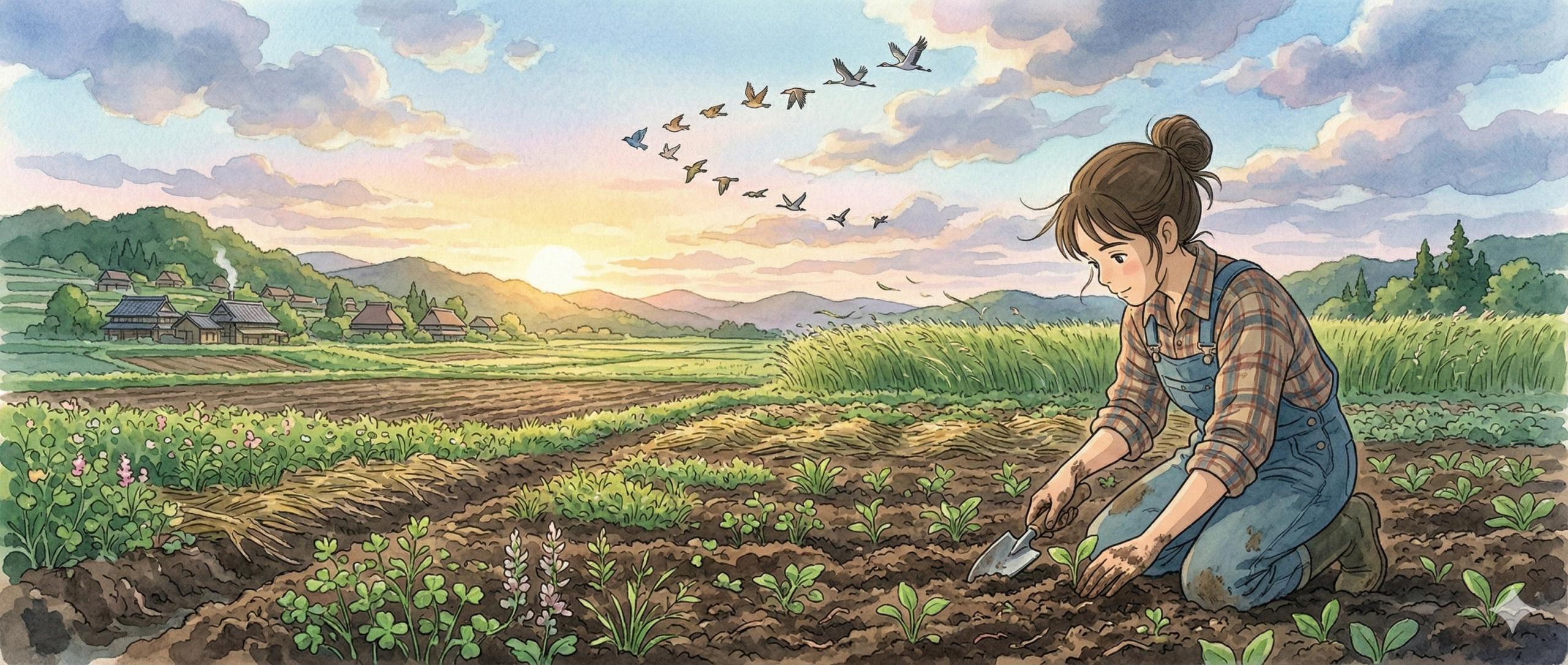
What if the secret to reversing climate change was right beneath our feet? It sounds like a bold claim, but scientists estimate that global soils can store up to three times more carbon than the entire atmosphere. Despite this incredible potential, our current industrial farming methods have turned our fields into “dirt”—a lifeless medium that requires constant chemical injections to produce a harvest. We are essentially mining the earth, leaving behind dust bowls and nutrient-depleted produce.
The challenge is that “sustainable” farming is no longer enough; we cannot simply sustain a degraded system. We need to heal it. Regenerative Agriculture serves as the ultimate solution, shifting the goal from “doing less harm” to “actively doing good.” It is a holistic approach that mimics nature to rebuild organic matter and restore soil biodiversity. This article provides a comprehensive roadmap of the core practices that turn barren land into thriving ecosystems, explaining how these techniques improve soil health, boost crop resilience, and offer a path toward a cooler, greener planet.
Understanding Regenerative Agriculture: Key Concepts and Importance
Regenerative agriculture is not a single product or a specific brand; it is a philosophy based on five core principles: minimizing soil disturbance, maximizing crop diversity, keeping the soil covered, maintaining living roots year-round, and integrating livestock. While industrial agriculture relies on “chemistry” (fertilisers and pesticides), regenerative agriculture relies on “biology” (bacteria, fungi, and earthworms).
Think of soil like a giant underground city. In a healthy city, you have complex infrastructure—tunnels built by worms, “highways” created by fungal mycelium, and a bustling population of microbes exchanging nutrients for carbon. Conventional farming is like a massive earthquake that happens every season (tilling), followed by a toxic gas leak (pesticides). It destroys the infrastructure and kills the workforce.
By contrast, regenerative practices act as urban renewal. By leaving the soil alone and feeding the microbes with diverse plant roots, we allow the underground city to rebuild itself. This modern movement draws heavily from indigenous land management, proving that when we stop fighting nature and start facilitating it, the earth responds with exponential vitality.
Why It Matters: The Top Benefits of Regenerative Practices
The transition to regenerative methods creates a ripple effect of benefits that extend far beyond the farm gate.
- Enhanced Water Retention: Soil rich in organic matter acts like a giant sponge. For every 1% increase in soil organic matter, an acre of land can hold an additional 20,000 gallons of water, drastically reducing the impact of both droughts and floods.
- Carbon Sequestration: Through photosynthesis, plants pull $CO_2$ from the air and pump carbon sugars into the soil to feed microbes. This process turns our farmland into a massive “carbon sink,” helping to mitigate global warming.
- Nutrient Density: Healthier soil produces healthier food. Plants grown in regenerative systems have access to a wider array of micronutrients, resulting in crops with higher antioxidant and mineral content.
- Economic Independence: By eliminating the need for expensive synthetic inputs, farmers can significantly reduce their overhead costs, making their businesses more resilient to market fluctuations and rising chemical prices.
Pro Fact: Only 5% of the soil is made up of organic matter, yet that small percentage controls nearly 90% of the soil’s biological functions, including nutrient cycling and pest suppression.
How to Get Started: A Practical Guide for Beginners
You don’t need a thousand-acre ranch to start practicing regeneration. Whether you have a community garden plot or a small backyard, these five steps will help you rebuild your soil health.
Step 1: Ditch the Tiller (No-Till)
The most important rule is to stop digging. Tilling exposes soil microbes to UV light and oxygen, which kills them and releases stored carbon. Instead of digging, use broadforks or simply layer organic matter on top of the surface.
Step 2: Plant Cover Crops
Never leave your soil “naked.” Bare soil is vulnerable to erosion and heat. Plant “green manures” like clover, vetch, or rye during the off-season. These plants protect the surface and keep living roots in the ground to feed the soil biology.
Step 3: Increase Diversity (Polycultures)
Nature never grows just one thing. Mix your vegetables with flowers, herbs, and different crop families. Diversity above ground leads to diversity below ground, as different plants exude different types of sugars that attract various beneficial microbes.
Step 4: Use High-Quality Compost and Mulch
Feed your soil from the top down. Use wood chips, straw, or leaf mold to cover the surface. As these materials break down, they provide a steady stream of food for earthworms and fungi, creating a rich humus layer.
Step 5: Integrate “Mobile” Fertilizers
If you have space, consider a “chicken tractor” or small-scale grazing. Animal manure and the mechanical action of hooves (when managed correctly) stimulate grass growth and provide an immediate, natural nutrient boost to the soil.
Beginner’s Tip: Start by observing your earthworm count. Dig a 12-inch cube of soil; if you find fewer than 10 worms, your soil biology is struggling. Aim for a “worm-rich” environment as your primary indicator of success.
Overcoming Challenges and Looking into the Future
The primary hurdle in regenerative agriculture is the “Transition Dip.” During the first 2-3 years of stopping chemical use, yields may decrease while the soil biology is still “waking up.” The solution is to transition slowly—reduce chemicals by 20% each year while increasing compost applications. Another challenge is Weed Management without tilling. This is solved through “crimping” cover crops (flattening them to create a natural weed-suppressing mat) or using heavy mulching.
The future of this movement is incredibly bright, with Soil Carbon Credits becoming a new revenue stream for farmers. Companies are now paying land managers for the amount of carbon they successfully sequester in their soil. Furthermore, advancements in metagenomics allow us to sequence the DNA of soil microbes, giving farmers a “weather report” for their underground ecosystem. As we move toward 2030, regenerative agriculture will likely transition from a “fringe” movement to the gold standard of global food production.
Conclusion
Regenerative agriculture is the bridge between our industrial past and a sustainable future. It reminds us that we are not separate from the earth, but part of a complex, breathing system. By focusing on soil health, we solve multiple problems at once: we feed ourselves better, we protect our water, and we help heal the atmosphere.
Your Task: Stop digging. This weekend, instead of turning over your garden beds, simply cover them with two inches of high-quality compost and a layer of straw.
We don’t just inherit the earth from our ancestors; we borrow it from our children. Let’s return it to them in better shape than we found it.
Frequently Asked Questions (FAQs)
1. Is regenerative agriculture just “organic” farming under a different name?
Not quite. Organic focuses on what you don’t use (no chemicals). Regenerative focuses on the results (increasing soil organic matter and biodiversity). You can be organic without being regenerative, but the best systems are both.
2. Can regenerative methods feed the growing global population?
Yes. While some grain yields might be slightly lower initially, the total “calorie per acre” and “nutrient per acre” are often higher because regenerative systems allow for multiple types of food to be grown in the same space simultaneously.
3. Does regenerative farming require animals?
While livestock integration is a core principle because of how they cycle nutrients, “vegan-organic” regenerative systems exist. These use green manures and fermented plant juices to provide the same biological stimulation that animals provide.
4. How long does it take to see results in the soil?
You will see earthworms return within months. However, significantly increasing soil organic matter (the dark, spongy stuff) usually takes 3 to 5 years of consistent practice.