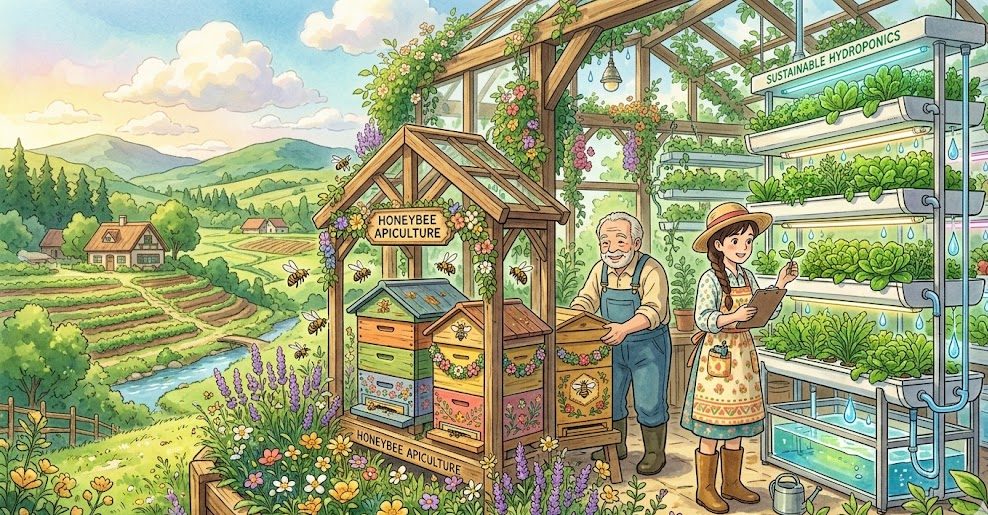
In the quest for long-term agricultural resilience, we are witnessing a shift away from traditional, resource-heavy farming. Modern, sustainable agriculture is increasingly defined by its ability to produce high-value yields while regenerating the environment. Two of the most promising pillars of this movement are advanced beekeeping (apiculture) and hydroponic systems.
When integrated, these technologies form a symbiotic relationship that maximizes productivity, minimizes space usage, and promotes ecological stability. This article explores how combining these two innovations can elevate your farming operation to a new level of excellence.
1. The Role of Apiculture in Sustainable Systems
Beekeeping is often overlooked as a technical agricultural enterprise, but it is the backbone of food security. Over 75% of the world’s food crops depend on pollination. Advanced apiculture is not just about honey production; it is about managing “pollination services” as a critical asset for your farm.
Smart Beekeeping Innovations
Modern apiculture has evolved far beyond wooden boxes. Today’s sustainable farmers are utilizing:
- IoT Hive Monitoring: Sensors inside the hive track temperature, humidity, and hive weight. An alert can tell you if a hive is overheating or if the colony is starving, allowing for precise interventions that prevent colony collapse.
- Acoustic Analysis: AI-powered tools can now analyze the “hum” of a hive to predict swarming behaviors or detect the presence of pests like the Varroa mite, enabling farmers to protect their colonies without harmful chemical treatments.
- Integrated Pollination Planning: By strategically placing hives near your high-value crops, you can increase yields by up to 30% without changing your soil management or fertilizer inputs.
2. Hydroponics: The Future of Resource Efficiency
If beekeeping is about biological optimization, hydroponics is about structural optimization. Hydroponics is the practice of growing plants without soil, using mineral-rich water solutions. It is the ultimate tool for farmers facing water scarcity or poor soil quality.
Why Hydroponics Wins on Sustainability
- Water Conservation: Hydroponic systems use up to 90% less water than traditional soil-based farming. The water is recirculated within the system, making it ideal for arid regions or urban environments.
- Vertical Expansion: Because you aren’t tied to the quality of your topsoil, you can grow upwards. Vertical hydroponic towers allow you to produce ten times the yield of a traditional field on the same footprint.
- Climate Control: Hydroponics allows you to grow year-round, regardless of the weather outside. By controlling the light, temperature, and nutrients, you eliminate the risk of crop loss due to erratic weather patterns.
3. The Synergistic Potential: Connecting Hives and Hydroponics
The true genius of advanced sustainable farming lies in the integration of these two systems. While hydroponics is often housed in greenhouses, beekeeping can be integrated to boost output.
Pollination in Controlled Environments
While many hydroponic crops (like leafy greens) are self-pollinating or wind-pollinated, high-value crops like strawberries, cucumbers, and tomatoes require active pollination to produce high-quality fruit.
- Controlled Environment Pollination: By integrating “smart hives” near or within controlled environments (with proper ventilation), you ensure that your fruiting crops reach their maximum potential.
- Ecological Health: Beekeeping promotes the presence of pollinators in your local area. A farm that hosts healthy bee colonies creates a “pollination zone” that supports not just your greenhouse crops, but the entire local ecosystem.
4. Economic Viability and High-Value Outputs
For the entrepreneurial farmer, sustainability must also be profitable. Combining these two systems creates multiple, non-overlapping revenue streams:
- High-Quality Produce: Hydroponically grown greens and fruits are often cleaner and have a longer shelf life, allowing them to be sold at a premium.
- Specialty Hive Products: Beyond honey, there is a massive market for bee pollen, propolis, and royal jelly—all of which are high-value products that require minimal extra land.
- Pollination Services: If your farm is near other large-scale growers, you can lease your colonies for professional pollination services, turning your biological assets into a service-based income stream.
5. Overcoming Barriers to Entry
Implementing these systems does require a shift in mindset and initial capital.
- Education: Spend time learning the biology of bees and the chemistry of nutrient solutions. These are precise fields.
- Phased Scaling: Do not attempt to build a massive greenhouse and a hundred-hive apiary simultaneously. Start with a small vertical hydroponic system to understand water balance, and one or two hives to understand bee behavior.
- Data Integration: Use the same management software to track your hydroponic nutrient pH and your hive health. Managing these as a singular “data dashboard” will make your farming life significantly easier.
Conclusion: Crafting a Resilient Agricultural Future
Advanced sustainable farming is about moving toward systems that support themselves. Hydroponics gives you control over the growth environment, while beekeeping brings the essential biological engine of pollination to your doorstep.
By embracing these innovations, you aren’t just farming; you are managing a complex, high-performing ecosystem. The farmers who succeed in the next decade will be those who stop viewing their land as a static space and start viewing it as a dynamic, interconnected system where every tool—from IoT sensors to bee colonies—serves a specific, profitable purpose.
What is the biggest hurdle you face when considering high-tech farming? Is it the initial setup cost or the technical learning curve? Share your thoughts below, and let’s discuss how to simplify the transition!