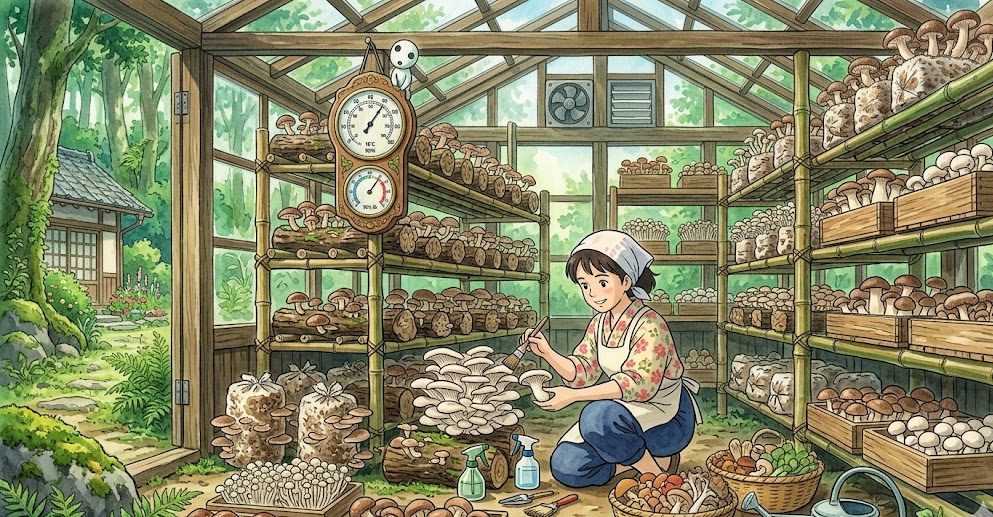
Unlike traditional green crops that rely on sunlight, soil, and open air, mushrooms are entirely different organisms. They don’t have roots, leaves, or seeds; instead, they grow from microscopic spores that form networks of thread-like structures called mycelium. Because they lack a protective outer skin, fungi are incredibly sensitive to their immediate atmosphere.
In the world of commercial or homestead mushroom cultivation, you don’t control the soil—you control the air.
The secret to transitioning from a hobbyist grower to a master cultivator lies in your ability to manipulate two critical environmental variables: temperature and humidity. If these two factors are even slightly misaligned, your crop can stall, fall victim to bacterial contamination, or completely dry out.
This ultimate guide will provide you with a professional blueprint for managing temperature and humidity across different growth stages to ensure a flawless, high-yielding mushroom harvest every single cycle.
The Dual Stages of Mushroom Growth
To manage a mushroom grow room professionally, you must first understand that a mushroom’s environmental needs change drastically during its lifecycle. A single grow room must transition through two distinct environmental zones:
1. The Incubation Phase (Mycelial Run)
During this phase, the mushroom spawn is actively eating its way through the substrate (such as sawdust, straw, or grain). The mycelium wants to stay hidden underground, mimicking conditions deep inside a damp, warm log or beneath forest leaf litter.
2. The Fruiting Phase (Pinning and Harvesting)
This phase is triggered when the fully colonized substrate is exposed to an environmental “shock.” This shock signals to the fungus that it has reached the outside air, prompting it to produce mushrooms (the fruiting bodies) to release its spores.
1. Mastering Temperature Control
Temperature acts as the biological throttle for mushrooms. If the temperature is too low, the metabolism of the mycelium slows down to a crawl, extending your production timeline. If the temperature is too high, the mycelium can literally overheat and die, or worse, encourage competitive molds like green trichoderma to wipe out your entire crop.
Managing Heat During Incubation
It is crucial to know that mycelium generates its own heat as it grows. If your incubation room ambient temperature is set to 24°C, the inside of your substrate bags could easily be sitting at 27°C or 28°C due to biological activity.
- The Rule of Thumb: Always keep your incubation room ambient temperature 2 to 3 degrees lower than the maximum target temperature of your specific strain.
- Control Methods: Use digital thermostat controllers hooked up to standard split-system air conditioners or small space heaters depending on your climate.
Shifting Temperatures for Fruiting
To force a block of mycelium to start producing pins (baby mushrooms), you generally need a temperature drop. For instance, while Oyster mushrooms incubate beautifully at 24°C, they require a drop to 15°C–18°C to trigger uniform, heavy pinning. This sudden cooling mimics the autumn rain that triggers wild mushrooms to pop up in nature.
2. Managing Humidity for Flawless Flushes
Mushrooms are roughly 90% water. Because they breathe through their cell walls and have no skin to lock in moisture, ambient humidity is the single most critical factor in determining whether your pins will mature or abort.
High Humidity for Pinning (95% – 100% RH)
When you first open your colonized bags to induce fruiting, the exposed mycelium is highly vulnerable to drying out. The Relative Humidity (RH) inside your fruiting chamber must be kept at a near-saturated level of 95% to 100%. This ultra-damp environment keeps the primordia (pins) soft and hydrated so they can easily push outward.
Lowering Humidity for Harvesting (85% – 90% RH)
Once the caps have formed and the mushrooms are actively growing in size, you must drop the humidity slightly to 85%–90% RH.
- Why? If the humidity stays at 100% during late growth, water will pool on the mushroom caps. This prevents the mushroom from transpiring naturally, leading to soggy, pale, and easily bruised mushrooms that have a terrible shelf life and are highly susceptible to bacterial blotch disease.
Environmental Targets by Mushroom Strain
Different mushrooms require radically different climates. Use this quick reference matrix to program your climate controllers accurately:
| Mushroom Species | Incubation Temp | Fruiting Temp | Pinning Humidity (RH) | Growth/Harvest Humidity |
| Pink Oyster | 24°C – 28°C | 20°C – 30°C | 95% – 100% | 85% – 90% |
| Blue/Grey Oyster | 20°C – 24°C | 10°C – 20°C | 95% – 100% | 85% – 90% |
| Lion’s Mane | 21°C – 24°C | 16°C – 19°C | 95% | 85% – 90% |
| Shiitake | 21°C – 25°C | 15°C – 18°C | 95% – 100% | 80% – 85% |
| King Oyster | 20°C – 23°C | 13°C – 16°C | 95% | 85% |
3. The Delicate Balance: Humidity vs. Fresh Air Exchange (FAE)
This is where most intermediate mushroom cultivators fail. Mushrooms breathe just like humans; they absorb Oxygen ($O_2$) and exhale Carbon Dioxide ($CO_2$).
During the fruiting phase, high levels of $CO_2$ will cause mushrooms to grow long, stringy, useless stems with tiny caps (often called “coral deformation”). To prevent this, you must run exhaust fans to introduce Fresh Air Exchange (FAE), replacing the room’s air 4 to 8 times every single hour.
The Cultivator’s Paradox
Every time your exhaust fan kicks on to suck out the toxic $CO_2$, it simultaneously sucks out all your carefully generated humidity, replacing it with dry outside air.
To solve this professionally, your humidity setup cannot rely on cheap home humidifiers. You need an automated system where your exhaust fans and humidifiers are linked via a digital hydrostat controller.
When the fan clears the air and the humidity drops, the hydrostat immediately activates a high-output ultrasonic mist maker or a centrifugal atomizing humidifier to pump micro-droplets back into the room instantly without soaking the mushroom caps.
4. Professional Hardware for Climate Automation
To run a hands-free, professional-grade mushroom operation, invest in the following modular automation components:
- Inkbird Temperature & Humidity Controllers: These dual-stage plug-and-play controllers allow you to plug in a heater/cooler and a humidifier/dehumidifier simultaneously. They feature waterproof sensor probes that hang directly in your crop canopy.
- Ultrasonic Mist Makers: Unlike traditional humidifiers that create large water droplets that fall and stain your mushrooms, ultrasonic units create a fine, floating fog ($<5$ microns) that hangs effortlessly in the air, giving perfect moisture coverage.
- Inline Inline Duct Fans (with Variable Speed Control): Look for EC-motor fans that allow you to precisely dial in your FAE rates without burning excessive electricity.
Final Thoughts: The Perfect Flush
Mushroom cultivation is a beautiful science of environmental mimicry. By keeping your incubation room warm and dark, dropping the temperature sharply to kickstart pinning, maintaining a near-saturated mist zone for early growth, and introducing crisp fresh air while maintaining an 85% relative humidity for final development, you unlock the absolute genetic maximum of your mushroom strains.
The formula is straightforward: Automate your hardware, monitor your parameters daily, and let the biology of the fungi do the rest of the heavy lifting.