The global food production industry is facing a massive space crisis. As urban centers expand, fertile agricultural land is rapidly diminishing, and real estate costs are climbing to unprecedented heights. For modern commercial growers, the traditional method of expanding horizontally over acres of soil is no longer financially viable.
The question driving modern agribusiness is simple: How can we produce maximum food using minimum space, water, and labor?
The answer lies in Commercial Hydroponic Farming. By eliminating soil entirely and delivering mineral-rich water solutions directly to plant roots, hydroponics allows growers to break free from geographic limitations. When managed with precision, a commercial hydroponic facility can produce up to 10 times the yield of a traditional soil farm within the exact same footprint.
Here is a comprehensive manual on how to design, optimize, and manage a small-space commercial hydroponic venture for maximum yields and profitability.
1. Choose the Right High-Density Hydroponic System
To squeeze maximum production out of a compact area, you must select a hydroponic configuration that optimizes both floor space and water circulation. While there are many hobbyist setups, commercial small-space operations rely on two primary systems:
A. Vertical Nutrient Film Technique (NFT)
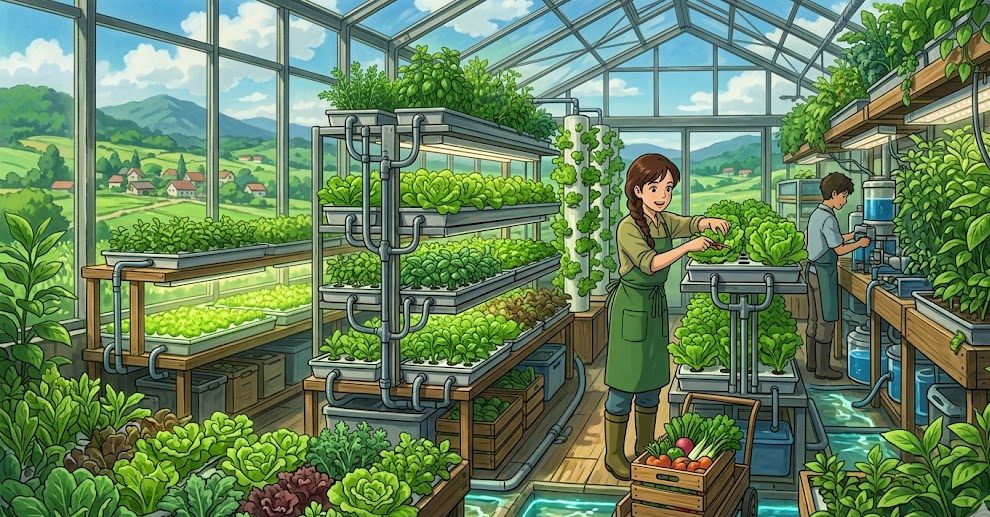
In a standard NFT system, a continuous, shallow stream of nutrient-rich water flows over the roots of the plants via gently sloped gullies. To maximize a small space, commercial growers stack these NFT channels vertically on A-frame racks or multi-tiered shelves. This multiplies your available growing footprint by 400% to 500% without purchasing extra land.
B. Vertical Aeroponic Towers
Aeroponics is the ultimate space-saving technology. Plants are secured along the sides of modular, vertical towers. Inside the column, a high-pressure pump atomizes the nutrient solution into a fine mist, spraying it directly onto the suspended roots at timed intervals.
- The Space Benefit: A single aeroponic tower occupying just 5 square feet of floor space can house up to 44 to 80 plants simultaneously.
2. Maximize Volumetric Space (Vertical Farming Layouts)
Traditional farming calculates yield per square foot of land. Commercial hydroponics calculates yield per cubic foot of volume. If your commercial facility has high ceilings (such as a warehouse, greenhouse, or shipping container), you must utilize that vertical clearance.
Floor-Bound Growing -> Static Output (Limited by Square Footage)
Multi-Tier Vertical Racks -> Scaled Output (Multiplied by Room Volume)
By investing in multi-tier rolling racks equipped with custom LED grow lights, you create an indoor matrix. Rolling racks allow you to eliminate permanent walkways between rows. When you need to tend to a specific crop row, you simply slide the racks apart, ensuring that 85% to 90% of your total room volume is actively producing crops rather than acting as empty floor space.
3. Implement Climate Automation and Environmental Control
In a high-density growing environment, plants are packed tightly together. This close proximity creates localized micro-climates with high humidity, which can stall plant transpiration and invite fungal pathogens like powdery mildew.
To maintain maximum yield velocity, your small-space hub must feature automated environmental tracking:
- Vapor Pressure Deficit (VPD) Management: Instead of just measuring relative humidity and temperature independently, commercial growers monitor VPD. Keeping the VPD in the sweet spot (typically between $0.8\text{ kPa}$ and $1.2\text{ kPa}$ for leafy greens) ensures that plants transpire perfectly, drinking nutrients at peak speeds.
- Air Turnover and CADR: Install high-volume oscillating fans and automated HVAC systems to ensure complete air turnover every 60 seconds. Constant, gentle airflow removes stagnant pockets of moisture from dense plant canopies.
4. Target Fast-Cycling, Premium Cash Crops
When space is limited, you cannot afford to grow crops with long gestation periods or low market values. Your crop choice must feature a high turnover rate and a premium retail price tag.
| Recommended Hydroponic Crop | Crop Cycle Duration | Space Efficiency Rating | Market Pricing Tier |
| Gourmet Basil (Genovese/Thai) | 21–28 Days | Extremely High | Premium (Local Cafes/Pizzerias) |
| Exotic Salad Mixes (Arugula/Kale) | 25–30 Days | High | Medium to High (Supermarkets) |
| Commercial Strawberries | Perennial (Continuous) | Medium to High | Luxury (Off-season premium) |
| Microgreens (Broccoli/Radish) | 7–10 Days | Maximum Density | High-End Retail / Chefs |
By focusing heavily on crops like loose-leaf lettuce, basil, and microgreens, your commercial facility can achieve 12 to 14 harvests per year, compared to just 2 or 3 harvests on a traditional outdoor soil farm.
5. Precision Nutrient Management: EC and pH Optimization
In soil, dirt acts as a buffer against nutrient mistakes. In hydroponics, there is no buffer. The water solution must be flawlessly balanced 24/7. Even a minor variation can stunt growth or cause root burn, instantly slashing your final yield weight.
- Electrical Conductivity (EC): EC measures the concentration of total dissolved solids (mineral salts) in your reservoir. Leafy greens require a lower EC (typically $1.2$ to $1.8\text{ mS/cm}$), while fruiting crops like tomatoes require a higher concentration ($2.0$ to $3.5\text{ mS/cm}$). Monitoring this via automated dosing pumps ensures crops are never underfed.
- pH Stability: Plants can only absorb nutrients if the water’s pH falls within a precise window (usually $5.5$ to $6.5$). If the pH drifts outside this range, a phenomenon known as “nutrient lockout” occurs. Plants will starve despite being submerged in minerals.
Using digital inline sensors that automatically correct EC and pH levels ensures that your plants grow at an accelerated rate, maturing up to 25% faster than their soil counterparts.
6. Utilize Supplemental Carbon Dioxide ($CO_2$) Injection
In a sealed, highly intensive indoor hydroponic room, tightly packed plants consume available carbon dioxide rapidly during lighting hours. If $CO_2$ levels drop below ambient outdoor levels (around $400\text{ ppm}$), plant photosynthesis grinds to a halt, limiting your output.
By integrating a commercial $CO_2$ generator or compressed gas tank regulated via environmental controllers, you can elevate indoor levels to $1,200\text{ ppm}$ to $1,500\text{ ppm}$. This rich atmosphere supercharges the photosynthesis engine, allowing crops to tolerate higher temperatures, utilize light more efficiently, and boost final harvest weights by up to 20%.
Conclusion
Commercial hydroponic farming in a small space proves that modern agriculture is a game of efficiency, not size. You do not need massive land holdings to run a high-earning commercial agricultural operation.
By stacking your systems vertically, selecting ultra-fast cycling crops, automating your climate controls, and maintaining strict control over your nutrient solutions, you can generate massive yields out of a standard warehouse or backyard plot. In the modern agricultural economy, precision is the ultimate multiplier.