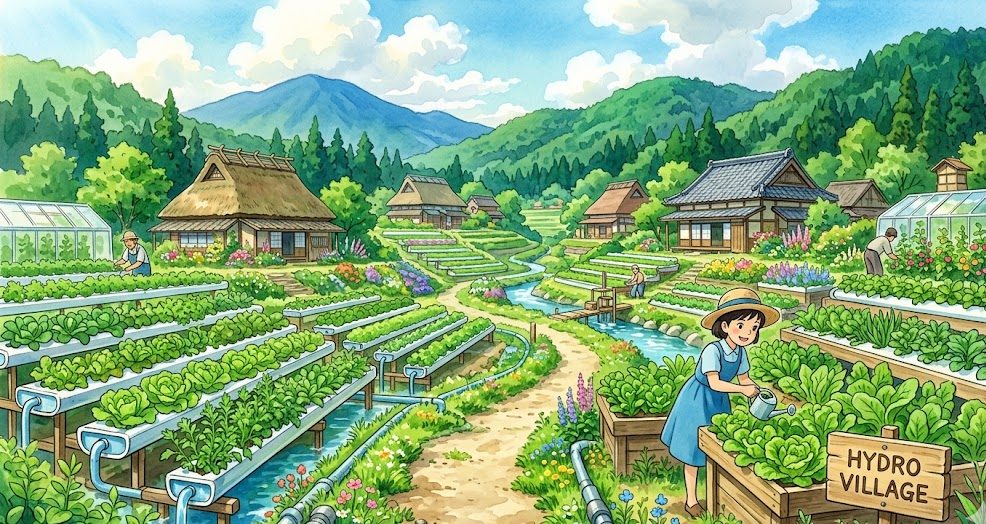
For thousands of years, agriculture has been defined by a single element: soil. It was long believed that the earth was the only medium capable of anchoring and feeding plant life. However, as modern science pulled back the layers of plant biology, a fascinating truth emerged—plants don’t actually need soil to grow; they only need the water, oxygen, and nutrients that soil happens to hold.
This realization paved the way for Hydroponics, a revolutionary method of growing plants in a water-based, nutrient-rich solution without using a single grain of dirt. For beginners looking to enter the world of modern agriculture, hydroponic farming offers a faster, cleaner, and highly productive alternative to conventional gardening. Whether you want to grow fresh greens in a small urban space or build a commercial cultivation business, this guide provides the foundational knowledge needed to achieve soil-free success.
What is Hydroponics and How Does It Work?
In a traditional garden, plant roots must grow long and wide to search through the soil for moisture and nutrients. This expends a significant amount of energy that could otherwise be used to grow leaves, flowers, and fruits.
In a hydroponic system, this struggle is completely eliminated. The plant’s roots are suspended directly in a dynamic, water-based solution containing a perfectly balanced mix of essential macro and micronutrients. Because the food is delivered directly to the root zone, the plant spends its energy growing upward at an accelerated rate.
To keep the plants upright without soil, growers use inert, sterile growing mediums such as cocopeat (coconut coir), perlite, vermiculite, clay pebbles, or rockwool. These mediums hold no nutritional value on their own; their sole purpose is to support the plant structure and retain an optimal balance of moisture and oxygen around the roots.
3 Popular Hydroponic Systems for Beginners
There are several ways to design a hydroponic farm, ranging from simple DIY setups to fully automated commercial arrays. For beginners, the following three systems are the easiest to build, maintain, and scale:
1. The Kratky Method (Passive Deep Water Culture)
The Kratky system is the absolute easiest, lowest-cost way to start hydroponic farming. It is a completely passive system, meaning it requires no electricity, water pumps, or air pumps.
- How it works: Plants are placed in net pots filled with a growing medium (like clay pebbles) and suspended over a reservoir filled with nutrient water. The water level is set so only the very tips of the roots touch the solution. As the plant grows and drinks the water, the liquid level drops, creating an expanding “air zone” inside the reservoir that allows the upper roots to absorb vital oxygen.
- Best for: Leafy greens like lettuce, spinach, and small herbs.
2. Deep Water Culture (DWC)
Deep Water Culture is a slight upgrade from the Kratky method and is widely considered the standard system for active beginners.
- How it works: Plants are supported on a floating raft (usually made of styrofoam) over a deep reservoir of nutrient solution. Unlike the Kratky method, the roots stay completely submerged in the water. To prevent the roots from suffocating or drowning, an electric air pump connected to an air stone sits at the bottom of the tank, continuously bubbling oxygen through the liquid.
- Best for: Rapid lettuce production, basil, and larger vegetative plants.
3. Nutrient Film Technique (NFT)
The NFT system is highly popular among commercial urban farmers and scale-oriented growers because of its incredible spatial efficiency.
- How it works: Plants are grown in long, slightly sloped PVC pipes or gullies. A water pump constantly pumps a very thin stream (a “film”) of nutrient solution from a main reservoir to the high end of the channel. The water glides past the bottom of the exposed roots down the slope, draining back into the reservoir. This ensures that the roots are constantly fed while receiving maximum exposure to atmospheric oxygen.
- Best for: High-density leafy greens, strawberries, and herbs.
+-----------------------------------------------------------------------+
|                    THE HYDROPONIC NUTRIENT CYCLE                      |
+-----------------------------------------------------------------------+
|                                                                       |
|   [ RESERVOIR ]   ---> Holds Water + Balanced Macro/Micronutrients    |
|                             (Monitored for optimal pH and EC)         |
|                                                                       |
|   [ ROOT ZONE ]   ---> Suspended in Inert Medium (Clay Pebbles/Coir)  |
|                             (Receives direct feeding + maximum oxygen)|
|                                                                       |
|   [ SYSTEM TYPE ] ---> Kratky (Passive), DWC (Bubbles), NFT (Channels)|
|                             (Accelerates growth cycles by up to 30%)  |
|                                                                       |
+-----------------------------------------------------------------------+
Monitoring the Essentials: pH and EC Control
The secret to maximizing your hydroponic yield lies in managing water chemistry. Because there is no soil to buffer mistakes, beginners must monitor two critical metrics using basic digital meters:
1. The pH Level (Potential Hydrogen)
The pH scale measures how acidic or alkaline your water is. Plants can only absorb nutrients when the water sits within a specific, slightly acidic window. For almost all hydroponic crops, the ideal pH range is 5.5 to 6.5. If the pH climbs too high or drops too low, the plant experience a phenomenon called “nutrient lockout,” where its roots physically cannot absorb food, leading to deficiencies and stunted growth.
2. The EC Level (Electrical Conductivity)
EC measures the electrical conductivity of the water, which tells you exactly how concentrated or dense your nutrient solution is. Think of it as a gauge for how much food is dissolved in the water.
- Young seedlings require a very low EC (around 0.8 to 1.2).
- Mature, heavy-fruiting plants like tomatoes or peppers need a much higher EC concentration (1.8 to 2.5). Checking your EC daily ensures your plants are never starved or chemically burned.
Comparing Conventional Soil vs. Hydroponic Systems
Transitioning to a soil-free agricultural model alters every growth metric of a standard crop cycle:
| Growth Feature | Traditional Soil Agriculture | Hydroponic Farming System |
|---|---|---|
| Growth Speed | Standard; limited by root foraging time. | 30% to 50% faster vegetative growth. |
| Water Consumption | High; up to 90% is lost to deep soil runoff. | 90% lower; water is recirculated and reused. |
| Weed Control | High labor required for manual weeding or tilling. | Zero weeds; no soil means no weed seeds can take root. |
| Soil-Borne Diseases | Frequent risk of root rot, nematodes, and fungi. | Extremely rare; clean, sterile water-based inputs. |
| Spatial Yield Efficiency | Restricted by field size and row spacing. | Highly dense; easily adapts to vertical stacking. |
Export to Sheets
Common Beginner Mistakes to Avoid
While hydroponics is highly rewarding, its precision means that minor errors can escalate quickly. Keep these tips in mind to protect your crop:
- Neglecting System Cleanliness: Warm, nutrient-rich water is a breeding ground for algae and root-rot pathogens (Pythium). Always use opaque, light-proof reservoirs to block out sunlight and clean your system thoroughly between crop cycles.
- Ignoring Water Temperature: Plants absorb oxygen best when the water temperature stays between 18°C and 22°C. If your water gets too warm (above 24°C), its oxygen-holding capacity plummets, causing roots to rot.
- Using Poor Quality Water: Avoid using hard tap water heavily chlorinated or dense with mineral salts. Start with filtered, RO (Reverse Osmosis), or clean rainwater for a blank canvas to mix your nutrients accurately.
Conclusion: Step Into the Future of Farming
Hydroponic farming represents a massive leap forward in sustainable, high-yield food production. By stripping away the variables, heavy labor, and environmental strains associated with traditional dirt farming, hydroponics gives you total, precise control over your plants’ health.
By starting with a simple, manageable setup like a Deep Water Culture raft or a Kratky bucket, tracking your pH and EC levels carefully, and picking easy leafy greens, any beginner can unlock incredible soil-free success. It’s an efficient, water-saving, and highly profitable way to grow the cleanest, freshest produce imaginable.