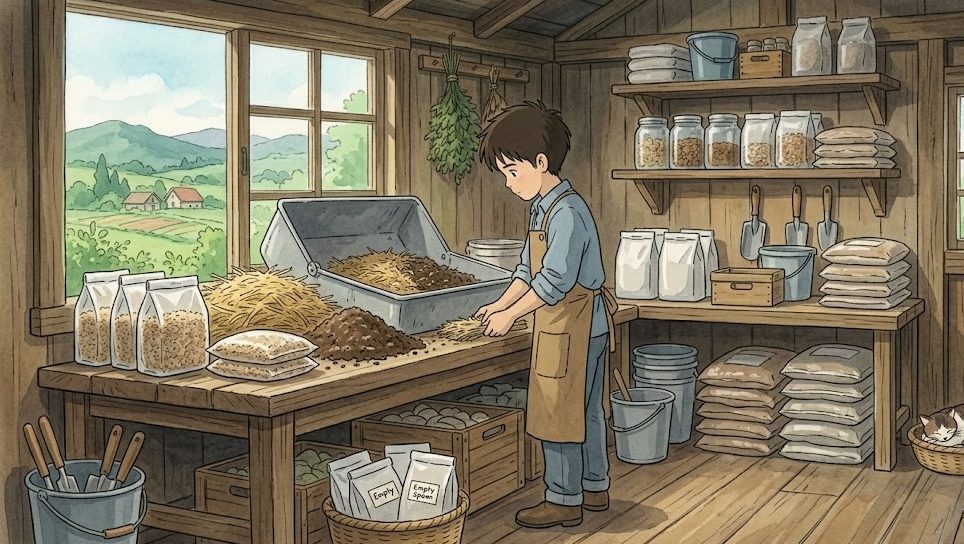
What if you could harvest “gourmet meat” from a dark corner of your kitchen using nothing more than a bucket of sawdust? While most people spend months battling weeds and weather to grow a few tomatoes, mushrooms can double their mass every 24 hours, reaching harvestable size in just a few weeks. In fact, you can grow up to 25 pounds of mushrooms per year in a space no larger than a standard laundry basket. Despite this staggering efficiency, many aspiring gardeners are intimidated by the perceived “mad scientist” requirements of mycology.
The challenge lies in the transition from soil-based thinking to fungal biology. We are conditioned to think about seeds and sunlight, but mushrooms thrive in the shadows and feed on what we consider waste. This “knowledge gap”—the fear of contamination or the mystery of “spawning”—prevents thousands from accessing one of the most sustainable protein sources on Earth. Indoor mushroom growing is the ultimate solution to urban food insecurity. This guide provides a comprehensive, step-by-step roadmap to mastering the fungal lifecycle, transforming your home into a productive, soil-free farm.
Understanding Indoor Mushroom Growing: Key Concepts and Importance
To grow mushrooms successfully, you must first understand that they are not plants; they are the fruit of a vast, underground network called mycelium. While a plant uses chlorophyll to turn sunlight into energy, fungi are “decomposers” that break down organic matter. In the wild, they are the forest’s recycling crew. Indoors, we simply provide them with the “trash” they love—like straw, coffee grounds, or hardwood sawdust—and control the weather to trigger them to fruit.
Shutterstock
Explore
Think of mushroom growing like brewing a fine sourdough. You aren’t “planting” anything; you are culturing an organism. You start with a “starter” (called spawn), introduce it to “flour” (called substrate), and let it ferment in a controlled environment. The history of indoor cultivation dates back to 17th-century France, where farmers grew mushrooms in underground caves. Today, the modern “DIY” movement has moved this into the spare bedroom.
The importance of indoor mycology today cannot be overstated. As our climate becomes more unpredictable, the ability to grow calorie-dense, nutrient-rich food in a climate-controlled indoor environment offers a vital layer of food security. By bypassing the need for vast tracts of land and chemical fertilizers, indoor mushroom growing represents the pinnacle of circular agriculture.
Why It Matters: The Top Benefits of Indoor Mycology
Beyond the thrill of the harvest, growing mushrooms indoors offers significant advantages for your health, your wallet, and the planet.
- Unmatched Space Efficiency: Mushrooms grow vertically. Using a “Martha Tent” (a small, tiered greenhouse), you can produce enough food to feed a family of four in just 4 square feet of floor space.
- Total Pesticide Control: Because mushrooms grow in a controlled indoor environment, there is zero need for the herbicides or pesticides common in industrial farming. You are harvesting the purest possible organic produce.
- Waste Valorization: You can grow gourmet Oyster or Lion’s Mane mushrooms on materials that would normally go to a landfill, such as shredded cardboard, used coffee grounds, or waste straw.
- Year-Round Production: Unlike traditional gardening, which is slave to the seasons, an indoor setup allows you to harvest fresh fungi in the dead of winter or the height of a heatwave.
Pro Fact: Mushrooms are the only non-animal source of Vitamin D. When indoor-grown mushrooms are exposed to a little UV light or even 15 minutes of sunlight post-harvest, their Vitamin D content skyrockets by over 400%.
How to Get Started: A Practical Guide for Beginners
Ready to launch your indoor farm? Follow this 5-step actionable plan to ensure your first “flush” is a massive success.
Step 1: Select Your Species and Spawn
For beginners, Oyster mushrooms (Pleurotus ostreatus) are the gold standard. They are aggressive growers that can easily outcompete “bad” molds. Purchase “Grain Spawn” from a reputable supplier; this is your “seed” and the most critical component of your build.
Step 2: Prepare the Substrate
You must “clean” your growing medium to give your mushrooms a head start. The easiest home method is pasteurization. Soak chopped straw or hardwood pellets in hot water (70°C to 80°C) for two hours. This kills competing bacteria but leaves beneficial microbes that help the mushrooms grow.
Step 3: Inoculation (The Planting)
Once your substrate has cooled, mix in your grain spawn. A ratio of 1 part spawn to 10 parts substrate is ideal. Pack this mixture into “grow bags” or recycled plastic buckets with 1/2-inch holes drilled into the sides.
Step 4: Incubation (The “Run”)
Store your bags in a dark, warm spot (roughly 20°C–24°C). Over the next 2-3 weeks, the white mycelium will colonize the bag, turning the brown substrate into a solid white block. This is often called the “spawn run.”
Step 5: Fruiting and Harvesting
Once the bag is fully white, move it to a spot with indirect light and high humidity. Mist the holes 2-3 times daily. Within days, “pins” will emerge. Harvest the clusters when the edges of the mushroom caps are still slightly curled downward.
Beginner’s Tip: Avoid the “Green Monster.” Contamination is the #1 reason for failure. Always wash your hands and wipe down your workspace with 70% isopropyl alcohol before handling your spawn or substrate. If you see green or black fuzz, discard it immediately.
Overcoming Challenges and Looking into the Future
The primary hurdle for indoor growers is Fresh Air Exchange (FAE). Mushrooms breathe oxygen and exhale $CO_2$, just like us. If $CO_2$ levels get too high, your mushrooms will grow long, spindly stems and tiny caps. The solution is simple: ensure your grow area has a small fan or that you “fan” the area manually several times a day. Another challenge is Spore Load; some mushrooms release millions of spores. Harvesting early and using a simple air filter can mitigate any respiratory irritation.
Looking ahead, the future of indoor mycology is moving toward Automated Myco-Pods. We are seeing the rise of smart-home integrated units that monitor humidity and CO2 via smartphone, making the process nearly hands-free. Furthermore, the use of Mycelium as a material is a growing trend; after you harvest your food, the “spent” block can be dried and used as biodegradable packaging or insulation. We are entering an era where our “gardens” don’t just feed us—they help build our world.
Conclusion
Indoor mushroom growing is a powerful blend of science and nature that allows anyone, regardless of their living situation, to become a producer. By mastering the balance of humidity, air, and substrate, you unlock a year-round harvest of some of the most delicious and medicinal foods available.
Your Task: Order an “Oyster Mushroom Grow Kit” or a bag of grain spawn today. Starting with a pre-made kit is the best way to see the fruiting process firsthand before you move on to pasteurizing your own substrate.
The forest doesn’t need a backyard to thrive; it just needs a little space in your home and the curiosity to let it grow.
Frequently Asked Questions (FAQs)
1. Do mushrooms need total darkness to grow?
No. While mycelium grows well in the dark during the incubation phase, the actual mushrooms (the fruiting bodies) need a small amount of indirect light to develop properly. A normal room with a window is perfect.
2. Can I grow mushrooms in my basement?
Yes! Basements are often ideal because they stay cool and humid. Just ensure you have a small LED light on a timer and a way to circulate fresh air so $CO_2$ doesn’t build up.
3. What is “Contamination,” and how do I spot it?
Contamination happens when “competitor” fungi (molds) or bacteria take over the substrate. Healthy mycelium is pure white. If you see green, bright yellow, or black patches, or if the bag smells like rotting trash instead of fresh earth, it is contaminated.
4. How many times can I harvest from one bag?
Most mushroom bags will give you 2 to 3 “flushes” (harvests). After the first harvest, let the bag rest for a week, keep it humid, and a second crop will usually emerge from the same holes.