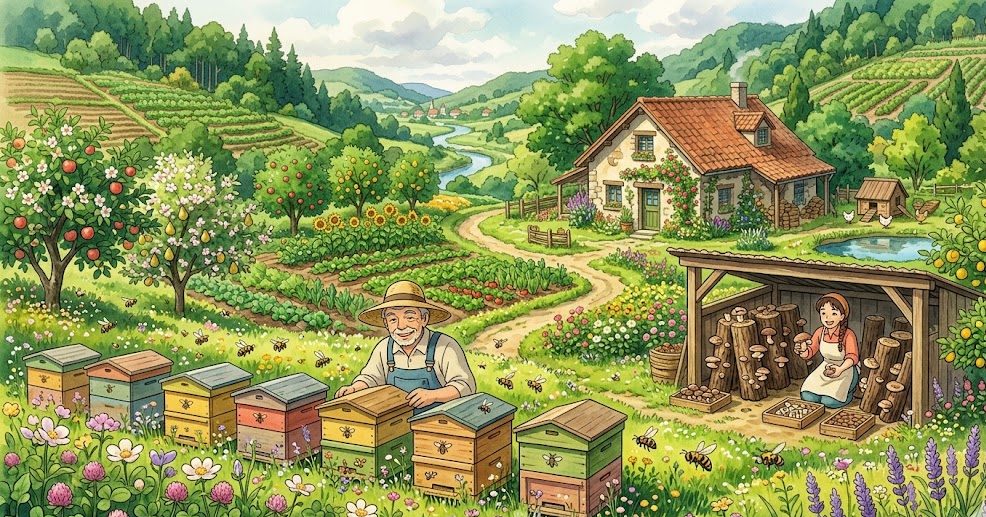
Agriculture is shifting away from the era of massive, resource-heavy monocultures. Today, the most profitable farms are those that embrace biodiversity, leverage niche markets, and prioritize sustainability. If you are looking to maximize your land’s potential, Beekeeping and Fungi Farming represent two of the most lucrative, low-footprint, and highly scalable agricultural ventures available today.
By integrating these specialized practices with sustainable techniques, you can transform your land into a high-yield, high-margin business that thrives in any economy.
1. Beekeeping: The “Pollination-Plus” Profit Model
Beekeeping is often overlooked by traditional farmers, yet it is one of the most vital components of a profitable ecosystem. It offers a “double-revenue” model: the direct sale of hive products and the indirect increase in crop yields through improved pollination.
Diversifying Revenue Streams
A profitable apiary goes beyond just honey. To maximize your return on investment, consider the following:
- Specialty Honey: Focus on mono-floral honey (e.g., lavender, clover, or acacia). These command significantly higher prices in gourmet markets compared to generic wildflower honey.
- Beeswax and Propolis: These are highly sought after by the cosmetics and pharmaceutical industries. They are secondary products that require minimal processing but add substantial value to your bottom line.
- Pollination Services: If you grow fruits, nuts, or vegetables, your bees are the primary workers that ensure high yield. By keeping healthy hives, you are essentially securing your own production stability.
Sustainability Tip:
Always prioritize the health of your bees by avoiding synthetic pesticides. Sustainable beekeeping is about creating a habitat where bees can thrive naturally, which in turn leads to more resilient hives and higher-quality wax and honey.
2. Fungi Farming: The High-Efficiency Goldmine
Fungi farming—or mycology—is perhaps the most space-efficient form of agriculture. Mushrooms can be grown in vertical stacks, dark sheds, or repurposed shipping containers, making them an ideal venture for farmers looking to utilize under-used spaces.
The Profit Potential of Gourmet Mushrooms
Gourmet mushrooms like Oyster, Shiitake, and Lion’s Mane are in high demand among chefs and health-conscious consumers. Because mushrooms grow on agricultural waste—such as straw, sawdust, or coffee grounds—the input costs are incredibly low.
Why Fungi are a “Must-Have” for Profit:
- Rapid Cycle: Many mushroom species can be harvested just 3–6 weeks after inoculation, providing a much faster cash-flow turnaround than traditional row crops.
- Vertical Integration: You can easily stack mushroom shelves to increase your output per square meter by 5x or 10x compared to field-grown crops.
- Waste-to-Wealth: Your “spent mushroom substrate” (the organic waste left after harvest) becomes a nutrient-rich soil conditioner that you can use to fertilize your other crops or sell as premium organic compost.
3. Integrating Sustainable Techniques
The key to a truly profitable farm is the synergy between different enterprises. When your beekeeping supports your fruit production, and your mushroom substrate fertilizes your soil, you create a “circular farm.”
| Technique | Function | Economic Benefit |
| Circular Nutrient Loops | Using mushroom compost for soil health. | Reduced fertilizer costs. |
| Pollination Synergy | Bees increasing garden/orchard yields. | Higher product volume. |
| Vertical Growing | Fungi farming in limited footprints. | Higher yield per square meter. |
| Integrated Pest Management | Avoiding harsh chemicals to save bees. | Reduced chemical/input costs. |
Building a Circular Economy
Sustainable techniques are not just about “going green”—they are about reducing waste. Every input that doesn’t need to be purchased is an input that directly increases your profit. By using mushroom compost to enrich your soil and keeping bees to increase your orchard’s output, you are building a self-sustaining system that requires fewer external resources.
4. Strategic Planning for the Profitable Farm
Transitioning to a multi-enterprise farm requires careful planning. Do not try to launch beekeeping and mushroom farming simultaneously on a massive scale.
- Start with Market Validation: Reach out to local restaurants and farmers’ markets. Ask which gourmet mushroom varieties are in high demand. Check the market price for local, raw honey in your area.
- Modular Scaling: Begin with 5–10 beehives and a single mushroom growing room. Once you have optimized your production and built a customer base, expand.
- Digital Branding: You are selling high-quality, sustainable products. Invest in professional labels and social media accounts that showcase the “story” of your farm—customers are willing to pay a premium for products that are local, sustainable, and transparent.
Conclusion: The Business of Nature
The “Profitable Farm” of the future is small, efficient, and interconnected. By combining the high-value output of gourmet fungi with the ecological and economic benefits of beekeeping, you create a business model that is not only robust but also remarkably rewarding.
Success in this field requires a shift in mindset: look at every piece of farm waste as a potential resource and every niche market as an opportunity for expansion. When you work with nature rather than trying to overpower it with chemicals and heavy machinery, profitability becomes a natural byproduct of your farm’s health.