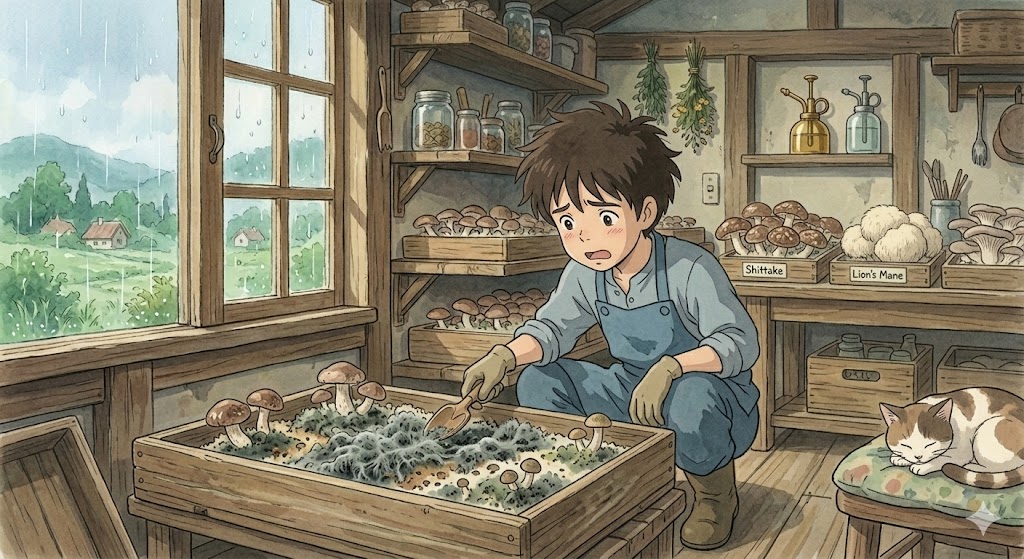
Imagine spending weeks meticulously preparing substrate, sterilizing jars, and inoculating your grain, only to wake up and find your entire crop covered in a fuzzy, neon-green carpet of mold. This is the heartbreaking reality for nearly 70% of first-time mushroom growers. Unlike plants, which are generally hardy and forgiving of a missed watering, mushrooms are delicate fungi that exist in a constant biological war with microscopic competitors. One tiny slip in hygiene or a slight drop in humidity can turn a gourmet harvest into a biohazardous waste project.
The challenge of mushroom cultivation lies in its invisibility; you are managing a laboratory-grade environment often within the confines of a spare bedroom or kitchen. The “pain point” for most beginners is the steep learning curve where “close enough” simply isn’t good enough. Mastering the art of avoiding common mistakes serves as the ultimate solution, shifting your experience from a game of chance to a predictable, high-yield science. This guide provides a roadmap of the most frequent pitfalls—from contamination to poor airflow—and offers professional fixes to ensure your indoor farm thrives from the very first flush.
Understanding Mushroom Cultivation: Key Concepts and Importance
To cultivate mushrooms successfully, you must understand that you are not “growing” a plant; you are nurturing a culture. In the wild, fungi are the masters of decay, but in a home-grow environment, they are the “underdogs.” They require a head start in a sterile environment because every breath you take releases thousands of competing mold spores and bacteria that want to eat the same substrate you’ve prepared for your mushrooms.
Shutterstock
Explore
Think of mushroom cultivation like running a high-end restaurant kitchen. If the chef touches raw chicken and then handles a salad, the whole meal becomes dangerous. In mycology, your “raw chicken” is the unsterilized air and surfaces around you. The importance of Aseptic Technique—the method of working in a way that prevents contamination—cannot be overstated.
Historically, mushroom growing was a shrouded mystery, but the modern “DIY” movement has brought lab-grade concepts into the home. Whether you are using a Still Air Box (SAB) or a Laminar Flow Hood, the goal is the same: to create a “sterile window” where your mushroom mycelium can claim its territory without being overwhelmed by “Trich” (green mold) or “Cobweb” mold. Understanding that you are a guardian of a sterile space is the first step toward a bountiful harvest.
Why It Matters: The Top Benefits of Avoiding Mistakes
Learning from the failures of others isn’t just about saving time; it’s about protecting your investment and your health.
- Maximized Biological Efficiency: By avoiding mistakes in substrate moisture and temperature, you ensure your fungi reach 100% biological efficiency—meaning you get the maximum possible weight of mushrooms from every bag.
- Cost Prevention: Mushroom supplies—like liquid cultures, specialized bags, and organic rye grain—add up. Avoiding a “contam” (contamination) event means you aren’t throwing your hard-earned money into the compost bin.
- Food Safety: Some common molds that take over mushroom kits can produce mycotoxins or trigger respiratory issues. A clean, successful grow ensures the food you put on your table is pure and safe.
- Mental Resilience: There is nothing more discouraging than a failed grow. By following “best practices,” you build the confidence needed to move from easy species like Oyster mushrooms to more difficult ones like Lion’s Mane or Reishi.
Pro Fact: Most “failed” mushroom kits aren’t due to bad genetics. Over 80% of contamination occurs during the “inoculation” phase, where the grower accidentally introduces outside bacteria via their hands or unsterilized tools.
How to Get Started: A Practical Guide for Beginners
If you want to avoid the “beginner’s curse,” follow this 5-step implementation plan designed to bypass the most common errors.
Step 1: Master the Pressure Cooker
The most common mistake is under-sterilizing. A standard kitchen steamer isn’t enough for grain spawn. You must use a pressure cooker capable of reaching 15 PSI for at least 90 minutes. This ensures that even the most heat-resistant bacterial endospores are neutralized.
Step 2: Perfect Your “Field Capacity”
Substrate that is too wet will drown the mycelium and lead to “sour rot” (bacteria). Substrate that is too dry won’t produce mushrooms. Aim for Field Capacity: when you squeeze a handful of substrate as hard as you can, only a few drops of water should come out.
Step 3: Prioritize Fresh Air Exchange (FAE)
Beginners often confuse “humidity” with “stagnant air.” Mushrooms breathe oxygen and exhale $CO_2$, just like humans. If you don’t provide enough Fresh Air Exchange, your mushrooms will grow long, skinny stems and tiny caps—a condition known as “legginess.”
Step 4: Use a Still Air Box (SAB)
Never inoculate your bags in the open air of a kitchen. Even a simple, clear plastic bin with two holes cut for your arms creates a “dead air” space that significantly drops your contamination rate by allowing heavy spores to settle to the bottom rather than landing in your jars.
Step 5: Temperature Stability
Avoid the temptation to keep your grow in a hot cupboard. Most gourmet mushrooms prefer 20°C to 24°C for incubation. If the temperature hits 27°C or higher, the growth of mycelium slows down, but the growth of thermophilic molds accelerates, inviting disaster.
Beginner’s Tip: “Flame sterilize” your needle until it glows red-hot before every single injection. A needle that looks clean is still covered in invisible microbes that will ruin your work.
Overcoming Challenges and Looking into the Future
One of the greatest hurdles is identifying Contamination vs. Bruising. Beginners often throw away healthy cakes because they see blue spots, which is actually just “bruising” from handling or drying out. A simple “Q-tip test” can solve this: if the color rubs off on a cotton bud, it’s mold; if it doesn’t, it’s just bruising. Another challenge is Spore Load; if you harvest too late, your house will be covered in fine dust. The fix is to harvest just as the “veils” under the caps begin to tear.
The future of home cultivation is moving toward Automated Grow Tents. We are seeing the rise of sensors that monitor $CO_2$ levels and trigger fans automatically, removing the human error of “forgetting to mist.” Additionally, the development of “low-temp” cultures will allow people to grow gourmet mushrooms in unheated garages during winter, making the hobby more sustainable and energy-efficient.
Conclusion
Mushroom cultivation is a journey of patience and precision. While the mistakes of contamination, poor airflow, and incorrect moisture are common, they are also entirely preventable with a disciplined approach. By shifting your focus from “growing fast” to “growing clean,” you transform your indoor space into a productive fungal sanctuary.
Your Task: Check your current setup for airflow. If you aren’t fanning your fruiting chamber at least three times a day or using an automated fan, start today. Fresh air is the secret ingredient that turns “okay” mushrooms into “gourmet” masterpieces.
Every failed bag is a lesson, but every successful harvest is a triumph of science over chaos!
Frequently Asked Questions (FAQs)
1. My mushroom jar has a yellow liquid at the bottom. Is it contaminated?
Not necessarily. This is often “mycelium metabolites” or “piss.” It’s a sign that the mycelium is stressed or fighting off a minor infection. As long as it doesn’t smell foul or look slimy, it’s usually okay to proceed.
2. Can I use a HEPA air purifier instead of a Flow Hood?
No. An air purifier cleans the room air over time, but it creates “turbulent” air which actually blows spores around. For sterile work, you need either “Still Air” (an SAB) or “Laminar Flow” (a professional flow hood).
3. Why are my Oyster mushrooms growing long stems and no caps?
This is the classic sign of high $CO_2$ levels. Your mushrooms are “reaching” for fresh air. Increase your ventilation or fan the chamber more frequently to encourage cap development.
4. How do I know if my grain spawn is fully colonized?
The grain should be completely white, looking like it’s covered in snow or thick cotton. There should be no visible uncolonized grain and no “unusual” colors like green, pink, or black.